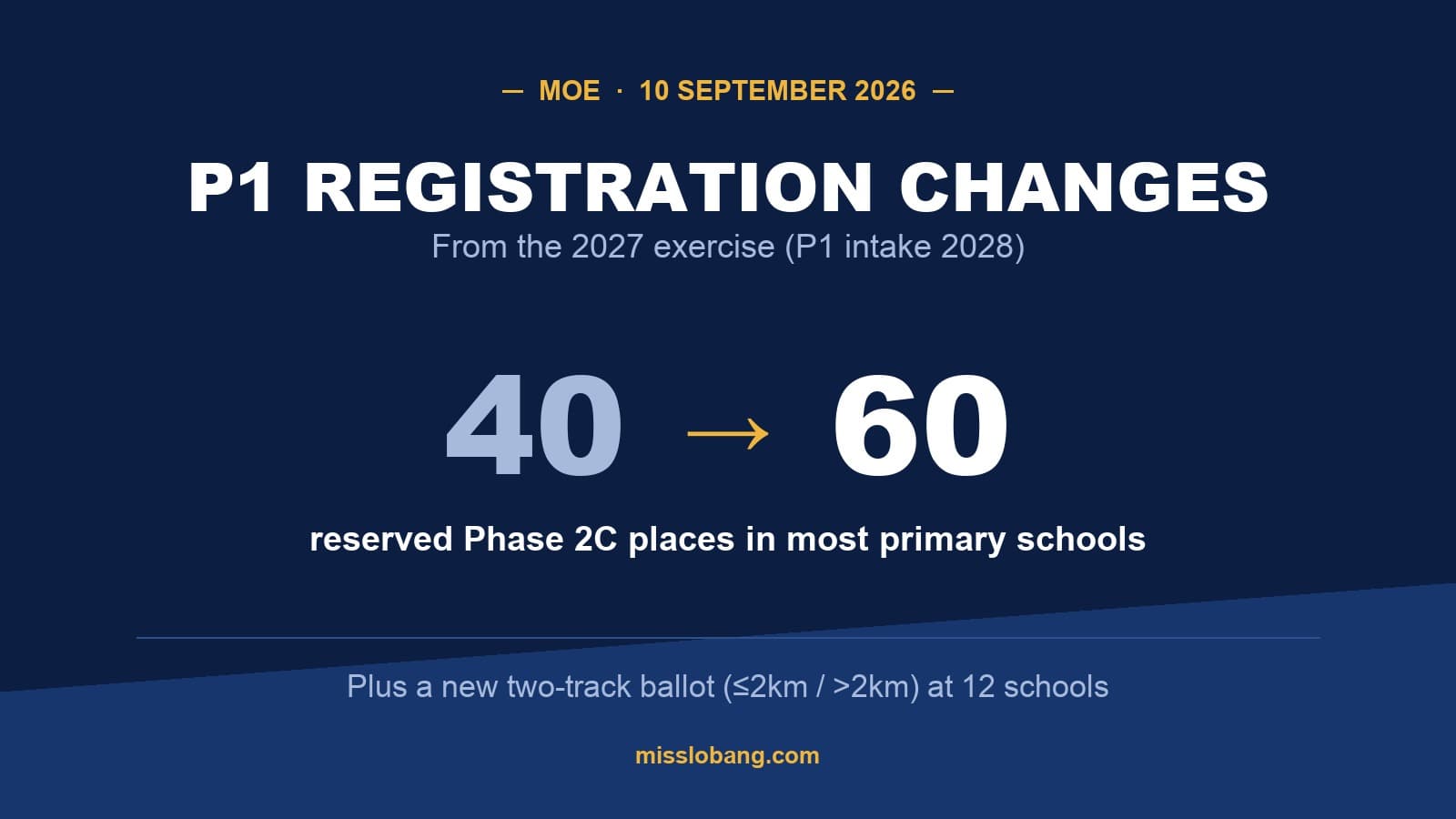
> Quick view: From the 2027 P1 Registration Exercise (children starting Primary 1 in 2028), reserved Phase 2C places go from 40 to 60 in every school except small-intake schools with fewer than 180 P1 places, which stay at 40. Phase 2B stays at 20, and the extra 20 places come out of the earlier phases. Separately, 12 named schools get a Two-Track Scheme in Phase 2C: places are split equally between children living within 2km and children living beyond 2km, with no distance priority inside either track and a ballot when citizen applicants outnumber places. Announced by MOE on Thursday 10 September 2026. The 2026 exercise is unaffected.
Every year the same conversation goes around the parent chats. Whether it is worth signing up as a parent volunteer two years early. Whether it is worth renting near a school. Whether a family with no alumni parent, no sibling in the school and no church or clan connection has any realistic shot at a popular primary school at all.
MOE has now moved two levers at once, and they pull in the same direction: more places for families with no prior connection, and less advantage for families who simply live close by.
Change 1: Phase 2C goes from 40 reserved places to 60
Phase 2C is the phase open to every child, whether or not the family has any tie to the school. Under the revised framework it gets 60 reserved places instead of 40.
| Current framework | From the 2027 exercise | |
|---|---|---|
| Phase 2B reserved places | 20 | 20, no change |
| Phase 2C reserved places | 40 | 60, except small-intake schools with fewer than 180 P1 places, which stay at 40 |
| Where the extra places come from | the earlier registration phases | |
| Phase priority order | 1, 2A, 2B, 2C, 2C Supplementary, 3 | unchanged |
MOE is direct about the trade-off. In its own FAQ it confirms the 20 additional Phase 2C places are taken from the earlier phases, while stressing that Phase 2A and 2B families "will continue to have priority admission ahead of applicants in Phase 2C". So the queue order is intact. What shrinks is the pool of reserved places those earlier phases can draw on at a school where every phase is oversubscribed.
One detail worth knowing: 60 is a floor, not a ceiling. If Phases 2A and 2B have more places than applicants, the leftovers flow down, so a Phase 2C at a less contested school can be considerably larger than 60.
Change 2: a two-track ballot at 12 schools
The second change is narrower and sharper. At 12 schools, Phase 2C is split into two tracks:
- Phase 2C (2km or under), for children living within 2km of the school
- Phase 2C (over 2km), for children living beyond 2km
Places are divided equally between them. Inside each track there is no home-school distance priority at all. If citizen applicants in a track outnumber that track's places, MOE ballots. If a track has places left after every citizen applicant in it is admitted, those places flow across to citizen applicants in the other track. When the total is an odd number, the spare place goes to the 2km-or-under track.
Citizens still come before permanent residents. All citizen applicants in both tracks are placed first, and only then are PRs considered for whatever remains, with those remaining places again split equally across the two tracks.
The 12 schools
MOE selected them on a stated rule: public housing accounts for less than 40% of dwelling units within 2km of the school. Nationally, about 8 in 10 residents live in HDB flats.
| School | Address |
|---|---|
| Anglo-Chinese School (Junior) | 16 Winstedt Road, S227988 |
| Anglo-Chinese School (Primary) | 50 Barker Road, S309918 |
| CHIJ (Katong) Primary | 17 Martia Road, S424821 |
| Methodist Girls' School (Primary) | 11 Blackmore Drive, S599986 |
| Nanyang Primary School | 52 King's Road, S268097 |
| Ngee Ann Primary School | 344 Marine Terrace, S449149 |
| Pei Hwa Presbyterian Primary School | 7 Pei Wah Avenue, S597610 |
| Raffles Girls' Primary School | 21 Hillcrest Road, S289072 |
| Singapore Chinese Girls' Primary School | 190 Dunearn Road, S309437 |
| St. Margaret's School (Primary) | 136 Sophia Road, S228197 |
| Tanjong Katong Primary School | 10 Seraya Road, S437259 |
| Tao Nan School | 49 Marine Crescent, S449761 |
MOE says it will review the list periodically as housing profiles around schools change, but does not expect frequent changes.
The worked example MOE published
Take a school with the minimum 60 reserved Phase 2C places and nothing flowing down from earlier phases. That splits into 30 and 30.
| Phase 2C (2km or under) | Phase 2C (over 2km) | |
|---|---|---|
| Places to start | 30 | 30 |
| Citizen applicants | 40 | 25 |
| Outcome | 5 unused places flow in from the other track, so 35 places are balloted among 40 applicants | all 25 admitted, no ballot, 5 places flow across |
That is the mechanism in one table. A track that is undersubscribed does not waste its places, and a track that is oversubscribed does not get to reach across for more than the other track genuinely has spare.
What has not changed
Quite a lot, and it is worth being precise, because the phases most families actually use are untouched.
- Phase 1 (a sibling already in the school) is unchanged.
- Phase 2A (parent or sibling is an alumnus, parent on the School Advisory or Management Committee, parent is staff, or the child is at an MOE Kindergarten in the school) is unchanged, and excess 2A places still flow to 2B and 2C in a 1:2 ratio.
- Phase 2B (qualifying parent volunteer, church or clan endorsement, endorsed active community leader) keeps its 20 reserved places.
- Phase 2C Supplementary and Phase 3 (international students) are unchanged.
- Balloting still happens in any phase from 2A to 2C Supplementary when applicants exceed vacancies.
- Outside the 12 schools, home-school distance still decides Phase 2C ballots after citizenship, exactly as before.
What it means if you are registering
If your child starts P1 in 2027, this is not your exercise. Register as you would have.
If your child starts P1 in 2028 or later, three practical points:
- A school with no family connection is a slightly better bet than it was. Fifty per cent more reserved Phase 2C places at most schools is a real change in the odds, though at the most heavily oversubscribed schools Phase 2C will still ballot.
- If you are eyeing one of the 12 schools, moving closer buys you less. Within Phase 2C, proximity now gets you into a track rather than to the front of a queue. The 2km line still matters, since it decides which track you are in, but distance inside the track does not.
- If you live well outside the 2km ring of one of the 12, you now have a genuine allocation rather than a place at the back of a distance-ordered list. Half the Phase 2C places at those schools are set aside for your track.
You can check your home-school distance on MOE's own tool at onemap.gov.sg/school.
This is a summary of MOE's announcement, not advice about any individual child's placement. Registration rules, dates and the school list can be revised, so confirm against MOE before you plan around any of it.
*Source: Ministry of Education, "Enhancing the Primary One Registration Framework for Greater Access and Inclusivity", press release published 10 September 2026, with Annex A (list of 12 schools) and Annex B (overview of the revised framework). Cover graphic: MissLobang.*