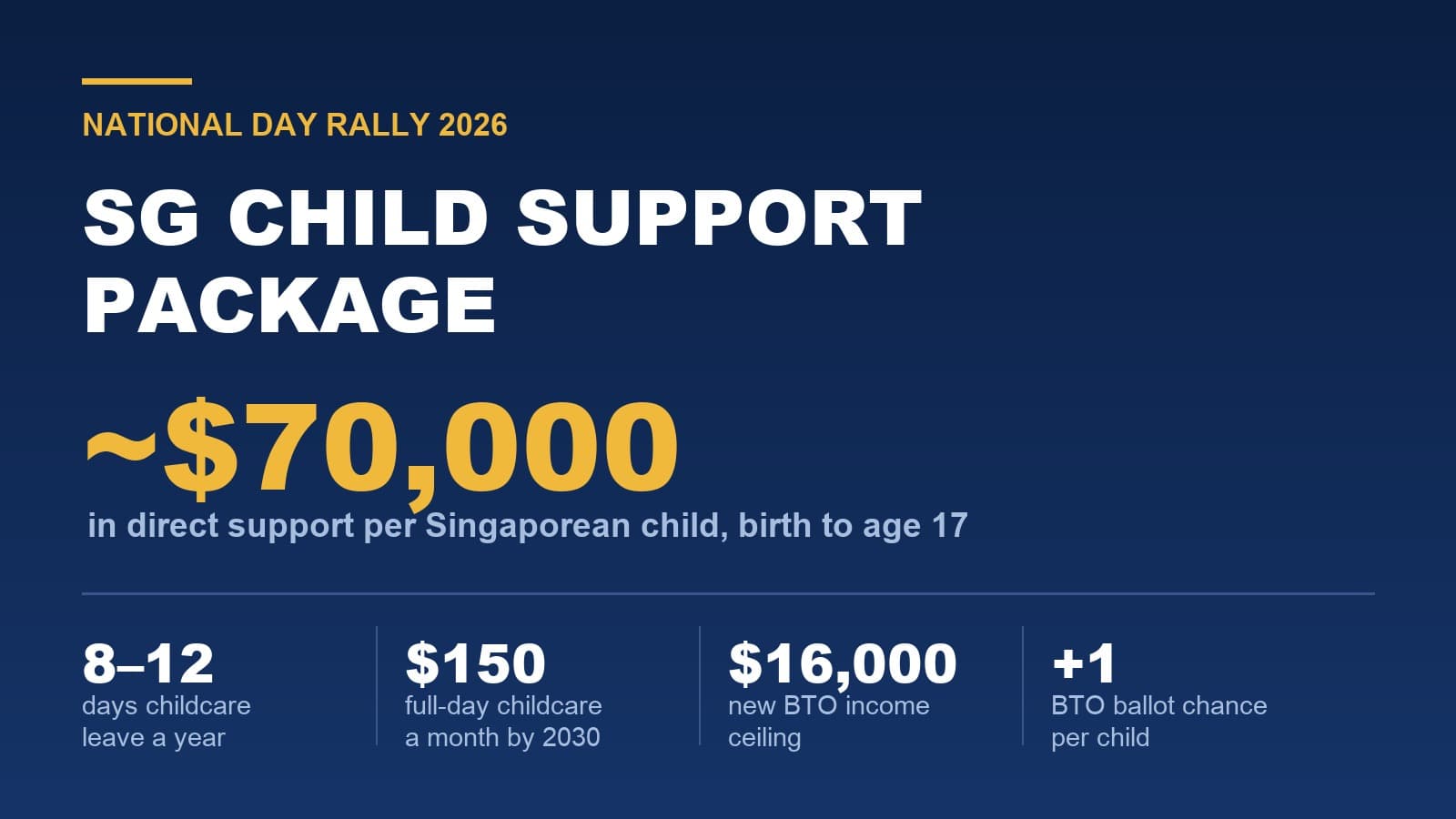
> Quick view: Every Singaporean child gets ~$70,000 birth to 17 (same for every child, any birth order), childcare leave rises to 8–12 days per parent, full-day childcare at government-supported preschools falls to $150/month by 2030, and the BTO income ceiling rises to $16,000 for HFE applications from Mon 24 Aug 2026 — with the October BTO exercise pushed to November.
At the National Day Rally on 23 August 2026, Prime Minister Lawrence Wong announced the biggest reset of Singapore's family support in years. Rather than concentrating help around the birth of a child, the stated aim is to support parents consistently through the whole journey of raising them.
These are the first recommendations from the Marriage and Parenthood Reset Workgroup, chaired by Minister in the Prime Minister's Office Indranee Rajah, to be accepted by the government. A fuller set is due in early 2027, with more measures flagged for Budget 2027.
1. The SG Child Support Package — almost $70,000 per child
The headline change is simplification: every Singaporean child receives the same support, regardless of birth order. Today it ranges from $27,500 to $56,500 depending on where the child falls in the family.
| Component | Amount | When |
|---|---|---|
| Baby Gift (cash) | $10,000 | Two tranches within 12 months of birth |
| Child Credits | $32,000 total | $2,000 a year, from the year the child turns 1 to the year they turn 16 |
| CDA First Step Grant | $5,000 | At birth |
| Government CDA co-matching | up to $5,000 | As parents save |
| PSEA top-up | $10,000 | When the child turns 17 |
| New package subtotal | $62,000 | |
| MediSave Grant for Newborns (existing) | $5,000 | At birth |
| Edusave contributions (existing) | annual | Primary and secondary school |
| Total | ~$70,000 | Birth to age 17 |
As at June, more than 610,000 children across 380,000 households are expected to benefit.
Two structural changes matter beyond the headline number:
- Child Credits replace and enhance the Large Family LifeSG Credits. Those paid $1,000 a year for six years, and only to the third and subsequent child. The new credits double the annual amount to $2,000, run for 16 years, and go to children of every birth order.
- The CDA now stays open until the end of the year the child turns 16, instead of closing at 12 — a longer runway for government co-matching and for spending on approved child-raising costs.
The transition dates (read these if you already have children)
- Children born on or after 1 Jan 2015 have their CDAs extended to the end of the year they turn 16. Those born before 1 Jan 2015 keep their PSEA instead, because their CDAs would already have closed.
- Children born before 1 Apr 2027 still receiving Baby Bonus Cash Gift payouts keep them until 31 Mar 2027. As the Baby Gift replaces it, they receive a top-up where applicable by 30 Apr 2027 to bring total support to $10,000.
- Child Credits: children turning 1 to 16 in 2026 receive their 2026 payment of $2,000 by 30 Apr 2027. Children with birthdays between January and April 2027 also get their 2027 credits by 30 Apr 2027; those with birthdays from May to December get paid on their birthdays. From 2028, payment is annual, on the child's birthday.
- The Large Family LifeSG Credits cease, with no disbursements in 2027. If you have three or more children, note that gap.
- CDA co-matching caps: children born on or after 1 Apr 2027 get the $5,000 First Step Grant and up to $5,000 co-matching. Children born 1 Jan 2015 – 31 Mar 2027 keep their existing caps until 30 Sep 2027, then move to the uniform $5,000 cap from 1 Oct 2027. Children born 1 Jan 2009 – 31 Dec 2014 keep existing PSEA co-matching until 30 Sep 2027, then the same $5,000 cap. PSEA co-matching ceases for new PSEAs opened from 1 Jan 2028.
2. Childcare leave: 8, 10 or 12 days — but no start date yet
Childcare leave becomes tied to the number of children, for Singaporean children up to age 12:
| Number of children | Leave per parent, per year |
|---|---|
| 1 | 8 days |
| 2 | 10 days |
| 3 or more | 12 days |
Today a parent gets 6 days if their child is 6 or below, or 2 days if the child is 7 to 12 — and it is not tied to how many children they have. PM Wong's example: a working couple with three primary school children goes from a combined 4 days today to a combined 24 days.
NPTD said the higher 8-day baseline is set so both parents together can cover mandated preschool and primary school closures, with a buffer for unplanned sick days.
Important: the change needs legislative amendments, and NPTD and MSF said the start date will be announced later. They advise discussing leave plans with employers early.
Employers stop paying for it
The government will cover employers' costs for the full duration of every statutory child-related leave scheme, regardless of birth order — maternity, paternity, shared parental, adoption and childcare leave — and also compensate self-employed parents for income lost during those schemes. Reimbursements stay capped at $500 a day or $2,500 a week, including CPF contributions.
Existing parental leave is unchanged at about 30 weeks government-paid: 16 weeks maternity, 4 weeks paternity, 10 weeks shared parental. Asked whether Singapore would go further, PM Wong said he would not rule it out, but that employers need time to adapt to the recent changes first.
For context, MSF data shows 2024 take-up of childcare leave was 54% among fathers and 59% among mothers; paternity leave was 61% and maternity leave 77%.
3. Preschool fees: $150 childcare and $300 infant care by 2030
At government-supported preschools, monthly fees will fall to:
| Care type | Fee target | Cost today (after basic subsidies) |
|---|---|---|
| Full-day childcare | $150/month | $365 – $559 |
| Full-day infant care | $300/month | $746 – $1,256 |
These are before means-testing and apply to every Singaporean child regardless of household income — lower-income families will pay even less.
The catch is timing and coverage:
- Fees fall progressively from 2028, reaching the targets by 2030. More detail on the timeline comes in early 2027.
- Government-supported centres today have places for about 80% of preschoolers. The network has to expand first, with more help for operators that join and meet requirements.
- The lower fees apply at government-supported preschools only — not private or international preschools.
Separately, full childcare and infant care subsidies will be extended regardless of the mother's working status. The mother is the main applicant (a single father is, in cases of divorce, separation or widowhood). Today, non-working applicants get only a basic $150/month for both full-day childcare and infant care, while working applicants get $300 (childcare) and $600 (infant care) plus means-tested additional subsidies of up to $467 and $710.
MSF and NPTD also committed to more infant care places, a bigger infant educator workforce, and expanded student care capacity in the primary school years.
4. Housing: higher income ceilings from 24 August, and more ballot chances
Announced by MND and HDB in a joint press release while PM Wong was speaking:
| Ceiling | Old | New |
|---|---|---|
| BTO flats (families) | $14,000 | $16,000 |
| Executive Condominiums | $16,000 | $18,000 |
| Singles, aged 35 and above | $7,000 | $8,000 |
When it applies:
- For families and singles, the revised ceiling kicks in for those applying for an HDB Flat Eligibility (HFE) letter from Monday 24 August 2026. The HFE letter covers a new subsidised flat, a resale flat bought with the CPF Housing Grant, or an HDB housing loan.
- For ECs, the new ceiling applies only to new units in projects with land sale tender closing dates on or after 24 August 2026. It does not apply to balance units in existing ECs, or to new units in ECs whose tenders were awarded before then.
The BTO exercise has moved. To give buyers time to review their plans under the new ceilings, the October exercise is now in November 2026. MND and HDB asked buyers to apply for an HFE letter and submit all required documents by 25 September 2026. About 7,960 flats in Bedok, Geylang, Sembawang, Tengah, Toa Payoh and Yishun will launch, plus community care apartments in Toa Payoh.
The ceilings were last raised in 2019 (BTO $12,000 to $14,000; EC $14,000 to $16,000). Since then median monthly household income rose to $12,446 last year from $11,558 — up 6.8% in real terms — and income per household member rose 7.5% in real terms, from $3,837 to $4,160.
One extra ballot chance per child, from February 2027
From February 2027, first-timer families get one additional ballot chance for each Singaporean child aged 18 and below, across all BTO and SBF applications.
For reference, first-timer families currently get 2 ballot chances (second-timers get 1), and those under the First-Timer (Parents & Married Couples) category get 3. First-timer families who have failed two or more BTO applications for Standard flats already get an extra chance per subsequent application, capped at 5 in total.
Larger families were also promised an additional MediSave top-up and more help with transport, and National Development Minister Chee Hong Tat has been asked to consider additional housing support for them.
5. Also flagged for seniors
PM Wong said several ministries are working on a package for seniors: help to keep working, more flexibility to use MediSave for those with healthy balances, and making it easier to unlock the value of their homes for retirement while continuing to live in them. Details will come when ready.
What this means for you
- Expecting or with young children: the money is larger, simpler and spread across 16 years instead of front-loaded. But most of it flows from 2027 onward, and the 2026 Child Credits arrive by 30 April 2027.
- Three or more children: you gain overall, but the Large Family LifeSG Credits stop with no 2027 disbursement — check how that lands for your household.
- Buying a flat and just over the old ceiling: the ceiling change is live for HFE applications from 24 August 2026, but the exercise you were waiting for in October is now in November — and the document deadline is 25 September 2026.
- Counting on more childcare leave: do not plan around it yet. No start date has been announced.
This article summarises official announcements made at the National Day Rally on 23 August 2026 and the accompanying MND/HDB, MSF and NPTD releases. It is general information, not financial or housing advice. Eligibility rules have conditions and exceptions — confirm your own situation with HDB, MSF or CPF before making any decision.