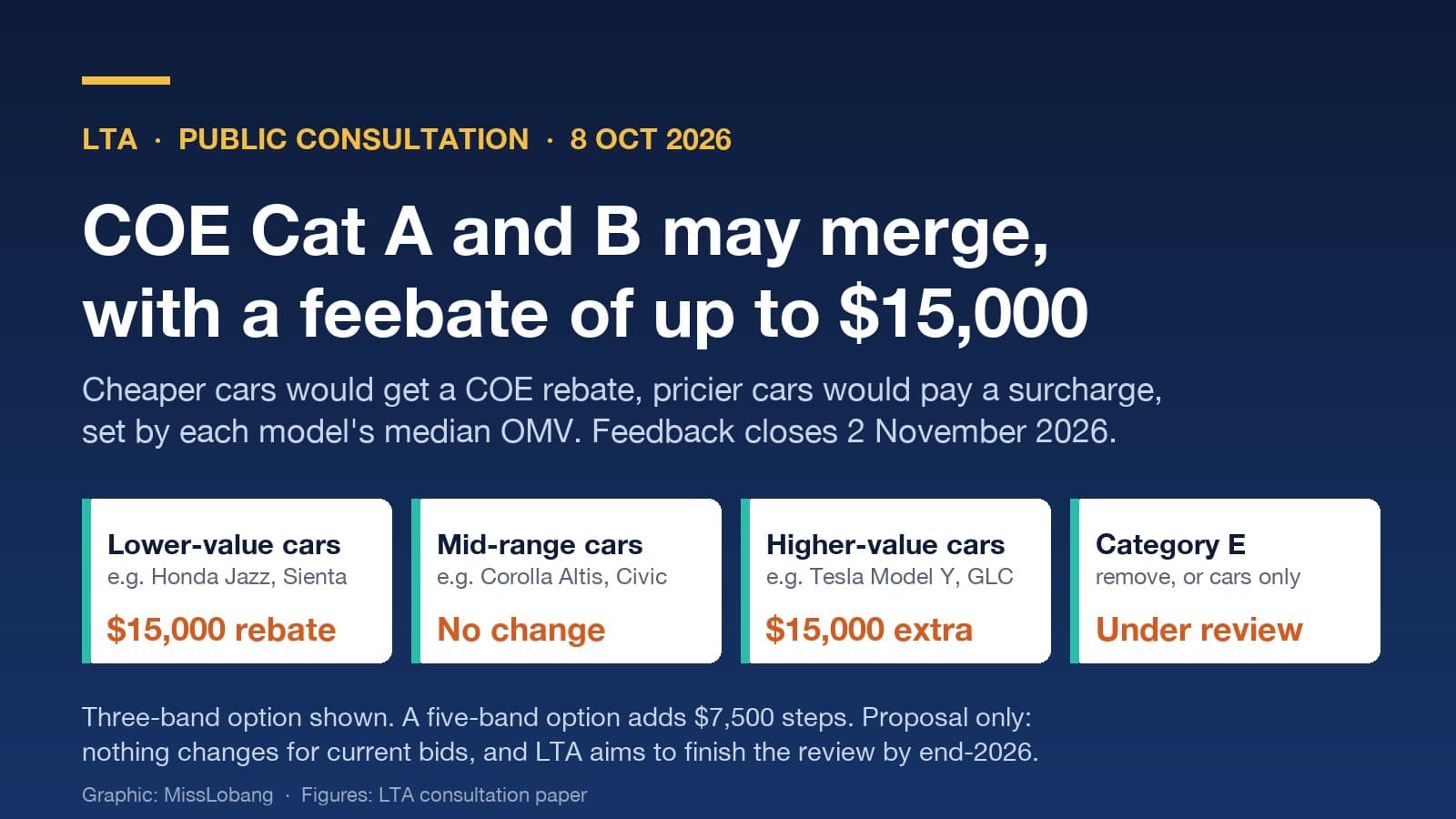
> Quick view: the Land Transport Authority (LTA) is proposing to merge COE Categories A and B into a single passenger car category. To keep luxury buyers paying more, it would add a fee-and-rebate ("feebate") of up to $15,000 to the COE price, based on each car model's median Open Market Value (OMV). It is a proposal, not a decision. Public feedback is open from 8 October to 2 November 2026 (11.59pm), and LTA aims to finish the review by the end of 2026.
LTA published the consultation paper on REACH on 8 October 2026. If you are planning to buy a car in the next year or two, this is the biggest change to how car COEs are sorted since Categories A and B were created in 1999.
Why LTA wants to change it
Category A was meant for mass-market cars and Category B for higher-value ones, separated by engine capacity and engine power. LTA says that line no longer works:
- Electric cars are software-driven, so makers can tune a model's power to fit under the Category A threshold. LTA's own example: the same Tesla Model Y can fall into Category A or B depending on its power rating.
- Buyers of mass-market and higher-value cars now compete for the same Category A COEs.
- From February to June 2026, the Category A price was higher than Category B on three occasions.
More than 200 members of the public, academics and motor-industry representatives were engaged in focus groups in April and May 2026 before this paper.
What LTA is proposing
- One car category. Categories A and B become a single pool. LTA says a bigger pool could also help reduce price swings.
- A feebate on the COE price. Buyers of lower-value cars get a rebate, mid-range cars see no adjustment, and higher-value cars pay an extra fee. The rebate or surcharge is applied to the prevailing COE price.
- Value measured by median OMV per model. Not the selling price, which LTA says is too easy to depress with discounts and overtrade. Bands would be set by OMV percentile, reviewed every year and published, so you would know a model's rebate or surcharge before you buy. Car retailers could appeal a model's band.
The two band options on the table
Option A: three bands
| Band | OMV percentile (2025 registrations) | Adjustment | Example models |
|---|---|---|---|
| 1 | 0-35th | $15,000 rebate | Honda Jazz, Toyota Sienta, Honda Freed, Suzuki Swift, BYD Atto 3, Volvo EX30 110kW |
| 2 | 35-50th | $0 | Toyota Corolla Altis, Honda Civic 1.5 Turbo, Nissan Serena, Audi A3 |
| 3 | Above 50th | $15,000 surcharge | Tesla Model Y RWD, Tesla Model 3 RWD 110, Mercedes A180, Mercedes GLC, Toyota Alphard, Honda Odyssey |
Option B: five bands
| Band | OMV percentile | Adjustment | Example models |
|---|---|---|---|
| 1 | 0-10th | $15,000 rebate | Honda Jazz, Mazda 3, Nissan Note, Suzuki Swift, MG S5 |
| 2 | 10-35th | $7,500 rebate | Toyota Sienta, Honda Freed, Toyota Noah, BYD Atto 3 |
| 3 | 35-50th | $0 | Toyota Corolla Altis, Honda Civic 1.5 Turbo, Nissan Serena |
| 4 | 50-75th | $7,500 surcharge | Audi Q3, Mercedes A180, Honda Odyssey, Tesla Model 3 RWD 110 |
| 5 | Above 75th | $15,000 surcharge | Tesla Model Y RWD, Mercedes GLC, Toyota Alphard, BMW iX2 |
The model lists are LTA's indicative, non-exhaustive examples. LTA says three bands are simpler but create bigger jumps between neighbouring cars, while five bands are fairer to similar cars that land in adjacent bands but are harder to run.
Renewals and Category E
- COE renewals: after a merger there would be one Prevailing Quota Premium (PQP). LTA suggests the feebate may not need to apply to renewals, since Category A and B owners already pay broadly similar PQPs, and says transitional arrangements for existing owners could be considered. It wants views on this.
- Category E: the open category now mostly goes to Category B cars. If A and B merge, LTA is weighing two options: remove Category E entirely, or keep it for cars only so urgent buyers can still get one without eating into Category C (commercial vehicle) supply.
Ideas LTA is not taking forward for now
The paper also explains why several popular suggestions were left out: allocating COEs by family needs, pay-as-you-bid, a separate category for private-hire cars, and an ABSD-style surcharge on second cars. Two smaller changes are being worked on, though:
- Letting individuals submit their first bid online (today it must be at a DBS/POSB ATM), and reviewing the per-bid fee ($2 for individuals, $8 or $10 for motor dealers).
- Asking dealers to publish car prices without the COE, so buyers can compare and bid on their own.
For larger families, LTA points to the transport grant announced at the National Day Rally 2026 for families with three or more Singapore Citizen children, covering taxi or public transport. Details are still to come.
What it means for you
- Buying a mass-market car soon? Under the proposal, models like the Jazz or Sienta would get a rebate off the single COE price. But that single price is unknown, and nothing changes until LTA decides. LTA has not given a start date.
- Eyeing a pricier EV or luxury model? Cars that slipped into Category A on a tuned power rating would likely land in a surcharge band, because the measure becomes value, not power.
- Already own a car? Watch the renewal question. Whether the feebate touches renewals and whether there are transitional arrangements are both open.
- Have a view? Say so before 2 November. You can submit online at go.gov.sg/coe-pcd-feedback, or mail a hard copy to Policy Division (Private Transport), Land Transport Authority, 1 Hampshire Road, Singapore 219428.
Fine print
- Everything here is a proposal under public consultation. Bands, amounts and the Category E treatment can change.
- The example models and percentiles are based on 2025 registrations and would be reviewed yearly.
- The rebate or surcharge applies to the COE price, not the car's list price, and does not change how bidding works.
- This article summarises LTA's consultation paper of 8 October 2026. It is not financial advice. Confirm details with LTA before making a purchase decision.
Related
- 7 Best Car-Sharing, Rental, Leasing and Driving School Options in Singapore 2026
- 5 Best Car Insurance Plans in Singapore (2026)
- 7 Cheapest EV Charging Networks in Singapore (2026)
- Cheapest Petrol in Singapore Right Now (2026)
- Grab Now Sells Cars: We Read All 44 Listings
Cover graphic: MissLobang. Figures: Land Transport Authority consultation paper.