*Proposed only. The Land Transport and Related Matters (No. 2) Bill was read the first time in Parliament on 8 September 2026. It is not law yet, and no start date has been set.*
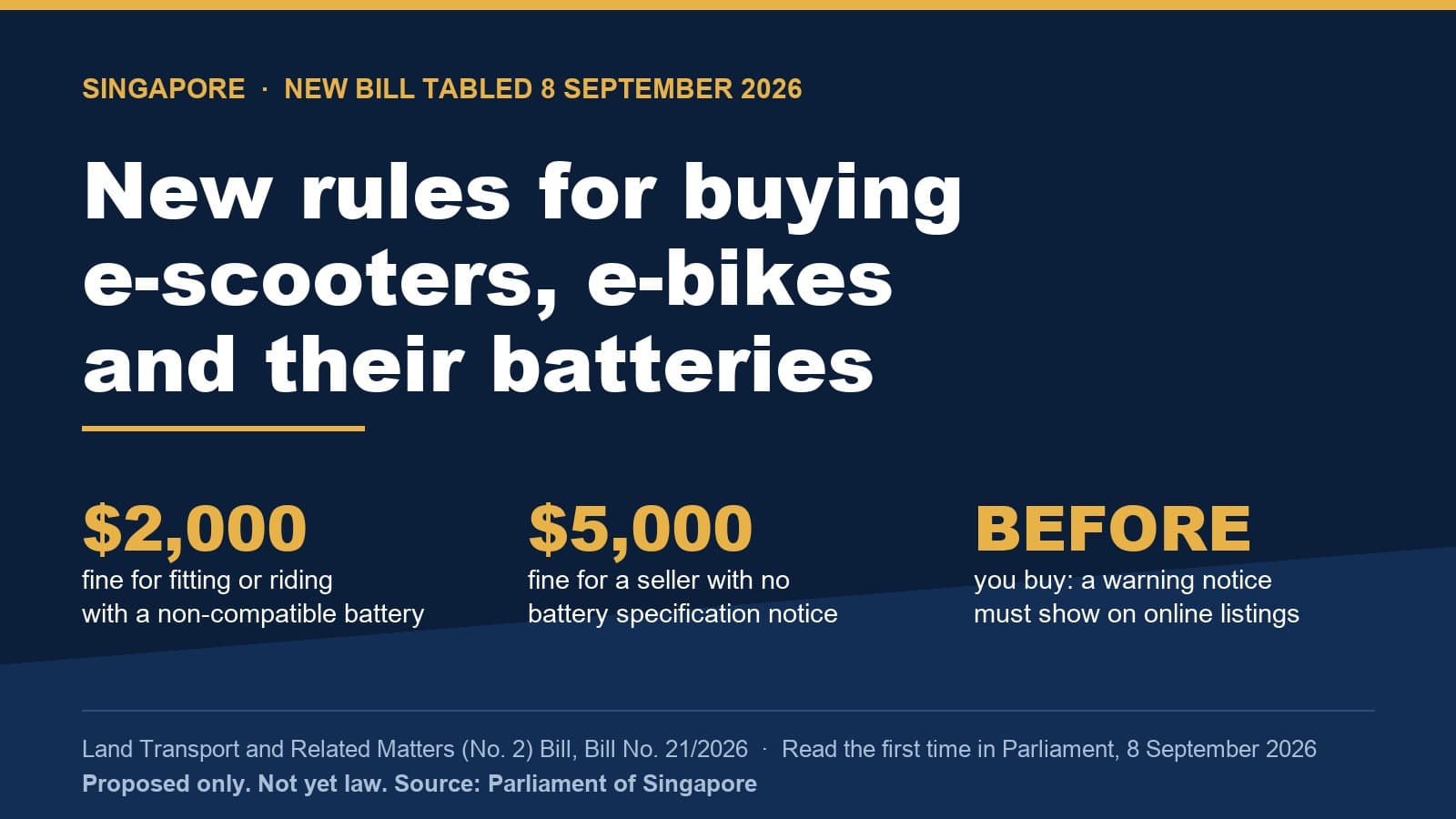
> Quick view: A new Bill tabled in Parliament on 8 September 2026 would change how personal mobility devices (PMDs), power-assisted bicycles (PABs), mobility vehicles and their batteries are sold in Singapore. Online listings would have to show you a warning notice before you buy. Anyone selling a mobility device battery would have to publish a specification notice naming every device the battery actually fits. And a new offence would catch the owner, not just the shop: fitting a non-compatible battery, or riding a device powered by one, would carry a fine of up to $2,000 or three months' jail.
What was tabled
The Land Transport and Related Matters (No. 2) Bill, Bill No. 21/2026 was read the first time in Parliament on 8 September 2026. Its second reading is listed as the next available sitting, so nothing in it has taken effect.
The Bill amends four Acts: the Active Mobility Act 2017, the Electric Vehicles Charging Act 2022, the Road Traffic Act 1961 and the Small Motorised Vehicles (Safety) Act 2020. Most of the consumer-facing changes sit in the Active Mobility Act half.
Three of them will matter if you buy, own or ride any of these devices.
1. A warning notice would have to appear before you buy online
Shops that sell PMDs, PABs or mobility vehicles already have to display warning notices on their premises. The Bill adds a second duty for online selling.
Under the new subsection, a person selling one of these devices through an online marketplace must ensure that, *before the consumer purchases* it, a warning notice is published to the consumer in the prescribed manner.
Two details in the drafting are worth reading twice:
- The online duty applies "whether or not in the course of business". The in-store duty is limited to sellers acting in the course of business. The online one is not, so as drafted it reaches private and second-hand sellers, not only retailers.
- "Online marketplace" is defined broadly: any social media platform, Internet application, website or web service that lets a person sell or offer these devices to customers by electronic means.
What the notice must actually say is left to regulations. The Bill only says it must be prescribed for that class of vehicle and be in the prescribed form, and it allows different forms for the in-store and online versions.
2. Battery sellers would have to publish a specification notice
This is an entirely new section (31A) covering mobility device batteries, defined as a prescribed type of battery used to power a PMD, PAB or mobility vehicle.
Sellers would have to display a specification notice in store, and publish one to the consumer before purchase when selling through an online marketplace. Again the online duty applies whether or not the seller is in the course of business.
The notice must set out prescribed information about the battery, including the brand and model of every PMD, PAB or mobility vehicle the battery is compatible with. That is the part that helps a buyer most: today a listing can simply say "fits most e-bikes".
Publishing a specification notice the seller knows, or ought reasonably to know, is false or misleading is a separate offence.
3. The wrong battery would become your offence, not just the seller's
New section 34A is the change most likely to catch ordinary owners out. It would make it an offence to:
- fit, or cause to be fitted, a battery that is not a compatible battery into a PMD, PAB or mobility vehicle; or
- ride or use a PMD, PAB or mobility vehicle powered by a non-compatible battery.
The Bill closes the obvious defence too: it is expressly not a defence to prove that you never powered the device up after fitting the battery.
A "compatible mobility device battery" is defined narrowly. Broadly, it is the battery that was fitted in and tested together with that device (or another device of the same brand and model) to meet the prescribed safety standards, or another battery of the same brand and model as that one, meeting any prescribed criteria. In plain terms, the battery the device was certified with, or an identical one, rather than a cheaper third-party pack that happens to fit the slot.
Selling someone a non-compatible battery while knowing, or being reckless as to whether, the buyer intends to fit it into a device it does not suit is a heavier offence under new section 34B.
Also in the Bill
- False or misleading representations (new section 32A) when selling a PMD, PAB, bicycle, mobility vehicle, a mobility device battery, or any component intended for assembly with one. It also catches a person who merely takes part in publishing such a representation.
- A defined category of "non-compliant alteration services advertisement": advertising that promotes services to alter a device so that it becomes non-compliant or unsafe.
- Advertising offences extended to cover non-compliant devices, unapproved and unsealed PABs, and non-compatible batteries.
When would this start
There is no date. The Bill states it comes into operation on a date the Minister appoints by notification in the Gazette, and it has only had its first reading. The second reading and debate come at a later sitting, and the specific requirements (what a warning notice looks like, which batteries count as a prescribed type) are left to regulations that have not been published.
So nothing here changes what you can legally buy or ride today.
What this means for you now
If you own or are shopping for an e-scooter, a power-assisted bicycle or a mobility scooter:
- Buying a replacement battery is the risk area. The direction of travel is clear even before the Bill passes. A third-party pack that is not the brand and model your device was certified with is what section 34A is aimed at.
- Keep the paperwork. The brand and model of the battery your device shipped with is what a compatibility claim would be measured against.
- Treat "fits most models" listings with suspicion. The Bill exists partly because those listings carry no verifiable compatibility information today.
- Check the current rules with LTA before you buy anything. Device certification, weight and speed criteria and where each device may be ridden are set by the Land Transport Authority and are unchanged by this Bill.
This is a summary of a Bill, not legal advice. Confirm anything that affects you with LTA or the Ministry of Transport, and read the Bill itself if the detail matters to you.
What we could not confirm
At the time of writing, neither the Ministry of Transport nor LTA had published a press release or plain-language explainer for this Bill. Everything above is taken directly from the text of Bill No. 21/2026 as published by Parliament. The maximum penalties quoted are those in the Bill as introduced, and can change during the second reading.
Source: Parliament of Singapore, Land Transport and Related Matters (No. 2) Bill, Bill No. 21/2026, read the first time on 8 September 2026.