Scams in Singapore are falling, but the ones that hit online shoppers are still going up. The Singapore Police Force released its Mid-Year Scam and Cybercrime Brief 2026 on 26 August 2026, and for anyone who buys deals, pre-orders or collectibles online, the numbers point in one direction.
> Quick view: Scam cases fell 14.4% to 16,821 in the first half of 2026 and losses fell 17.9% to about S$410.6 million. But e-commerce scams rose 19.3% to 3,865 cases, making them the most reported scam type of all. Pokemon trading card cases more than doubled (up 116.8% to 605 cases, S$1.2 million lost), driven by pre-order listings that ask for a deposit months before delivery. By case count, Carousell (991) and Telegram (966) top SPF's e-commerce platform list; by money lost, Facebook is worst at about S$2.7 million. Median loss across all scams: S$1,350.
Photo: Singapore Police Force, Mid-Year Scam and Cybercrime Brief 2026 (Annex G).
The headline numbers
| 1H 2025 | 1H 2026 | Change | |
|---|---|---|---|
| Scam and cybercrime cases | 22,397 | 18,391 | -17.9% |
| Scam cases | 19,644 | 16,821 | -14.4% |
| Total lost to scams | ~S$500.2m | ~S$410.6m | -17.9% |
| Median loss per case | S$1,682 | S$1,350 | -19.8% |
Cases involving losses of S$100,000 or more fell 24.5%. About 69.5% of all scam cases involved losses under S$5,000, and 4.7% involved S$100,000 or more.
The Anti-Scam Centre froze more than S$97.7 million of scam proceeds in the first half of 2026, and says interventions with victims prevented at least a further S$127.1 million in losses.
One number did not improve: 80.8% of reported scams involved self-effected transfers, up from 78.8%. In plain terms, in four out of five cases the scammer never touched the victim's account. The victim was talked into pressing send.
E-commerce scams are now the most reported scam type
This is the part that matters most if you shop deals online.
| Scam type | Cases 1H 2026 | Cases 1H 2025 | Amount lost | Average loss |
|---|---|---|---|---|
| E-commerce | 3,865 | 3,240 | S$8.3m | S$2,160 |
| Phishing | 3,104 | 3,772 | S$9.6m | S$3,108 |
| Investment | 2,256 | 2,692 | S$169.8m | S$75,267 |
| Job | 2,247 | 2,717 | S$34.9m | S$15,534 |
| Government officials impersonation | 1,363 | 1,772 | S$90.8m | S$66,643 |
E-commerce scams were the only one of the top five to grow, up 19.3% in cases and 18.9% in losses. Most victims were aged 30 to 49 (41.3% of this scam type). SPF says the most common platforms scammers used to reach them were Carousell and Telegram.
The pre-order trap
Pokemon trading cards remained the single most common item in e-commerce scams, and the growth is steep: 605 cases in the first half of 2026, up 116.8% from 279 a year earlier. That is 15.7% of all reported e-commerce scam cases. Losses jumped 172.4% to S$1.2 million from about S$472,000.
SPF is specific about the mechanic. The rise was "largely driven by the rise of the pre-order trend". Victims found listings for trading cards or other popular collectibles and fan merchandise (K-pop lightsticks are named in the brief) on platforms such as Carousell. The seller asked for a deposit or full payment upfront, with the promised delivery date usually months away. Buyers only realised what had happened when the date passed with nothing delivered, or when they saw other buyers posting about the same seller.
That long gap is the whole scam. It buys the seller months before anyone raises an alarm.
Where e-commerce scams happen: SPF's own platform ranking
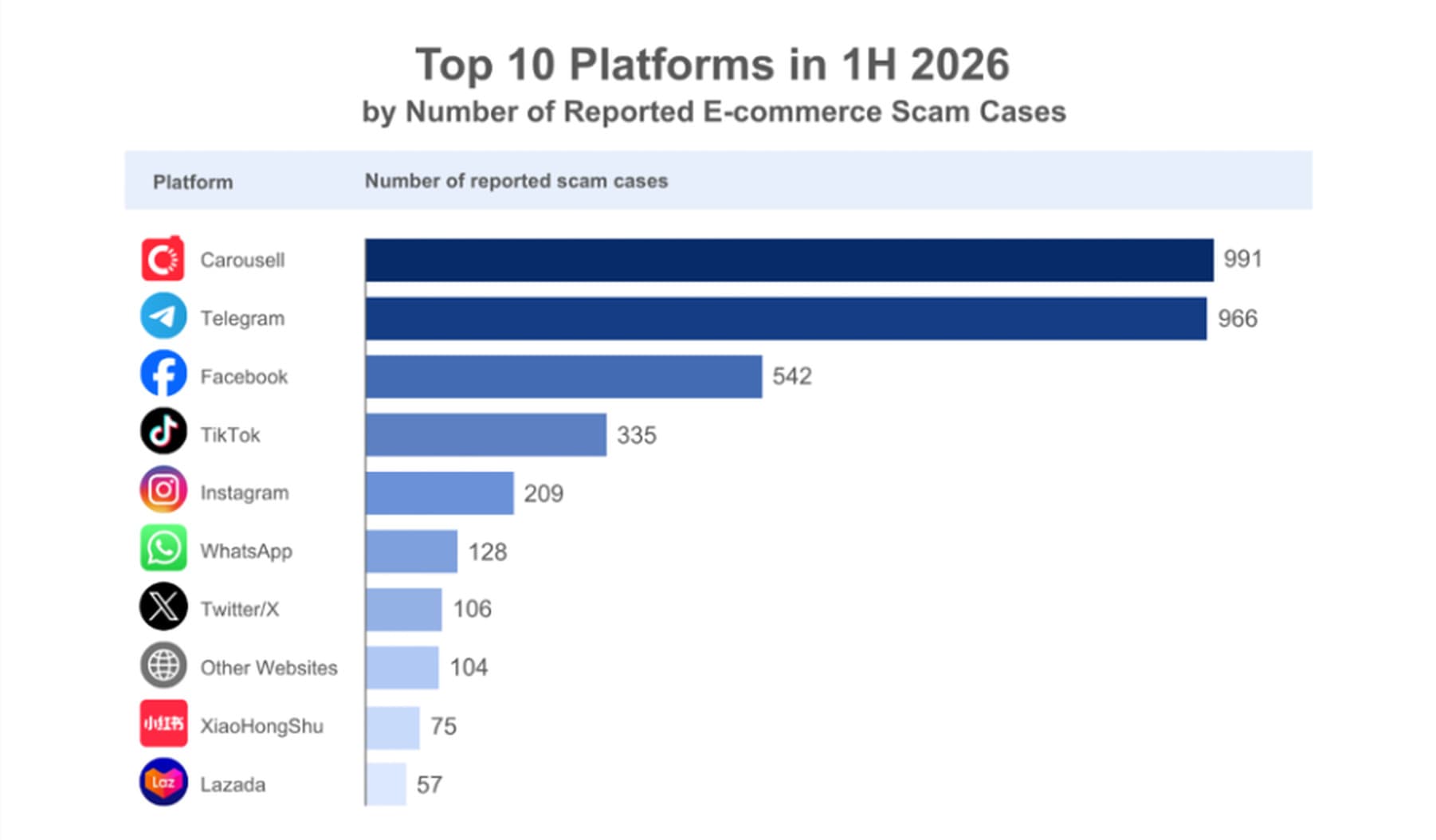
The brief introduces the E-commerce Scam Situation Report, which replaces the old Transaction Safety Ratings and ranks the top 10 platforms by both reported cases and reported losses. Two different platforms come top depending on which you measure.
By number of reported e-commerce scam cases
| Platform | Cases |
|---|---|
| Carousell | 991 |
| Telegram | 966 |
| 542 | |
| TikTok | 335 |
| 209 | |
| 128 | |
| Twitter/X | 106 |
| Other websites | 104 |
| XiaoHongShu | 75 |
| Lazada | 57 |
By total amount lost to e-commerce scams
| Platform | Amount lost |
|---|---|
| ~S$2.7m | |
| Carousell | ~S$1.0m |
| S$849K | |
| Other websites | S$753K |
| Telegram | S$715K |
| TikTok | S$415K |
| S$262K | |
| XiaoHongShu | S$177K |
| S$154K | |
| YouTube | S$108K |
The top 10 platforms accounted for 3,513 reported e-commerce scam cases and about S$7.2 million in losses. SPF's own note on these charts is worth repeating: the bar lengths in its infographic are illustrative, and the figures are reported cases linked to each platform, not a safety score for the platform itself.
Two more platform facts from the wider brief. Across all scam types, Carousell was the only designated online service to record an increase, with cases up 17.1% to 1,555 from 1,328. And of the 1,890 scam cases where the first contact came through an online shopping platform, 82.3% happened on Carousell, 10.7% on Facebook Marketplace and 3.1% on Lazada.
For balance, the brief also records what these platforms have built. Carousell has an escrow-based payment system with trackable delivery, mandatory two-factor authentication for new device logins, in-platform safeguards that discourage moving a deal off-platform, and, under the new E-Commerce Code, piloted verification for higher-risk sellers. Meta has introduced advertiser verification and risk-based verification for selected sellers and pages.
How scammers reach people
Online platforms were the first approach in 89.0% of all scam cases. The three Meta products (Facebook, WhatsApp, Instagram) together accounted for 34.1% of total cases.
- Messaging platforms: 27.6% of cases
- Social media: 26.7%
- Online shopping platforms: 11.2%
- Phone calls: 9.7%
Phone-call scams fell hardest, down 49.1% to 1,631 cases. Facebook cases fell 35.9%, TikTok fell 16.2% to 1,244 cases and Instagram fell 10.3%.
Who loses the most
Younger Singaporeans are the ones getting scammed. Older Singaporeans are the ones losing the money.
| Age group | Share of victims | Average loss |
|---|---|---|
| 19 and below | 6.6% | S$2,336 |
| 20 to 29 | 21.8% | S$7,498 |
| 30 to 49 | 36.0% | S$17,000 |
| 50 to 64 | 21.1% | S$32,879 |
| 65 and above | 14.4% | S$42,347 |
Among victims aged 19 and below, 45.6% fell for e-commerce scams. Among those aged 20 to 29, it was 36.1%. If you have a teenager buying cards, sneakers or concert merch on a marketplace, that is the number to show them.
The elderly are the smallest victim group but lose the most per case, and their average loss rose from S$35,374 a year ago. Their top scam type is government officials impersonation.
Two current tricks worth knowing
The parcel redelivery message. SPF flags an ongoing run of phishing cases delivered through Apple iMessage. Scammers pose as courier companies, messaging from email addresses of random letters and numbers or from overseas numbers, saying a parcel could not be delivered because of an invalid address. The link goes to a fake courier site asking for card details or banking credentials to pay a small redelivery fee. In some cases, once the OTP was given, the victim's card was added to Google Pay or Apple Pay. Verify delivery problems only through the courier's own app or website.
Social media boosting jobs. Among job scams, SPF names social media boosting as a growing variant: liking, following, sharing or boosting posts, listings or merchants for a commission. Volumes are still below the classic online-task variant, but the increase is sharp.
What changed on the defence side this year
Several of these are things you can switch on yourself.
- PayNow nicknames were discontinued for retail customers on 6 June 2026, so scammers can no longer use a nickname to look like a legitimate business or person.
- Singpass passkeys launched on 1 July 2026, a password-free login using biometrics or your six-digit app passcode. Because nothing is typed or transmitted, there is nothing for a phishing site to capture. It started in beta on iPhone mobile browsers, with Android and desktop to follow.
- Money Lock: about 589,000 bank customers have locked close to S$49 billion of savings as at 30 June 2026.
- CPF Trusted Contact and CPF Safety Switch: members aged 21 and above can appoint up to two people to receive copies of important transaction notifications. Members aged 55 and above can shut off CPF online access and withdrawals immediately if they think they have been scammed.
- Block overseas calls and texts: every telco offers it. About 1.3 million subscribers have activated overseas call blocking and 270,000 have blocked overseas SMSes.
- SIM card limit: 10 postpaid cards per subscriber across all telcos since February 2026. Check how many are registered to you at go.gov.sg/simcardhowmany.
- New Codes of Practice were issued on 17 August 2026 to designated messaging, social media and e-commerce services, and MHA has proposed penalties of up to S$10 million for non-compliance under the Online Criminal Harms Act.
- A single caller prefix for SPF is being developed with OGP and MDDI, and will be piloted by SPF later this year.
What this actually means before your next online purchase
- Treat a pre-order deposit as an unsecured loan. If delivery is months away and the money leaves now, you have no recourse for months. This is the exact pattern behind the 605 Pokemon card cases.
- Keep the payment inside the platform. SPF's guidance names in-platform payment that releases funds only after delivery is confirmed as one of three safeguards worth checking for. A seller who wants you to move to Telegram, PayNow or a bank transfer is removing that protection on purpose.
- Check the other two safeguards too: whether the platform verifies users against government-issued records, and whether it actively detects and removes suspicious accounts and listings.
- A "proof of payment" screenshot proves nothing. SPF notes scammers send fake ones to sellers as well. Check your own account.
- Verify redelivery and bank messages on the official app, never through a link in the message.
- When unsure, check first. ScamShield helpline 1799, or the ScamShield app.
This is a summary of an official police release for general information, not financial or legal advice. If you think you have been scammed, make a police report and contact your bank immediately.
Source: Singapore Police Force, Mid-Year Scam and Cybercrime Brief 2026, issued by the Public Affairs Department on 26 August 2026 at 3pm.
Related
- Pokémon TCG 30th Celebration at Cheers
- Singpass Passkeys Come to Android From 9 September 2026
- New Anti-Scam Law Passed: Police Can Disable Your Bank, Telco or App Account
- New Anti-Scam Rules for WhatsApp, Telegram and 5 Other Apps
- GST Voucher Cash August 2026: Up to $850
- DBS PayLah! $3 Saturday Cashback
- Singapore Online Shops With Free Shipping Deals