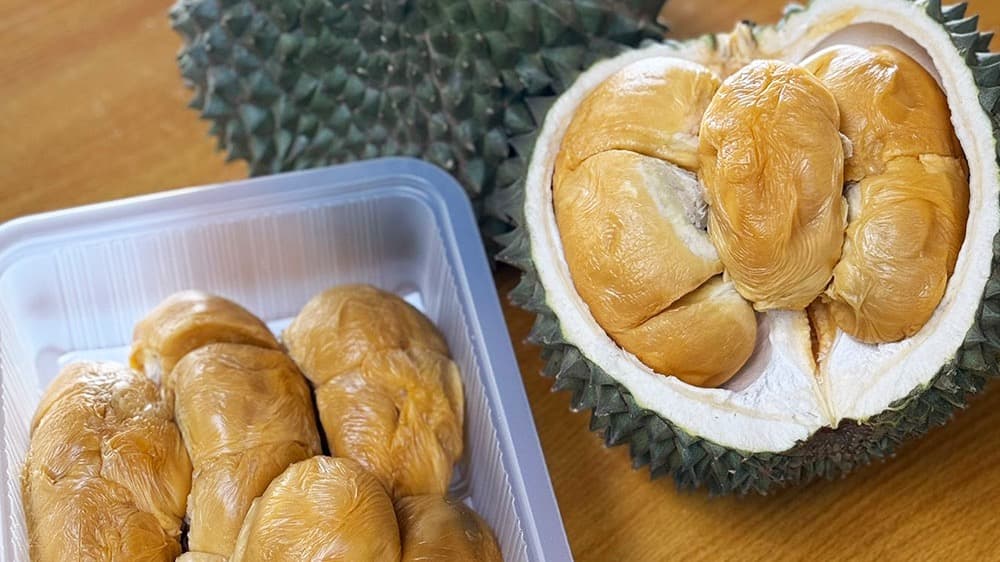
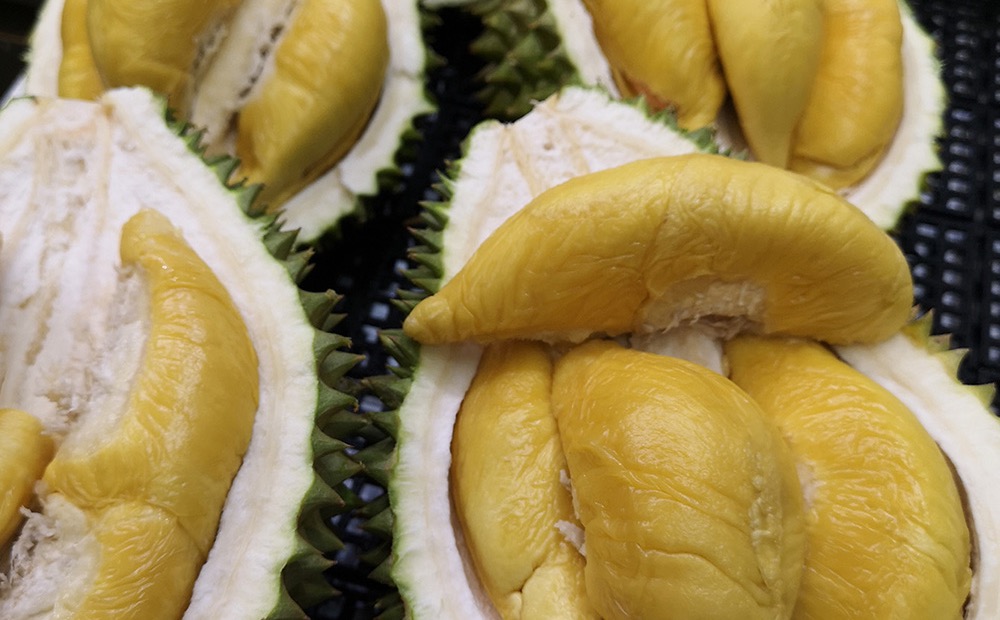
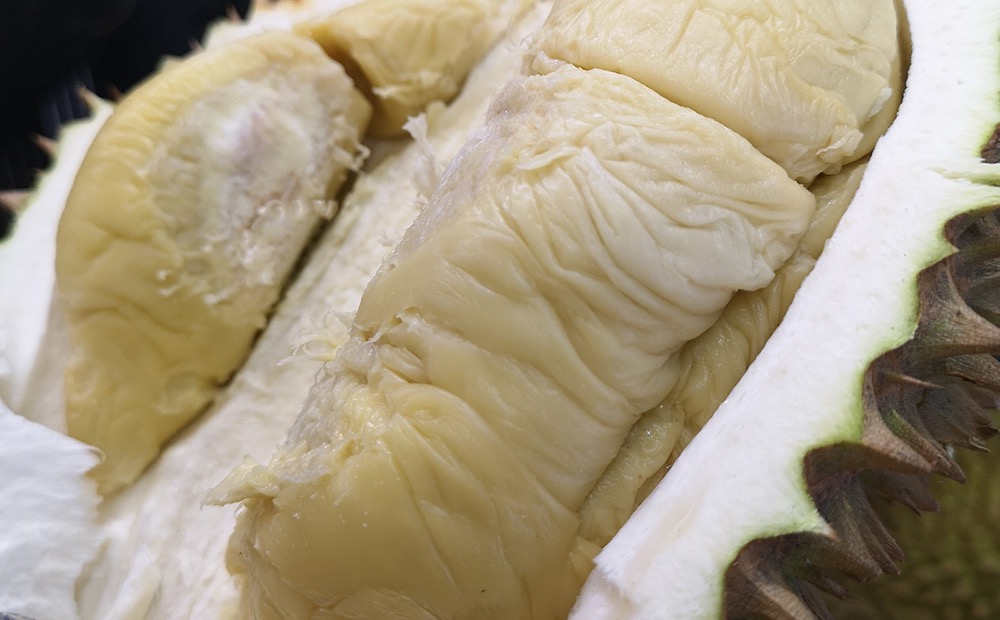
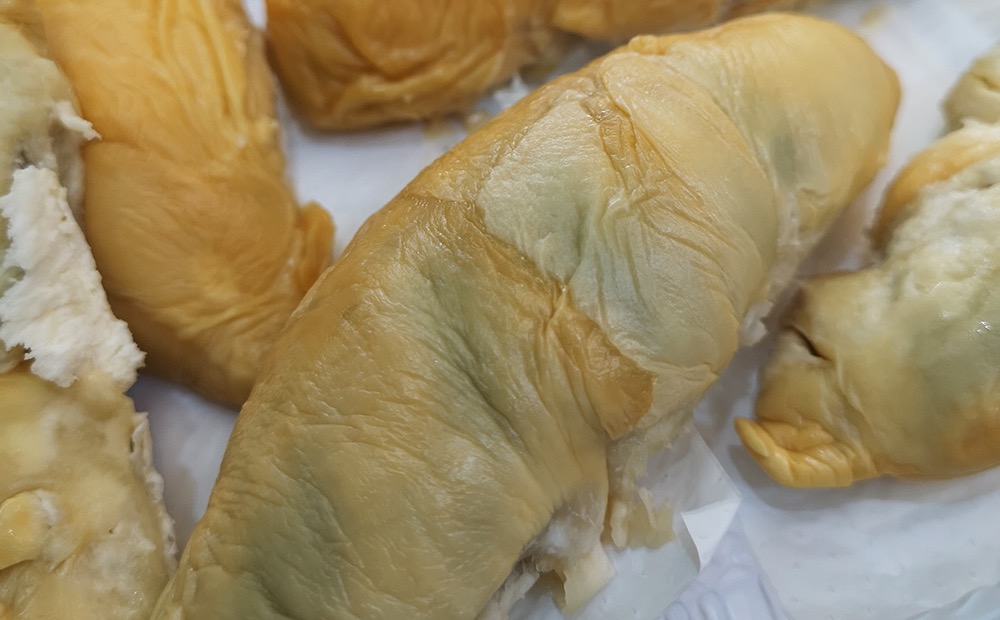
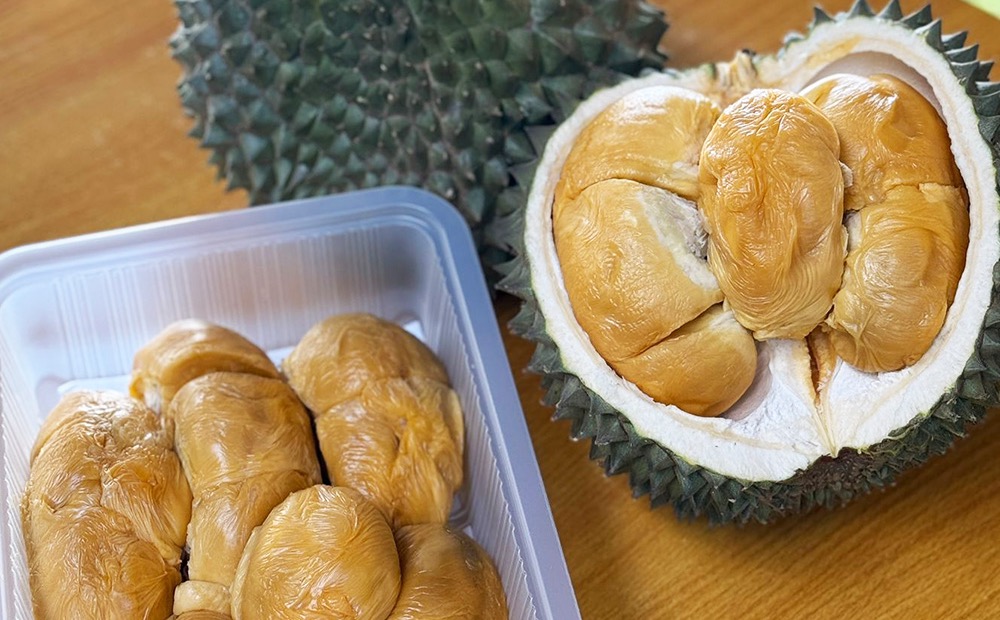
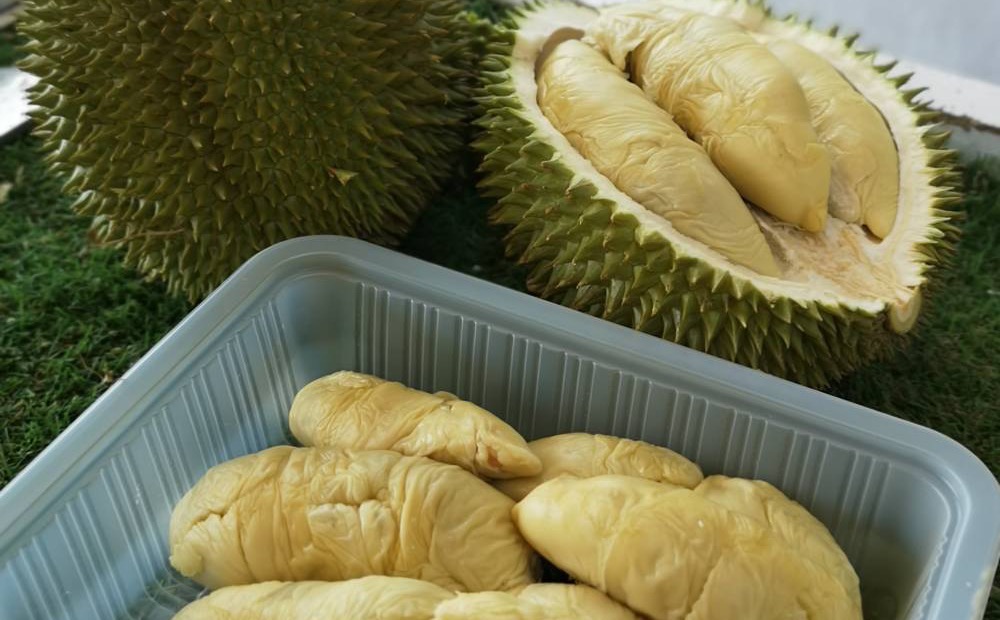
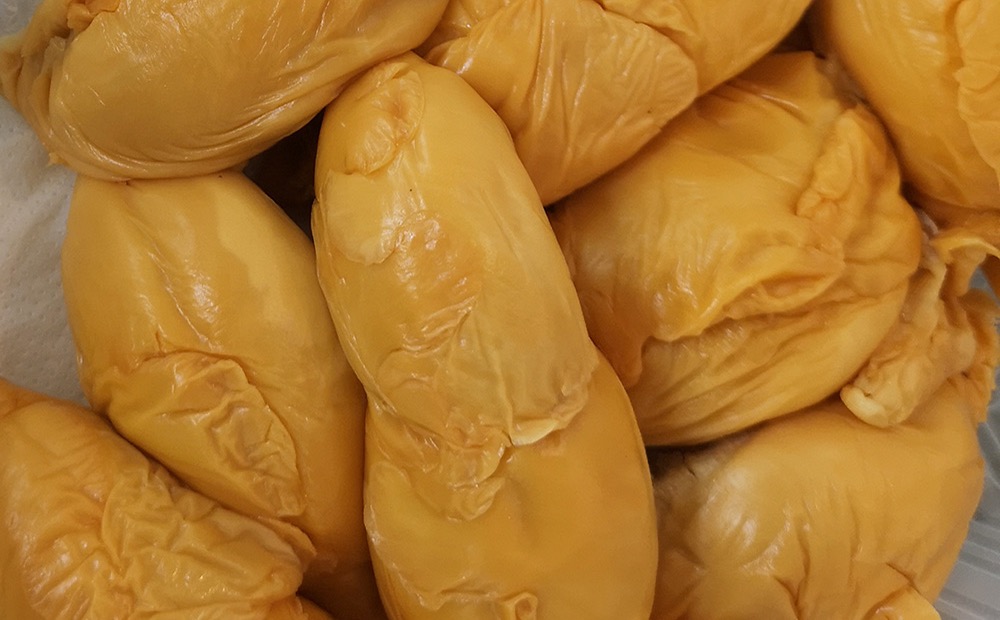
Is it still durian season? Checked 20 September, the answer at the specialists is still no, and what is left has got sharply more expensive in eight days. Durian Delivery has put $6/kg on every fresh line, taking its 800g Pahang Mao Shan Wang box from $60.80 to $80. Durian 36 has added a third $2/kg rise, to $28/kg. Black Thorn is the exception: it held at $21/kg, so at $67.20 for 800g it is now $12.80 cheaper than the plain Mao Shan Wang box at the same seller, a reversal of the usual premium. Fresh Durian has emptied out, with its own Mao Shan Wang ($52) and eight other lines all sold out, leaving Pahang Old Tree MSW at $55 as its last fresh box. 99 Old Trees has not moved, every variety still Season Ended. Here is our guide to the 6 types of durian in Singapore: what each tastes like, which you can still buy this week, when durian season ends, and the per-kg trap that turns $25/kg into $80 a box.
Singapore's fresh durian season is still closed at the specialists, and what is left has got sharply dearer in the past week.
> Quick view, 20 Sep 2026: The cheapest 800g Mao Shan Wang box is now $80 at Durian Delivery, up from $60.80 in eight days. Black Thorn held at $67.20, so it is now the cheaper premium pick. 99 Old Trees is still Season Ended.
Season status, checked 20 September 2026
The main season is still closed at the specialists, and the fresh durian that is left has got sharply more expensive in eight days. The premium order has also flipped: Black Thorn held its rate while Mao Shan Wang rose, so at one seller the splurge variety is now the cheaper box.
- Durian Delivery put $6/kg on every fresh line except one. Its 800g Pahang Mao Shan Wang box has gone from $60.80 to $80.00 ($19/kg to $25/kg), Pahang Old Tree MSW from $67.20 to $86.40 ($27/kg), Pahang Signature Black Gold to $92.80 ($29/kg), Penang Old Tree MSW to $99.20 ($31/kg) and Penang Signature Black Gold to $105.60 ($33/kg). Every one of those is exactly $6/kg above its 12 September rate.
- Black Thorn is the exception, and it changes the advice. Gua Musang Black Thorn held at $21/kg, $67.20 for 800g, while everything around it rose. It is now $12.80 cheaper than the plain Mao Shan Wang box at the same seller, and the cheapest fresh box on Durian Delivery's board. On 12 September it cost $6.40 more.
- Durian 36 has raised its board a third time. Another $2/kg on every line: fresh MSW $28/kg ($22 on 20 August, $24 on 2 September, $26 on 12 September), Black Gold MSW $30, Old Tree MSW $32, Raja Kunyit Gua Musang $34. Black Thorn rose with them to $28/kg here, so at Durian 36 the two premium names remain level. It is only at Durian Delivery that Black Thorn has pulled ahead on price.
- The budget tier has come back. Durian 36's D24 at $16/kg and XO at $18/kg, both Sold Out on 12 September, are orderable again, still flagged "only available after 7pm onwards". D24 now offers the 600g box only, at $38.40. Hulu Wang stays at $16/kg and in stock, so there are three lines at $16 to $18/kg where a week ago there was one.
- Fresh Durian has emptied out. Ten days ago its whole Mao Shan Wang family was in stock. Checked 20 September, only Pahang Old Tree MSW at $55 ($32/kg) still adds to cart, alongside its frozen MSW puree at $46. Its own Mao Shan Wang ($52), Pahang Black Gold ($58), Signature Black Gold ($62), Gua Musang Raja Kunyit ($62), Penang Black Thorn ($100), XO D24 ($36), King Red Prawn ($80) and Golden Phoenix ($85.80) all read Out of Stock. The FD35%DIS26 code for 35% off fresh durians is unchanged, with free delivery above $100.
- That "SAVE MORE" bundle now genuinely costs more. Fresh Durian's BUNDLE: MSW + Old Tree + Black Gold has gone from $165 to $170, while its three 400g components are still $52 + $55 + $58 = $165. The bundle is now $5 dearer than buying the three separately, where on 12 September it merely matched them. It is out of stock in any case.
- 99 Old Trees has not moved. Every fresh variety still reads "Season Ended", the header still reads "Season Ended ... Chilled and Frozen Durians Available ... Walk-in Purchase Only", and the published prices are unchanged: Mao Shan Wang [D197] and Black Thorn [D200] $88 per 750g, Tekka [D160] $72, Jinfeng [D198] $63, Ganghai, Black Pearl and Johor XO $59, Red Prawn [D175] $57, D88 $56, S17 and D13 $55, Bola and Celestial $53, Kasap Merah $52, Sultan King [D24] $48. Frozen MSW 450g is $53 over the counter.
- Frozen is no longer uniformly flat. Durian Delivery's frozen board did not move: vacuum-packed Penang MSW 800g $55, Black Thorn $70, Milky Red Prawn $40, Penang Hulu and Kun Bao $45. Durian 36's frozen did rise, by $2/kg, to $70.40 for 800g MSW (from $64), Black Gold and Black Thorn $76.80, Old Tree MSW $83.20.
- Royal Durian is still sold out of fresh Mao Shan Wang ($53). Its MSW gelato ($27.80) and MSW snowskin mooncakes ($78) are in stock.
> Heads up on prices: durian rates swing day to day with supply, so the figures here are the sellers' published rates on 20 September, not fixed prices. Always ask the stall for the day's rate, and have it weighed, before they husk it.
The cheapest way to eat durian right now
With fresh Mao Shan Wang at $80 and up for an 800g box, frozen has quietly become the value play, and one fresh variety now undercuts the king outright:
| What you want | Cheapest option, 20 Sep 2026 | Price |
|---|
| Fresh Mao Shan Wang, 800g | Durian Delivery, Pahang MSW | $80.00 ($25/kg) |
| Any fresh premium box, 800g | Durian Delivery, Gua Musang Black Thorn | $67.20 ($21/kg) |
| Mao Shan Wang flesh, any temperature | Durian Delivery, frozen Penang MSW 800g | $55.00 |
| Cheapest fresh durian by the kilo | Durian 36, Hulu Wang or D24 | $16/kg |
| Smallest fresh MSW box | Fresh Durian, Pahang Old Tree MSW 400g | $55.00 |
Frozen Penang MSW at $55 is $25 less than the cheapest fresh MSW box and $34.60 less than Durian 36's 800g box, and it is the one part of the board that did not rise this week.
Why a $25/kg durian costs $80 a box
An advertised per-kg rate is for the whole, un-husked fruit, not the flesh you eat, and roughly three-quarters of a durian's weight is husk and seed. Three sellers now publish the arithmetic themselves:
- Durian 36 spells it out on every product page: "Each package contains 600g of pure durian pulp, taken from about 2.4kg of whole durian (with husk) ... For 800g, made from approximately 3.2kg of husked durian." Its checkout prices it exactly that way: Mao Shan Wang at $28/kg comes to $67.20 for a 600g box and $89.60 for 800g, Old Tree MSW to $76.80 and $102.40, Black Gold MSW to $72 and $96.
- Durian Delivery shows the same ratio on its price list, where every per-kg badge times 3.2 is the box price exactly: $25/kg gives the $80.00 box, $21/kg gives $67.20, $33/kg gives $105.60.
- 99 Old Trees publishes a 26 to 27% flesh ratio, which works out at about 3kg of whole fruit for 800g of flesh.
So the only honest comparison is box against box, never badge against badge. On that basis Durian Delivery's $80 Mao Shan Wang box beats Durian 36's $89.60 for the same 800g, even though Durian 36's shelf price reads "$28".
What durian costs right now
Prices move daily with supply, so use this as a rough guide and always confirm the day's rate at the stall:
- June 2026 was a glut. A bumper Malaysian crop pushed Mao Shan Wang to around S$20/kg, with smaller or lower-grade fruit going for much less.
- By mid-July, with the Johor harvest winding down, sellers reported MSW firming to about S$22 to S$24/kg.
- Late July squeezed. Johor finished, fresh MSW sold out across most delivery services, and sellers warned prices would only keep climbing.
- The August restock reversed that, and prices fell twice, down to S$22/kg at Durian 36 on 20 August.
- Then it turned back, three times. Durian 36 added S$2/kg on 2 September, another on 12 September and another by 20 September. Fresh MSW is now S$28/kg, Black Gold MSW S$30/kg, Old Tree MSW S$32/kg, Raja Kunyit Gua Musang S$34/kg and Black Thorn S$28/kg. That is a 27% rise in a month.
- Durian Delivery moved in one step instead of three, adding S$6/kg to its whole fresh board between 12 and 20 September, and leaving only Black Thorn alone at S$21/kg.
- The cheap tier recovered. Hulu Wang holds at S$16/kg and is joined again by D24 at S$16/kg and XO at S$18/kg, both back in stock and both evening-only.
- 99 Old Trees still prints S$88 per 750g for its de-husked MSW box, but every fresh line there is Season Ended, so that price cannot be ordered online.
- Frozen split two ways. Durian Delivery held its frozen board flat (Penang MSW 800g S$55, Black Thorn S$70, Milky Red Prawn S$40), while Durian 36 put S$2/kg on its own (800g MSW S$70.40, Black Gold and Black Thorn S$76.80, Old Tree MSW S$83.20). So "frozen never moves" is only true of one of them.
- Street stalls usually undercut delivery rates, and they are now the most likely place to find Red Prawn or Golden Phoenix fresh at all.
When does durian season end in Singapore?
The main mid-year season runs roughly June to August 2026, this year ran slightly past that, and it closed at the specialists on 12 September and has not reopened. It ended variety by variety rather than all at once:
- The specialist has called it and kept it called. On 2 September, 99 Old Trees still badged Mao Shan Wang in season. By 12 September all of its fresh lines read Season Ended and its header switched to "Season Ended ... Chilled and Frozen Durians Available ... Walk-in Purchase Only". Checked again on 20 September, nothing has reopened. It had dated its own Pahang supply "till early September" and finished on schedule.
- The price list agrees. Three $2/kg rises at Durian 36 in eighteen days, a $6/kg step at Durian Delivery in eight, and a specialist trading walk-in only is what the tail of a harvest looks like.
- Johor finished in July; Pahang delivered the August restock and has now run out.
- Fresh durian is still buyable from the delivery sellers, because they source year-round or from their own plantations rather than following the Malaysian season. The range has narrowed, though: Fresh Durian is down to one fresh line, and the Mao Shan Wang family plus Black Thorn at Durian Delivery and Durian 36 is most of what is left.
- Frozen and chilled durian is available year-round, and Malaysia usually throws up a smaller second wave around November to December, with fewer varieties, higher prices and timing that shifts with the weather.
Which region supplies Singapore, and when
Nearly all of it comes up from Malaysia, and the regions peak at different times, which is why supply wobbles mid-season:
| Region | Typical window | Notes |
|---|
| Johor | ~June to July | Closest, floods the market first; finished early in 2026 |
| Pahang (Raub, Bentong) | ~late June to early September | Source of the August restock; ran out on cue, and 99 Old Trees closed its fresh season on 12 September |
| Penang | ~June to August | The name to look for on Black Thorn |
| Betong, S. Thailand | ~July to September | Later window; Thai-grown MSW appears when Malaysian stock is thin |
Windows shift by a few weeks each year with the weather.
Where to buy durian in Singapore
- Islandwide delivery: now the main route, because it is the only one with reliable stock. The choice is the Mao Shan Wang family plus Black Thorn at Durian Delivery and Durian 36, Hulu Wang and the evening-only D24 and XO at Durian 36, and a single Old Tree MSW box at Fresh Durian. See our 6 Best Durian Delivery Services in Singapore for who has what, at what per-kg rate.
- Durian belts: Geylang/Sims Avenue and Balestier (Whampoa) have the biggest cluster of stalls, and they are the best bet for comparing prices and "see flesh" deals, plus the last chance at a variety the delivery sellers no longer list.
- Neighbourhood stalls: most heartland towns still have a roadside durian seller for as long as the street supply lasts.
- Walk-in at the specialists: 99 Old Trees has closed online ordering for fresh durian but sells chilled and frozen over the counter, including the frozen MSW 450g box at $53.
- FairPrice and supermarkets: pre-packed, de-husked boxes if you want fuss-free. (FairPrice Xtra's durian buffets ran in June and have ended for this season.)
- Durian desserts: if you would rather have it plated, durian snowskin mooncakes are in their last week before Mid-Autumn on 25 September, and both 99 Old Trees and Royal Durian sell MSW versions.
How to eat durian for less
- Compare by the box, not by the kilo. Per-kg badges cover whole fruit, so the only like-for-like comparison is what one box of flesh costs. On that basis Durian Delivery's 800g MSW at $80 beats Durian 36's $89.60 for the same weight, even though Durian 36's badge looks like the smaller number.
- Buy the Black Thorn. At Durian Delivery it is $67.20 against $80 for Mao Shan Wang in the same 800g box, because it is the one line that did not take the $6/kg rise. The usual premium has not just gone, it has inverted.
- Take frozen seriously now. Durian Delivery's vacuum-packed Penang MSW is $55 for 800g and did not move this week, so it is $25 under the cheapest fresh MSW box.
- Check the cheap line before the premium one. Durian 36's Hulu Wang and D24 at $16/kg are well under half the MSW rate, and a bundle badged "SAVE MORE" can cost more than buying separately, as Fresh Durian's $170 bundle now does against $165 for its parts.
- Buy as a group and split a box or two so you can try more for less each.
- Watch the weighing and confirm the per-kg rate before husking, so there are no surprises.
- Go later in the evening. At Durian 36 that is literal: the $16/kg D24 and $18/kg XO are sold after 7pm only.
Related reads
- 6 Best Durian Delivery Services in Singapore 2026: every seller's live per-kg rate and box price, compared
- 10 Best Mooncakes in Singapore 2026: including the durian snowskin boxes, with the discounts still live
- Best Singapore Promos and Deals This Month: the month's live deals
*Durian seasonality, variety availability and prices vary with the harvest and supply and can change daily. Confirm at the stall before buying. Tasting notes are general guides; individual fruit varies. Cover image: 99 Old Trees official Black Thorn durian photograph (99oldtrees.com); item photos are illustrative.*