8 Best Coding & Robotics Classes for Kids in Singapore (2026): Four Now Publish Real Prices, From $31 an Hour, and Three Schools Other Roundups Still Rank Have Stopped Taking Enrolments
Search "coding classes for kids Singapore" and the first page hands you the same twenty names it handed you in 2023. We checked all of them against the schools' own websites on 28 August 2026, and three of the most-recommended are gone: First Code Academy's Singapore entity is struck off in ACRA and its domain now redirects to a parking lander; Saturday Kids' domain does the same and its facebook.com/saturdaykids handle has been released and reclaimed by an unrelated account; and SG Code Campus, ranked in almost every 2026 listicle as a top MOE-registered kids' school, now describes itself on its own homepage as an enterprise "applied-AI engineering and enablement company" serving government and academia. Of the eight schools still running, four now publish a real rate card, which is three more than when we first checked, and the order is not the one the roundups assume. Cheapest per hour is Empire Code at $31 to $38, depending on how many credits you buy and whether your child is already enrolled, with a 10-hour holiday camp at $350. Then Code Ninja at $39.63 to $46.33, its 1.5-hour classes sold as passes of 4, 5, 10 or 20 from $278 to $1,189. Then Nullspace Robotics at $45 to $52, with packages of 10 to 80 hours from $520 to $3,600. The Lab SG posts $60 to $70 a class plus an $80 registration fee, but does not publish the class length, so that is the one card you cannot convert to an hourly rate without asking. Coding Lab, Kodecoon, Lyza and LCCL still quote on enquiry, so the numbers other roundups print for those four are copies of copies. And the addresses in those roundups are wrong too: LCCL is at Forum Office Tower on Orchard Road, not Tanglin Shopping Centre; The Lab SG runs Kinex, Goldhill Plaza, Woods Square and Buangkok Square, not Wisteria and Centrepoint; Kodecoon now lists eight Singapore campuses, not five, its newest at City Square Mall; and Lyza has a second centre in Tampines that nobody lists.
Priya Nair28 August 202612 min readUpdated 10 Oct 2026
Singapore has no shortage of kids' coding schools. Until this year almost none of them would tell you the price.
> Quick view: four of eight now publish prices. Per hour: Empire Code $31-$38, Code Ninja $39.63-$46.33, Nullspace $45-$52. The Lab SG posts $60-$70 a class plus $80 registration. The other four quote on enquiry.
1
Nullspace Robotics: The Fullest Rate Card on This List, and the School MOE Hired for All Nine GEP Schools
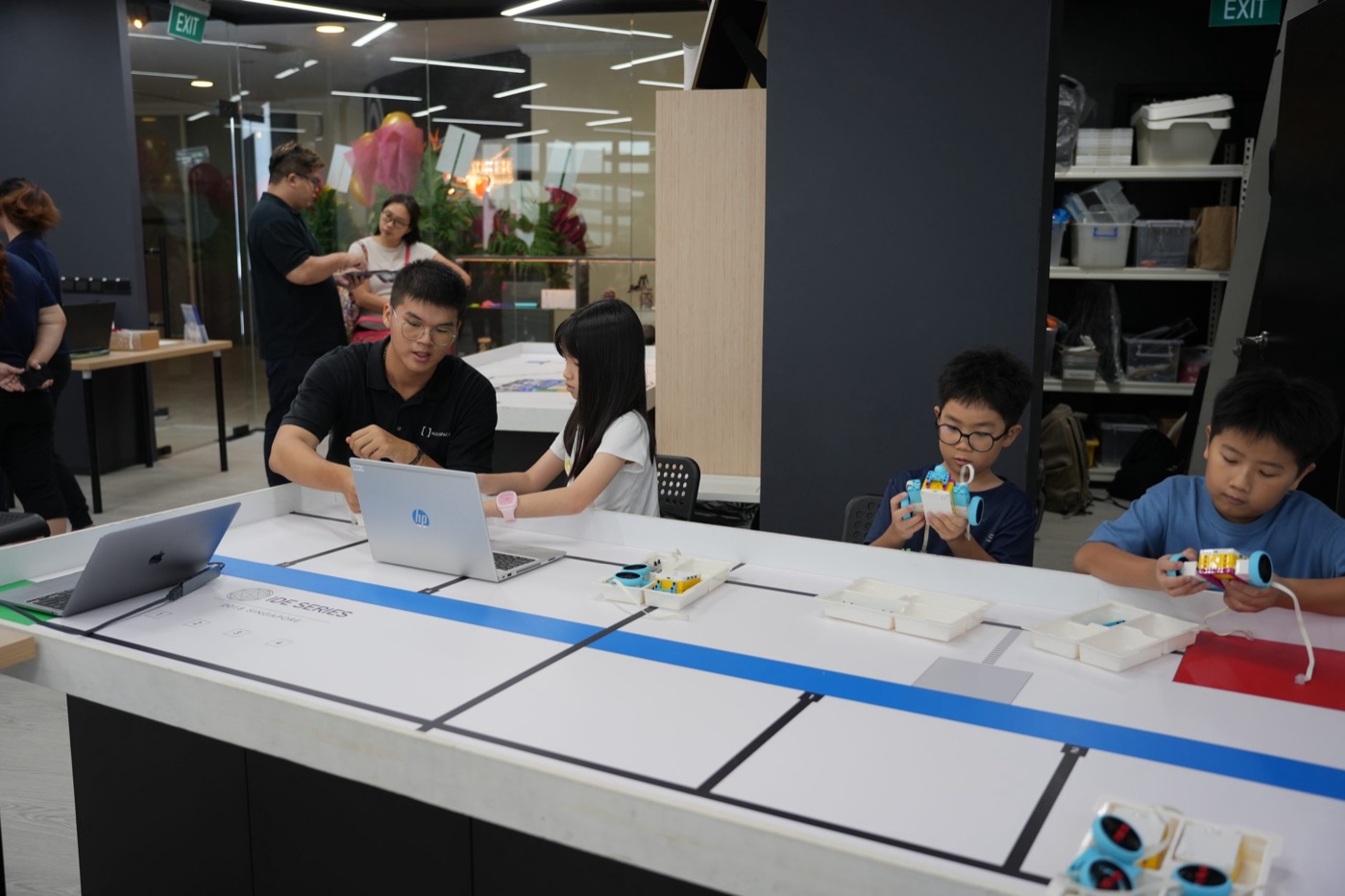
Established in 2008, and the school that puts the most on the table before you ask. Its course-package page prints the whole ladder, inclusive of 9% GST: 10 hours for $520, 20 for $1,000, 40 for $1,920 and 80 for $3,600, which is $52 an hour falling to $45 as the block grows. The same page carries the terms most schools make you discover after paying: packages are transferable but not refundable, they can be shared between two or more children on one parent account, they lapse after 3 months to 2 years depending on size, and a cancellation inside 72 hours costs you the session credit. Weekly terms map onto that ladder: STEM Little Explorer for ages 5-6 is one hour a session and one 10-hour package, $520 for a 10-week term; STEM Explorer for ages 7-8 is two hours a session and the 20-hour package, $1,000 a term. The September holiday run is now over: the 10-hour STEM Explorer and BuildUp 3D Printing camps ($550) finished on 11 September 2026 and the last Generative AI Creator Series workshop ($137.50 for 2.5 hours) ran on 10 September. The year-end schedule is now out, at Rochester Mall, Kallang Wave Mall and SAFRA Tampines. STEM Explorer (ages 7-8) and the BuildUp 3D Printing camp (ages 9-12) are $550 for five 2-hour mornings; the LEGO Robotics Engineer camp (ages 9-12) is $750 and the Minecraft Education camps (ages 9-12) $825, each 15 hours. Weeks run from 23 November to 31 December 2026, the last two being four-day weeks over Christmas. For post-PSLE children, the Generative AI Creator workshops (ages 9-14, $137.50 for 2.5 hours) run on 12 and 13 October 2026 at all three centres, with more dates in late November and December. One thing no roundup mentions: during the holidays Nullspace opens a fourth venue at Chai Chee, on top of its three year-round centres. Trials are $55 for ages 5-6 (one hour) and $110 for ages 7 and up (two hours), so a trial here is a real lesson you pay for rather than a sales session. Credentials worth checking rather than taking on trust: Nullspace was the appointed vendor for MOE Gifted Education Branch's Computer Enrichment Programme across all nine GEP primary schools from 2018 to 2025, it holds the STEM.org Accredited Educational Experience trustmark, and it organises the annual IDE Series competition, which drew over 2,200 participants in 2025. Average instructor-to-student ratio is 1:5. Three year-round centres: Rochester Mall in Buona Vista, Kallang Wave Mall and SAFRA Tampines. One caveat now that others have started publishing: Nullspace is no longer the cheapest published rate here, only the most completely documented one. Empire Code and Code Ninja both come in under it per hour. Best for: parents who want to compare a real number against a real number before committing, and children who want to build something physical rather than only write code.
Parent Referral Scheme pays $50 cash for each successful referral, and the friend you refer gets $50 off their first course sign-up. Creating a Parent Portal account also releases two $50 discount codes against a class booking. SAFRA and affiliated members get 15% off weekly or holiday à la carte classes at the SAFRA Tampines centre only, not stackable with other promotions. Year-end holiday camps run 23 November to 31 December 2026, $550 to $825 a week, and post-PSLE AI workshops ($137.50) run 12-13 October.
Coding Lab: MOE-Registered, Three Centres, and the Clearest Route From Scratch to an Olympiad Track
The academically structured option, and the one most often chosen by parents thinking several years ahead rather than one term ahead. Coding Lab is a MOE-registered enrichment centre founded by an MIT alumnus, and its curriculum runs as a genuine ladder rather than a menu: Junior Coders for preschoolers, then Scratch 1 and Scratch 2 for lower primary, App Inventor 1 and 2 and Python Junior 1 and 2 for upper primary, and Java, C++, web development and computer science electives for secondary and JC students. At the top of that ladder sits a National Olympiad in Informatics preparation track, which matters if your child is aiming at Direct School Admission or at discretionary admission consideration for NUS Computer Science later. There are also two-hour thematic workshops banded by age (5-6, 7-9, 10-12 and 13-18) if you want something shorter than a full term. Three centres: Bukit Timah at 9 King Albert Park (KAP Mall) #02-21, Marine Parade at Parkway Parade, and Tampines at Tampines Changkat Community Club. One caveat we will state plainly: Coding Lab publishes no fees anywhere on its site, so you will have to ask. The dates, at least, are now current: the camp page that was still advertising October 2025 when we checked in August has been refreshed, and its own homepage carries September Holiday Coding Camps on 4-11 September 2026 and Post-PSLE Holiday Coding Camps on 12-14 October 2026, and it now adds Year-End Holiday Coding Camps running from 2 November to 31 December 2026. No price is attached to any of them. Best for: a child who is likely to stay in coding for years, and parents who want a syllabus with a named endpoint.
Post-PSLE Holiday Coding Camps run 12-14 October 2026, and Year-End Holiday Coding Camps run 2 November to 31 December 2026, both listed on Coding Lab's own homepage. No price is published, so ask when you enquire.
Kodecoon Academy: Eight Campuses, the Newest at City Square Mall, So You Probably Do Not Have to Cross the Island
The widest physical network on this list by some distance, and the reason it belongs high up: for a weekly class over several years, a 15-minute journey beats a 50-minute one more reliably than any curriculum difference. Eight Singapore campuses, all re-verified from Kodecoon's own contact page on 10 October 2026: SingPost Centre HQ at 10 Eunos Road 8 #03-01/03, Our Tampines Hub at 1 Tampines Walk #B1-17/18, West Coast Plaza at 154 West Coast Road #01-74, Novena Regency at 275 Thomson Road #01-13, Punggol Digital District at 92 Punggol Way (Tower 92) #01-165/166, Junction 10 at 1 Woodlands Road #02-09, Lentor Modern at 1 Lentor Central #B1-03, and the newest, City Square Mall at 180 Kitchener Road #06-05. In September the contact page marked City Square as opening in October 2026; it now lists it alongside the others with no opening note, and no other roundup carries it yet. Note that several roundups still list only five, and that Kodecoon also runs campuses in Jakarta and Johor, so check you are reading the Singapore page. Programmes start at age 4 and cover block-based Scratch, mobile app development, JavaScript and Python, LEGO SPIKE Prime robotics, and week-long Roblox, Minecraft and virtual reality holiday bootcamps, plus a Direct School Admission preparation class and a Maker Technopreneurship programme. Placement is not self-selected: every student sits a logical reasoning assessment first and the school assigns the level. Competition record is current rather than historical, which is a useful signal on a page full of dated credentials: Kodecoon students took 23 medals at the Hwa Chong Info-communications Challenge in July 2026. Fees are on enquiry. Best for: heartland families, and children who need a level assigned to them rather than guessed at.
The Lab SG: Free Trial, a Rate Card It Now Publishes in Full, and Four Centres the Directories Have Wrong
The lowest-friction way to find out whether your child actually enjoys this, because the trial costs nothing and the school does not ask for a term commitment to sit it. Programmes are banded tightly by age: a Kinder programme for ages 5-6, a Junior programme for 7-9, a Coder programme for 10-14, and an advanced coding and Unity game development track for 14 and up. The subject mix is broader than most centres of this size, spanning block coding, Python and competitive programming, LEGO robotics, machine learning and AI project work, plus a Direct School Admission supplement programme and holiday programmes. It also runs school and corporate sessions, which is usually a sign the curriculum has survived contact with a syllabus rather than only with parents. On locations, be careful with what you read elsewhere: several 2026 roundups list The Lab SG at Wisteria Mall and The Centrepoint. Its own site lists four centres, and those are not among them: Kinex Mall in Tanjong Katong, Goldhill Plaza in Novena, Woods Square in Woodlands and Buangkok Square Mall. On fees, this entry has changed since we first published: The Lab SG now posts a full rate card on a Program Fees page buried under its MORE menu, which is why almost no roundup quotes it. Ages 5-6 pay $650 for ten classes, or $2,400 for forty across four terms, which is $65 falling to $60 a class. Ages 7-9 pay $700 for ten or $2,600 for forty, so $70 falling to $65. Ages 10-14 buy months rather than classes: $380 a month on a 3-month commitment, $340 on 6 months, $320 on 12, or $90 for a single entry. Registration is $80 per student on top, and the school confirms it runs sibling discounts but gives those rates only on request. The one figure it does not publish is the class length, so this is the rate card here you cannot convert into an hourly number without asking. Best for: a first trial before you spend anything, and for a child who might want to end up building games in Unity rather than sitting an olympiad.
Free trial class, no commitment required, bookable directly on the site for any of the four centres. Fees are now published in full: $650-$2,600 for 10 to 40 classes by age, plus an $80 registration fee.
Empire Code: The Cheapest Published Rate Here at $31 to $38 an Hour, a Free Trial, and October Camps Still Open
Now positioning itself as the Empire AI Education Centre while still trading as Empire Code, which is worth knowing because directories file it under one name or the other and a few still link an old logo. The age span is the widest here, from 4 to 19, split into preschool (4-6), lower primary (7-9), upper primary (10-12) and teens (13-16) with a further track above that. The positioning has moved with the name: the school now describes itself as teaching the technology behind AI rather than coding in the abstract, alongside its coding and robotics classes, holiday camps and a Direct School Admission programme. The practical reason it earns a place on this list right now is timing. It is the only school here with camp weeks running right through October: four-day camp weeks started on 28 September and 5 October, and three are still ahead, starting 12, 19 and 26 October 2026, pitched at the international-school calendars (Australian International School, Overseas Family School, UWCSEA, Tanglin Trust, Dulwich, Stamford American, SAS, CIS) rather than the MOE one. Ten courses run across those weeks at both campuses, ages 4 to 16, and an optional Friday "Pitch, Present & Market" workshop adds $70. Separately, a Post-PSLE camp runs 12 to 14 October 2026 for ages 7 to 12: three full days, 9.30am to 4pm, lunch included, eight subjects at either campus. It is $570 on your own device or $660 with one rented; the $100 early-bird discount closed on 4 October. After that, its year-end camps run five days each (12.5 hours, morning or afternoon) in weeks starting 23 November, 30 November, 7 December and 14 December 2026, plus 4 January 2027 for international schools: ten camps for ages 4 to 16 at $430 on your own device or $500 with one provided, 10% off for booking a morning and an afternoon camp in the same week (lunch included), and 10% off for siblings or referrals. The free trial is bookable directly and the school now states it plainly: one hour, ages 4 to 19, worth $45, with an MOE-approved teacher assessing the child and recommending a level before you leave. That is wider than the 4 to 16 its trial page used to state. The price is the reason it sits where it does, but the card is more conditional than a single figure suggests, and the enrolment form is where the whole of it is visible. A 10-hour camp is $350 on your own device or $410 with one rented. Weekly lessons are credits, one credit being one hour: $45 singly, then, on your own device, $350, $640 and $930 for 10, 20 and 30 credits if your child is already enrolled, which is $35, $32 and $31 an hour. A new student pays $380, $670 and $960 for the same blocks because the $30 registration fee is built in, so the real entry price is $38 an hour and the floor of $31 is only reachable once you are inside. Renting a device adds $60, $110 or $170 to those blocks. And one band is carved out entirely: JavaScript, Python with Data Analytics, C++, Unity with C# and Unreal Engine with C++ sit on a separate list sold only in 20-credit blocks, $800 for an existing student on their own device, or $830 for a new one, which is $40 an hour rather than $32. Credits can be shared between children in the same immediate family, and a forgotten laptop costs $10 that day. Two campuses: the Novena headquarters and River Valley on Mohamed Sultan Road. Best for: preschoolers at one end and JC-age teenagers at the other, families watching the per-hour price, and anyone who has left holiday-camp booking late.
Free 1-hour trial class worth $45, ages 4-19. October camp weeks still open, starting 12, 19 and 26 Oct: $350 for a 10-hour camp, $410 with a rented device, optional Friday workshop +$70. Post-PSLE 3-day camp 12-14 Oct: $570 own device, $660 with a rented one. Year-end 5-day camps from 23 Nov 2026 to 8 Jan 2027: $430, or $500 with a device. 10% sibling and referral discounts.
Code Ninja Singapore: Six Students to a Class, Passes From $278 Instead of a Fixed Term, and No Registration Fee
The one to look at if your objection to enrichment is the class size or the rigidity, rather than the price. Classes are capped at six students to one teacher, which is meaningfully smaller than a typical enrichment room, and there are no tests: progress is tracked through a Code Ninja Passport system with weekly written updates to parents, and the learning path is set to the individual child's ability rather than to a cohort. Languages are Scratch and Python, and the age range runs from Primary 3 to pre-university, with younger children considered case by case. The billing model is the genuinely different part, and the prices are real: 4 classes for $278 to be used within 6 weeks, 5 for $341 within 8 weeks, 10 for $656 within 4 months, or 20 for $1,189 within 6 months. Classes run 1 hour 30 minutes, so that band is $46.33 an hour at the smallest pass and $39.63 at the largest, which undercuts every other published rate here except Empire Code's camps. There is no registration fee, which two of the four schools that publish do charge. A family that travels or has an exam season can compress or spread lessons without forfeiting them, though read the expiry windows carefully, because a pass is only good value if you use it inside its window. A trial class is $65, and its terms are better than most: the fee is credited toward your first package if you carry on, and refunded in full if you say within 48 hours of the trial that it is not the right fit. Separately, a $278 holiday workshop, Build Your Own Awesome Computer, teaches ages 9 to 16 to assemble a desktop from its components. One thing worth knowing if you have hunted for these numbers before: they are not on codeninja.com.sg itself. They live in the Punchpass booking system its pricing page embeds, which is why almost no roundup quotes them. One centre, at 22 Havelock Road #01-689. Lessons are available on-premise or online. Best for: a child who disappears in a big class, and families whose weekends are not the same shape every month.
Trial class $65, credited toward your first package, or refunded in full if you say within 48 hours that it is not a fit. Lessons are then bought as flexible passes rather than a fixed term: 4 for $278, 5 for $341, 10 for $656 or 20 for $1,189, with no registration fee.
Lyza Education: A 20-Hour Foundation Pathway, an In-House Portfolio Platform, and a Second Centre in Tampines Nobody Lists
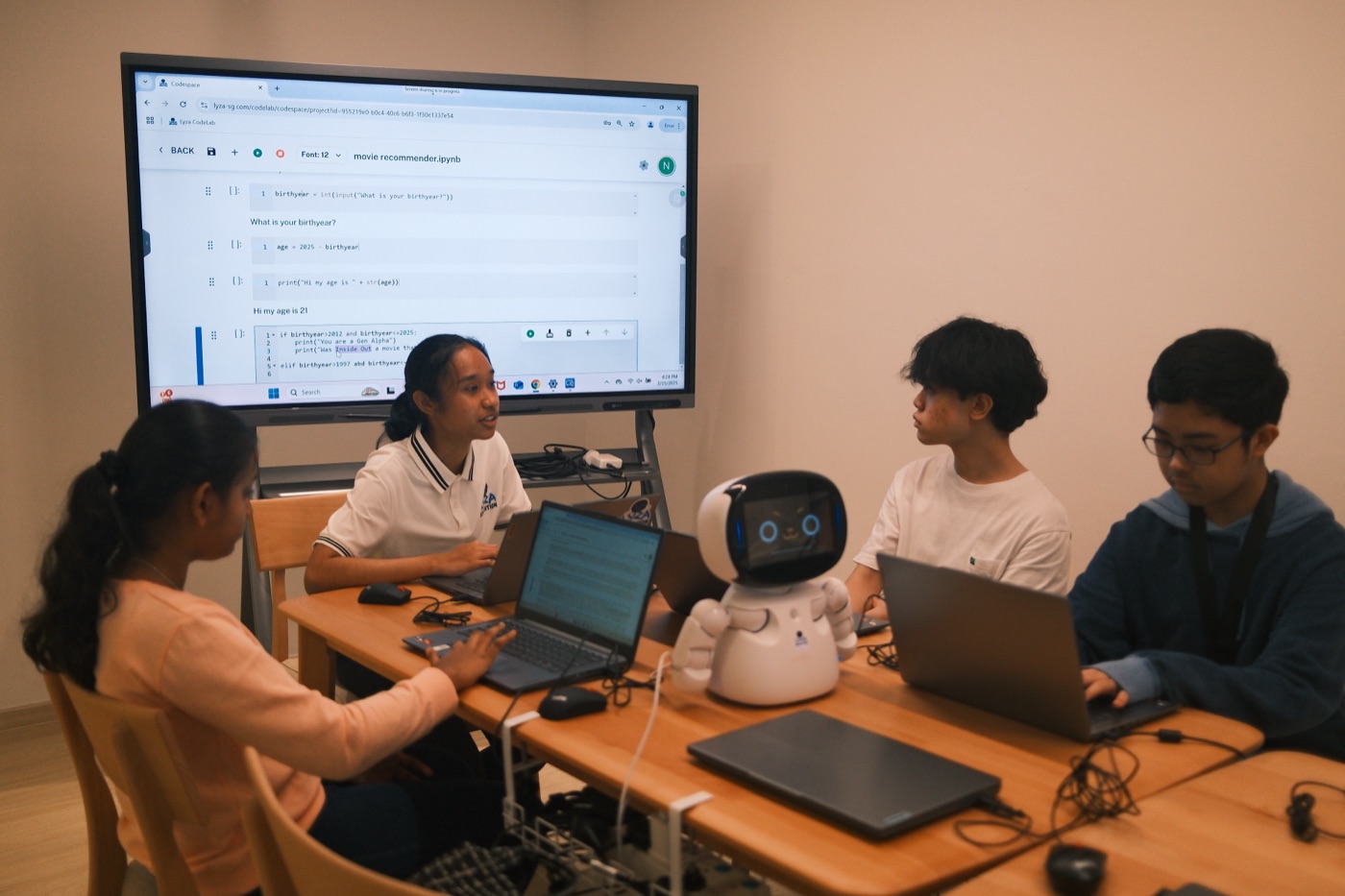
Founded by a senior technology leader who previously worked at Meta, Amazon and in investment banking, and built around a specific idea: that the output of a coding course should be a portfolio, not a certificate. Every student works on Lyza CodeLab, the school's own student platform, which tracks achievements and accumulates the child's projects into a personal portfolio intended to be usable later for Direct School Admission applications and internships. The structure is a 20-hour foundation pathway, then progression through four age bands: Discoverers for ages 5-6, Young Coders for 7-9, Coders and Architects for 10-12, and Explorers and Challengers for 13-17, moving from block-based coding and game creation into Python, data structures, algorithms and object-oriented programming. AI runs through the curriculum rather than sitting beside it as a separate module. A one-hour trial class is bookable online. On location, note that the roundups list Orchard only. Lyza's own contact page lists two centres: Far East Shopping Centre at 545 Orchard Road #16-07A, and Tampines. The Orchard centre opens Monday, Tuesday, Wednesday and Friday 9am to 6pm and weekends 9am to 6pm, and is closed on Thursdays and public holidays, which is an unusual pattern worth checking against your own week. Fees are on enquiry. Best for: an older child working towards DSA who needs evidence, not just attendance.
One-hour trial class, bookable online at either centre.
LCCL Coding Academy: The Clearest Sibling Discount on This List, 10% Off the Second Child and 15% Off the Third
The most useful pick for a family enrolling more than one child, because it is the only school here that publishes the sibling discount as a number rather than inviting you to ask. Second sibling is 10% off and third and subsequent siblings are 15% off, stated on LCCL's own site. Four programmes cover ages 5 to 18 as a continuous progression: Early Creators for 5-7, Kid Coders for 8-11, Teen Coders for 12-15 and Young Adults for 16-18, focused on computational thinking rather than on a single language, with holiday programmes including Game Programming bootcamps and Minecraft coding. On the address, most 2026 roundups place LCCL at Tanglin Shopping Centre. Its own site gives Forum Office Tower, 583 Orchard Road #13-01, Singapore 238884, so check before you make the trip. Opening hours are also worth noting, because they are built around after-school and weekend traffic rather than office hours: weekdays 1pm to 6pm, Saturdays 9am to 7pm, Sundays 9am to 5pm, closed on public holidays. Contact is +65 6817 2957. Fees themselves are on enquiry, and no trial price is published. Best for: two or three siblings enrolling together, where a 10% and 15% discount compounds across years rather than across one term.
Sibling discount published as a rate, not on request: 10% off the second child, 15% off the third and beyond.
Campuses, ages, what a trial costs and what the school will actually tell you about fees. Every row was re-read off the school's own website or its own booking system between 24 September and 10 October 2026, not from a directory listing. "On enquiry" means the school publishes no rate card at all, so treat any figure you see quoted for it elsewhere as unverified.
School
Singapore campuses
Ages
Trial class
Published fees
Nullspace Robotics
3, plus Chai Chee in the holidays (Rochester Mall, Kallang Wave Mall, SAFRA Tampines)
Full rate card: ages 5-6 $650/10 classes, $2,400/40; ages 7-9 $700/10, $2,600/40; ages 10-14 $320-$380 a month; $80 registration
Empire Code (Empire AI Education Centre)
2 (Novena HQ, River Valley)
4-19
Free 1-hour trial, ages 4-19
Full rate card: 1 credit $45; own device, existing student 10/20/30 credits $350/$640/$930, new student (incl $30 registration) $380/$670/$960; advanced-language modules 20 credits $800; Oct camps $350 per 10hr; Nov-Dec camps $430 per 12.5hr
Code Ninja Singapore
1 (22 Havelock Road)
P3 to pre-university
$65, credited to first pass
Full rate card: 1.5hr classes, 4 for $278, 5 for $341, 10 for $656, 20 for $1,189; $39.63-$46.33/hr; no registration fee
Lyza Education
2 (Far East Shopping Centre Orchard, Tampines)
5-17
1-hour trial, bookable online
On enquiry; 20-hour foundation pathway
LCCL Coding Academy
1 (Forum Office Tower, 583 Orchard Road)
5-18
Not published
On enquiry; 10% off 2nd sibling, 15% off 3rd+
Three schools every other roundup still ranks, and what we found instead
This is the part that matters most, because enrolling from a stale list wastes a term. All three were checked on 28 August 2026.
First Code Academy. Its Singapore entity, First Code Academy Pte. Ltd. (201507338E, incorporated 19 March 2015), shows as struck off in the business registry, and firstcodeacademy.com now bounces to a domain-parking lander. Two independent signals pointing the same way.
Saturday Kids. saturdaykids.com redirects to the same kind of parking lander, and the facebook.com/saturdaykids vanity handle has been released and is now held by an unrelated personal account. We could not reach the school through any channel it previously published. We are not asserting a formal closure, only that nothing it used to answer on still answers.
SG Code Campus. Still very much alive, but no longer in this category. Its own homepage now reads as an "applied-AI engineering and enablement company helping enterprise, government and academia design and deploy AI solutions at scale." Almost every 2026 listicle still ranks it as a top MOE-registered school for children, quoting fees of "S$320-420 per month".
What each school actually charges, per hour
This is the comparison no directory will give you, because it only exists where a school prints its own numbers. Four of the eight now do, up from one. Every figure below was read off the school's own fee page, enrolment form or booking system on 24 September 2026.
Empire Code: $31 to $38 an hour, the cheapest published rate here, but read the conditions. A 10-hour October camp is $350 on your own device, or $410 with one rented. Weekly lessons are credits, one credit being one hour: $45 singly, or $350, $640 and $930 for 10, 20 and 30 on your own device once your child is enrolled, which is $35, $32 and $31 an hour. A new student pays $380, $670 and $960 for the same blocks with the $30 registration fee built in, so the entry rate is really $38 an hour. Device rental adds $60 to $170 per block. JavaScript, Python with Data Analytics, C++, Unity and Unreal sit on a separate list, 20 credits only, $800 enrolled or $830 new, which is $40 an hour. Credits are shareable between siblings, and a forgotten laptop costs $10 that day.
Code Ninja: $39.63 to $46.33 an hour. Classes are 1 hour 30 minutes. Four are $278 to use within 6 weeks, five are $341 over 8 weeks, ten are $656 over 4 months, twenty are $1,189 over 6 months. No registration fee.
Nullspace Robotics: $45 to $52 an hour. Packages are 10 hours for $520, 20 for $1,000, 40 for $1,920 and 80 for $3,600, all inclusive of 9% GST. Holiday programmes are priced separately, from $110 for a 2-hour lesson to $825 for a 15-hour one.
The Lab SG: $60 to $70 a class, plus $80 to register. Ages 5-6 pay $650 for ten classes or $2,400 for forty. Ages 7-9 pay $700 or $2,600. Ages 10-14 buy months instead, $320 to $380 depending on the commitment, or $90 for a single entry. The class length is not published, so this is the one card here you cannot convert to an hourly figure without asking.
Coding Lab, Kodecoon, Lyza and LCCL still publish nothing at all. Any specific figure you see attached to those four elsewhere is someone's recollection of a quote, often years old and re-copied since. We would rather print "on enquiry" than a number we cannot stand behind.
How we checked
Every school here was opened directly: homepage, contact page, course pages and, where one exists, the fee page. Nothing was copied from a directory, and where a directory disagreed with a school's own site we went with the school. That is how the address and campus-count corrections above surfaced. It is also why two of these rate cards are new to this guide rather than to the schools: The Lab SG keeps its fees on a page filed under a MORE menu, and Code Ninja's are not on its website at all but inside the Punchpass booking system its pricing page embeds. Neither is hidden, exactly. Both are far enough off the main path that the roundups quoting "S$400-500 per term" never found them.
How to choose without visiting eight centres
Compare the hourly rate first, then the trial. Four schools now publish enough to compare directly, and the order surprises most parents: Empire Code is cheapest, Nullspace the dearest of the four. Compare the rate a new family actually pays, not the bulk rate: at Empire Code that is $38 an hour rather than $31. Where nothing is published, the trial is still the only comparable figure: free at The Lab SG and Empire Code, $65 at Code Ninja (credited toward a pass), $55 or $110 at Nullspace by age. A paid trial is not worse value: at Nullspace it buys a full-length real lesson rather than a taster.
Ask for the fee in writing, per hour. Terms are quoted in weeks, blocks in hours, credits in classes and camps in days, which makes them impossible to compare as given. The published band runs from $31 an hour at Empire Code, or $38 if you are new there, to $52 at Nullspace. Use that as your yardstick when one of the four silent schools quotes you a term price.
Check the campus list on the school's own site, not on a listicle. Four of the eight schools here have campus lists that differ from what the directories print.
Ask what happens to a missed lesson before you pay for a term. Pass-based billing, like Code Ninja's, handles this by design; term-based billing usually does not. Nullspace at least publishes its rule: cancel inside 72 hours and the session credit is deducted, and packages lapse after 3 months to 2 years depending on size.
If you have two or more children, ask about siblings up front. Only LCCL publishes the rate (10% and 15%). The Lab SG confirms it runs sibling arrangements but gives the rates only on request, and Nullspace lets one parent account share a single hour package between two or more children, which reaches the same place by a different route.
Match the endpoint to the child. Olympiad and DSA ladders (Coding Lab, Lyza) suit a child who will stay years. Robotics and physical build (Nullspace, The Lab SG) suit a child who wants something to hold.
How much do coding classes for kids cost in Singapore in 2026, and which schools publish a price?+
Half of them still will not tell you before you enquire, but half now will, and the published band runs from $31 to $70 an hour. Of the eight schools we re-checked on 24 September 2026, four publish a rate card. Empire Code is the cheapest at $31 to $38 an hour, and the spread matters: a 10-hour holiday camp is $350 on your own device or $410 with one rented, and weekly credits are $45 singly, or $350, $640 and $930 for 10, 20 and 30 on your own device once your child is enrolled. A new student pays $380, $670 and $960 for those same blocks because the $30 registration fee is folded in, so the entry rate is $38 an hour and $31 is the bulk rate you reach later. The advanced-language modules (JavaScript, Python with Data Analytics, C++, Unity, Unreal) are a separate 20-credit list at $800 enrolled or $830 new, which is $40 an hour. Code Ninja works out at $39.63 to $46.33 an hour, its classes being 1 hour 30 minutes and sold as passes: $278 for four, $341 for five, $656 for ten and $1,189 for twenty, with no registration fee. Nullspace Robotics runs $45 to $52 an hour, its packages priced at $520 for 10 hours, $1,000 for 20, $1,920 for 40 and $3,600 for 80, all inclusive of 9% GST; its year-end camps run 23 November to 31 December 2026 at $550 to $825 a week. The Lab SG posts $650 for ten classes and $2,400 for forty at ages 5-6, $700 and $2,600 at ages 7-9, and $320 to $380 a month at ages 10-14, plus an $80 registration fee, but does not publish the class length, so it is the one card you cannot convert to an hourly rate yourself. Coding Lab, Kodecoon, Lyza and LCCL quote on enquiry only, which means the specific figures attached to those four in other 2026 roundups, such as "S$400-500 per term" or "S$320-420 per month", are not published prices at all; they are recollections of past quotes, re-copied between listicles for years. Ask them for the fee expressed per hour, and hold it against the $31 to $52 the transparent four actually charge.
Is Saturday Kids or First Code Academy still open in Singapore?+
Neither can be reached through the channels they previously published, and we would not enrol with either on the strength of a 2026 listicle. First Code Academy is the clearer case: the Singapore entity, First Code Academy Pte. Ltd. (UEN 201507338E, incorporated 19 March 2015), shows as struck off in the business registry, and firstcodeacademy.com now redirects to a domain-parking lander rather than a website. For Saturday Kids, saturdaykids.com redirects to the same kind of lander, and the facebook.com/saturdaykids vanity URL has been released and is now held by an unrelated personal account, which is what happens when a page is deleted and the handle is freed. We are stating what we found rather than announcing a closure: no official statement was issued by either school, and we could reach neither. What we can say plainly is that both are still ranked in current guides, including guides updated for 2026, and that a parent following those guides would be contacting a dead domain. If you are looking at a roundup that recommends either school, that roundup has not been checked this year.
Which coding schools in Singapore offer a free trial class?+
The Lab SG and Empire Code both offer a free trial class that can be booked directly on their websites, and The Lab SG states explicitly that no commitment is required to sit it. Lyza Education offers a one-hour trial class bookable online without publishing a price for it, so ask when you book. Kodecoon does not run a conventional trial: every prospective student first sits a logical reasoning assessment and the school then assigns a level, so what you book is a recommendation session rather than a sample lesson. Two schools charge for the trial, and it is worth understanding why before you rule them out. Code Ninja charges $65, but credits it toward your first package and refunds it in full if you tell them within 48 hours that the class is not a fit. Nullspace charges $55 for ages 5-6 and $110 for ages 7 and up, but the $110 buys a full two-hour lesson at the school's normal length, so you are paying for a real class rather than a shortened taster. Coding Lab and LCCL publish no trial arrangement at all, so you would need to enquire. If your goal is simply to find out whether your child enjoys this before spending anything, start with The Lab SG or Empire Code.
Do coding classes actually help with DSA in Singapore?+
They can, but only if what the child ends up with is evidence rather than attendance, and the schools on this list differ sharply on that point. Direct School Admission panels respond to demonstrable work and competition results, not to a certificate of completion. Four schools here are structured around that. Coding Lab runs a National Olympiad in Informatics preparation track at the top of its ladder and publishes student results and awards. Nullspace organises the annual IDE Series competition, which drew over 2,200 participants in 2025, and its students compete in FIRST LEGO League. Kodecoon runs an explicit DSA preparation class and its students took 23 medals at the Hwa Chong Info-communications Challenge in July 2026, which is a current result rather than a historical one. Lyza builds every student a portfolio on its own CodeLab platform, specifically intended for DSA applications and internships later. The Lab SG and Empire Code both run DSA-oriented programmes as well. If DSA is the actual goal, ask the school what a student leaves with after two years, and treat "a certificate" as the wrong answer.
What age should a child start coding classes in Singapore?+
The schools themselves start between ages 4 and 7, and the split tells you something useful about what is actually being taught. Kodecoon and Empire Code both take children from age 4, and Nullspace, Coding Lab, The Lab SG, Lyza and LCCL all start at 5. At that age nothing resembling text code is involved: Nullspace's STEM Little Explorer for ages 5-6 is LEGO Technic and engineering in one-hour sessions, and the equivalent classes elsewhere are block-based sequencing and physical building. Real block coding with Scratch usually begins around ages 7 to 8, text-based languages such as Python around 10 to 12, and Java, C++, data structures and algorithms from about 13. Code Ninja is the outlier and deliberately so, starting at Primary 3 and taking younger children only case by case. Two practical notes. First, a five-year-old in a two-hour class is usually a mistake; check the session length, not only the age band. Second, starting later costs less than parents fear, because a 10-year-old moves through the block-coding stage in a fraction of the time a six-year-old takes.
#coding classes for kids singapore#best coding school singapore#robotics classes for kids singapore#coding lab singapore#nullspace robotics#kodecoon academy#coding class singapore price#kids coding trial class singapore#september holiday camp coding singapore#dsa coding portfolio singapore#scratch class singapore#python class for kids singapore#lego robotics singapore kids#ai classes for kids singapore#the lab sg coding