Almost every music school in Singapore hides its fees behind an enquiry form, which makes comparing them close to impossible. We did the digging, and the usual quoted floor of $225 a month turns out to be wrong: Ossia publishes a full 2026 rate card starting at $129 a month for keyboard and $175 for beginner piano, violin, guitar or drums, GST and facility fees included. Against that, Aureus is $279, Studio 72 $280 and Mandeville $225 to $706, while Cristofori publishes no rate card at all and only its own campaign artwork gives the game away, at a usual price of $229 for four 30-minute lessons. This guide has the published fees for 8 established schools, what violin and guitar actually cost grade by grade, the registration fees and deposits nobody mentions until you are at the front desk, every branch as at September 2026, and the make-up-lesson policies that matter more than the fee gap: Yamaha replaces no missed lesson at all, while Ossia gives you one a month. The August promotions at Ossia and Cristofori have both ended and neither has been replaced, so this is a month to buy on rate card rather than on offer. Six of the eight still run a genuinely free trial lesson.
What music school fees actually cost in Singapore
The honest range for a weekly one-to-one lesson is wider than any roundup admits, because two schools price by lesson length and one prices by grade.
Priced by lesson length (the same fee whether you are a beginner or Grade 8): Aureus Academy is $279 / $399 / $519 a month for four 30 / 45 / 60-minute lessons, with all lesson materials and books bundled in. Studio 72 is $280 / $330 / $380 for the same three lengths, dropping to an effective $230 / $280 / $330 a month on a 12-lesson package ($690 / $840 / $990). Mandeville Conservatory prices by teacher category as well as length, from $225 (Category 1, 30 min) to $706 (Category 3, 60 min post-Grade 8).
Priced by grade: Ossia Music School is the outlier, and the reason the floor of this market is far lower than the usual "$225 and up". Its published 2026 rates start at $129 a month for keyboard (Initial, 30 min), $135 for ukulele, $153 for the 3-4 year-old Music Introductory class, $175 for beginner piano, violin, guitar or drums, and $179 for basic vocal, all inclusive of GST and facility fees, which is not how anyone else on this page quotes. The trade is at the top, and it is not quite the trade most write-ups describe: the fee rises because the LESSON GETS LONGER as well as harder. Beginner piano at $175 is 30 minutes, Grades 1 to 5 are 45 minutes ($228 to $260) and Grade 6 upward is a full hour, reaching $406 at Grade 8, $450 at Grade 8 acoustic guitar, $530 at Grade 8 drums and $532 at LRSM. Per hour that is still cheaper than Aureus, whose 60-minute rate is a flat $519 whatever the level. So Ossia is the cheapest school here for a beginner and, once you compare like for like, not the dearest for an advanced student either.
Group is where the real floor is. Ossia's classical guitar group runs from $100 a month and its acoustic guitar and ukulele groups from $118. Studio 72's group classes are $270 per person for a pair and $210 each for a three-person class (4 × 60 min over 4 weeks). Mandeville's group term fee is $196 a month billed as $588 for three months.
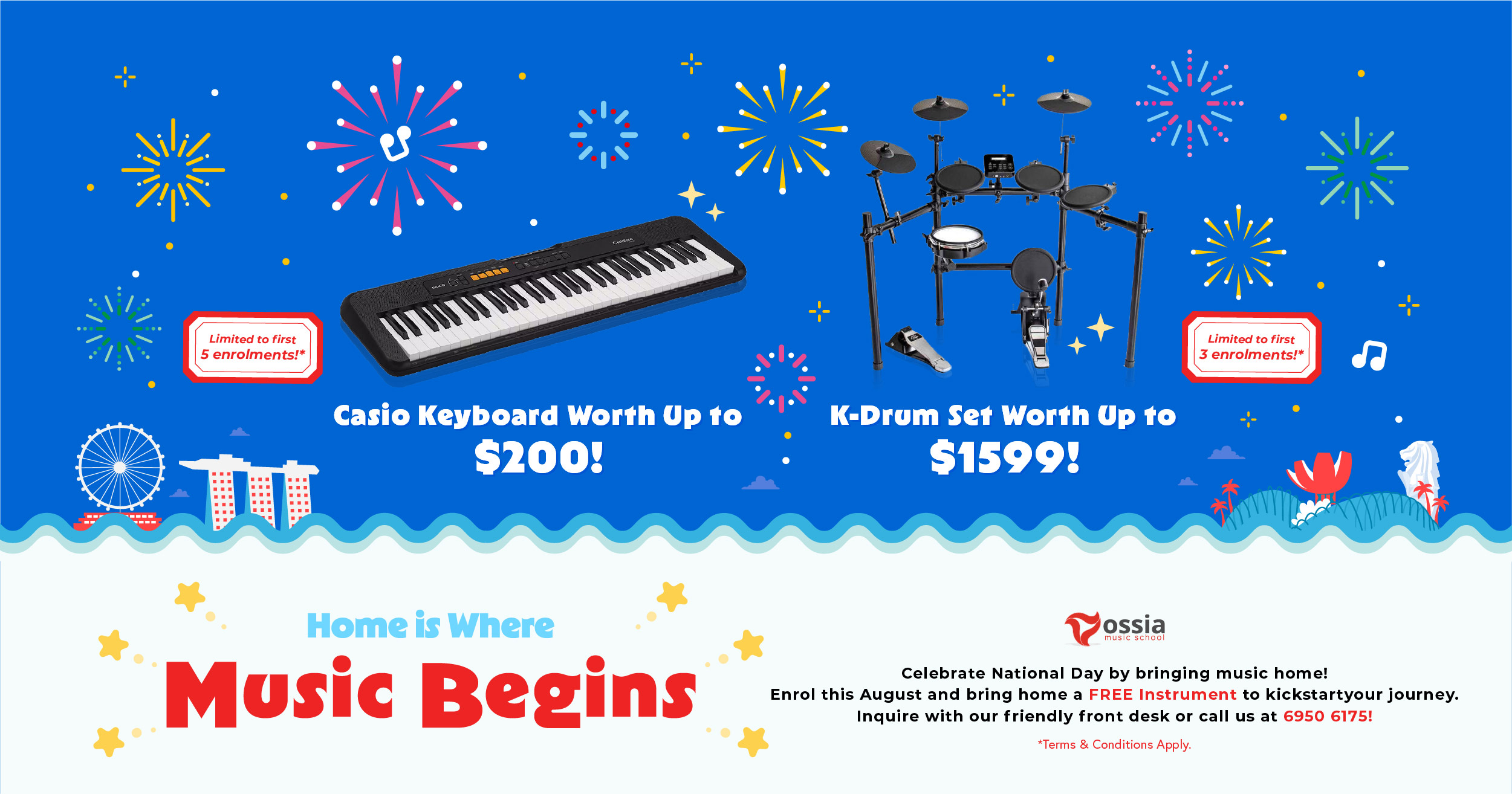
Package pricing is a fourth model, and this month it has reverted. Cristofori does not publish a monthly rate. Its August 2026 festival material priced the entry packages to the dollar, at $199 for the Piano Explorer (4 individual 30-minute piano lessons within a month, plus free practice-studio rental and an eBook) and $349 for the Cocktail Music Package (8 one-to-one 30-minute lessons within 3 months, mix and match up to two of piano, drums, guitar and violin). Both offers ended with the campaign on 31 August and nothing has replaced them, so what stands are the usual prices the same artwork printed beside them: $229 for four 30-minute lessons and $399 for the eight-lesson package. That $229 is Cristofori's real monthly individual rate; it still undercuts both Aureus and Studio 72, and it is quoted for children, so an adult should ask for the adult figure.
THE COSTS THAT ARE NOT IN THE MONTHLY FEE. Registration or enrolment fees: Mandeville $80, Studio 72 $45, Ossia $39, Yamaha charges one but does not publish the amount. Deposits: Mandeville and Ossia both take a full month's fees, Studio 72 takes $70 refundable, and Yamaha takes $150 only if you decline its GIRO payment scheme. Books and materials are extra almost everywhere; Aureus is the exception. Exam entry fees go straight to ABRSM or Trinity, never to the school. A realistic first-month outlay at a school taking a deposit is roughly two months' fees plus registration.
Best violin schools in Singapore, and what violin lessons actually cost
Not every school on this page teaches every instrument, and violin is where the list splits most sharply.
The violin specialists. Finger Waltz teaches piano and violin and nothing else, across two East-side branches (Katong Shopping Centre and PLQ Mall), which is the strongest answer if you live east and want a school that is not spreading itself across eight instruments. Mandeville Conservatory was founded by former Singapore Symphony Orchestra musicians and is the deepest string school here, running violin, viola, cello and double bass, an Ensemble Programme and a Violin Stars group track. Harmony & Pitch teaches violin and viola with an explicit ABRSM, Trinity and diploma route.
The convenient ones. Aureus Academy teaches violin at all 30 of its mall centres and Cristofori across its 36 branches, so for most families the nearest violin teacher will be one of those two.
Who does not teach it. Studio 72 has no violin at all: it is guitar, drums, vocals, keyboard, bass and ukulele only. Worth knowing before you walk down to Boat Quay.
What violin costs, cheapest first. Ossia is the only school publishing a violin rate card: beginner is $175 a month for four 30-minute lessons, Grades 1 to 5 run $228 to $260 at 45 minutes, and Grade 6 to 8 run $343 to $406 at a full hour, GST and facility fees already included. Mandeville's group violin is $196 a month, billed as $588 a term, and its individual violin is $225 to $706 depending on teacher category and length. Aureus is $279, $399 or $519. Cristofori and Harmony & Pitch quote on request, and Finger Waltz does the same, though its free trial plus 10% off the first term (only if you sign up on the spot) is the cheapest way to test a teacher. Mandeville's Parkway Parade branch also runs an 8-lesson introductory course in piano or violin for ages 5 and up with no enrolment fee and no deposit, which is the lowest-commitment start for violin anywhere in this guide.
Guitar lessons in Singapore: the rates, and where group beats one-to-one
Guitar is the instrument where the gap between an individual lesson and a group class is widest, and where the cheapest real tuition on this page sits.
Group is dramatically cheaper. Ossia's classical guitar group starts at $100 a month and its acoustic guitar and ukulele groups at $118, both inclusive of GST and facility fees. Nothing else in this guide comes close: that is under a third of what the same school charges for one-to-one, and roughly a third of Aureus. Studio 72 runs group guitar at $270 per person for a pair and $210 each for a three, over four 60-minute sessions. Mandeville's guitar group is $196 a month, billed as $588 a term, and it also runs an 8-lesson introductory guitar or ukulele course for ages 6 and up with no enrolment fee and no deposit.
One-to-one guitar rates. Ossia is $175 a month at beginner level for either acoustic or classical guitar at 30 minutes, climbing to $415 for Grade 8 classical and $450 for Grade 8 acoustic at 60 minutes. Aureus is $279, $399 or $519 for 30, 45 or 60 minutes. Studio 72 is $280, $330 or $380, dropping to an effective $230 a month on a 12-lesson package, and it teaches bass as well. Mandeville is $225 to $706 by teacher category. Cristofori teaches acoustic, classical and electric or bass guitar across 36 branches but publishes no rate; its usual price of $229 for four individual 30-minute lessons is the best public indication.
Who to call for what. For a child starting cheaply, Ossia's classical guitar group at $100 is the clear answer. For an adult who wants to play in a band rather than sit Grade 3, Studio 72. For exams and diplomas, Harmony & Pitch. For an electric or bass guitar and lessons from the same shop, Cristofori.
The make-up lesson policy matters more than $20 a month
This is the single biggest practical difference between the schools on this page, and none of them lead with it.
Yamaha is the strictest by a distance. Its own FAQ states that lessons are not conducted during Yamaha Term Holidays or on gazetted public holidays, and that there is strictly no replacement of lessons: missed lessons are not replaced, not transferable and not refundable. If your child's slot falls on a public holiday, that lesson is simply gone. Yamaha also runs individual lessons on weekdays only, with the exception of the Yamaha Pianoforte Course, and bills either monthly or per three-month term, with GIRO deducted between the 4th and 6th of the month; a failed GIRO deduction costs $5 plus GST, and so does a late non-GIRO payment.
Ossia is the most forgiving. A lesson falling on a public holiday becomes a make-up credit on your account, students get one make-up lesson a month with 24 hours' notice by WhatsApp or email, and a same-day cancellation still earns a replacement if you produce an MC. Unused fifth-week slots auto-schedule outstanding make-up credits.
If your family travels, has an unpredictable work roster or catches every bug going round the childcare centre, that difference is worth more over a year than any of the fee gaps above.
How to choose, in the order that actually matters
1. Distance beats reputation. The single strongest predictor of whether a child is still learning in two years is whether getting to the lesson is easy. Aureus (30 mall centres) and Cristofori (36 branches) win on this by default; Ossia covers the North and West; Finger Waltz covers the East.
2. One-to-one or group? Aureus, Ossia and Mandeville's individual track are one-to-one. Yamaha's children's curriculum is deliberately group-based, and for a pre-schooler that is often the better format, not a compromise. Studio 72 and Mandeville offer both, and group is materially cheaper.
3. Take the trial before the sales conversation. Six of these eight run a free trial. A teacher who is patient with your specific child matters far more than the school's brand, and you cannot assess that from a website.
4. Ask for the all-in first-month total, in writing. The monthly fee is rarely what you pay first. See the fee section above for every registration charge and deposit we could verify at source.
5. Decide the exam question early. ABRSM and Trinity grades give structure and a certificate, but a syllabus year narrows what a child plays for months at a time. If your child is not exam-minded, Studio 72's pop-and-band model or a Rock & Pop syllabus is a happier route than classical grades.
One ownership note
Aureus Academy and Ossia Music School are not independent rivals. Ossia's own website lists it under the Aureus Group, which it describes as five companies with around 22 locations, 500 staff and more than 18,000 students in Singapore, founded in 2013 by brothers Lawrence and Julius Holmefjord-Sarabi. They are run as separate brands with different pricing models and different branch networks, so comparing them is still worth doing, but if you are shortlisting them as two independent second opinions, they are not.
Related reads
*All fees, branch lists and promotions were re-verified against each school's own website, fee tables, PDF rate cards and campaign artwork on 16 September 2026. Fees change and promotions have caps and terms, so confirm directly with the school before you enrol.*