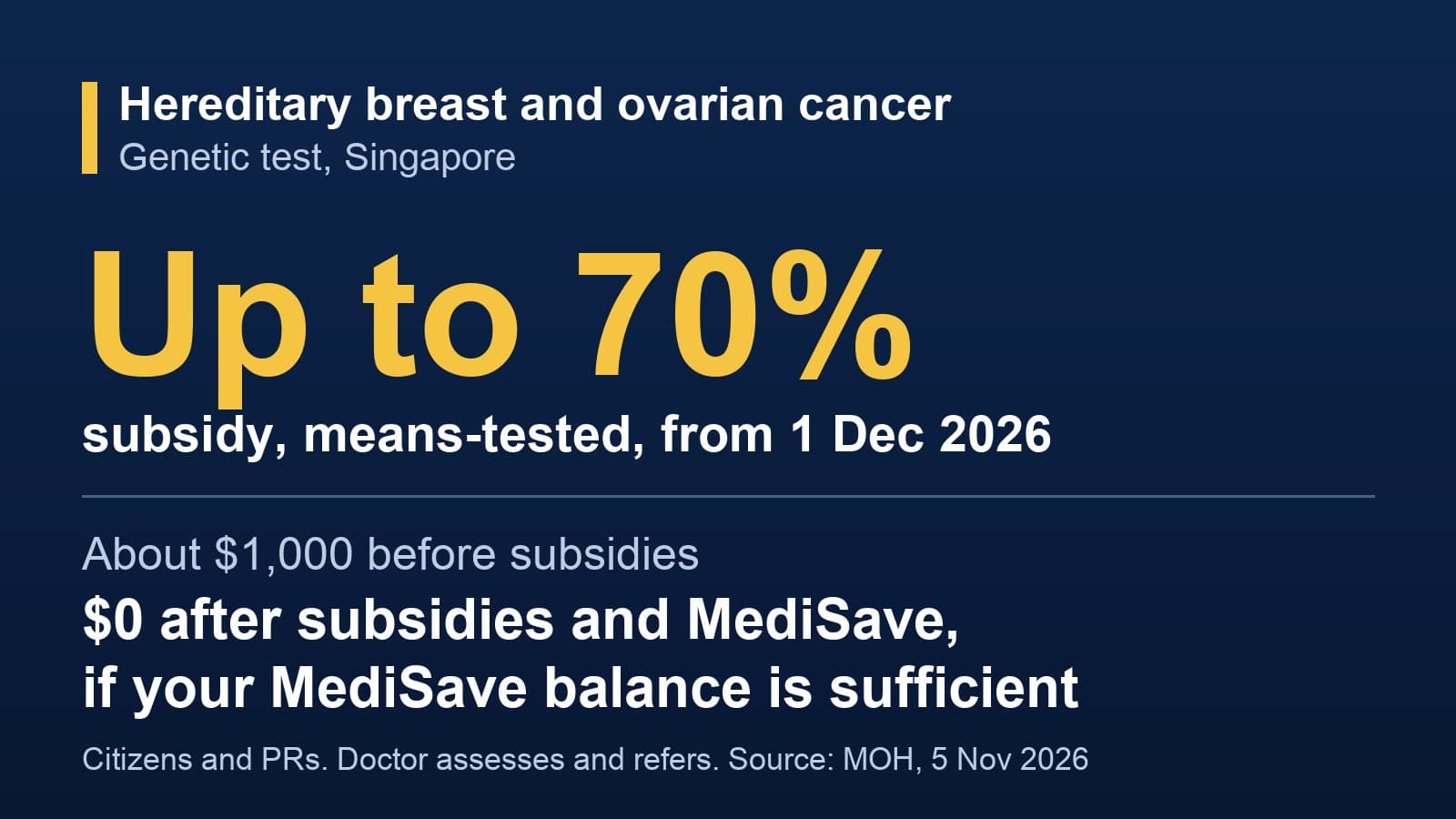
> Quick view: From 1 December 2026, genetic testing for hereditary breast and ovarian cancer (HBOC) gets means-tested subsidies of up to 70% for eligible Citizens and PRs at three public cancer clinics. MOH's indicative price is about $1,000 before subsidies, and $0 after subsidies and MediSave if your balance is sufficient. A doctor assesses and refers you: this is not a general screening test.
The Ministry of Health (MOH) confirmed the start date in a press release on 5 November 2026, following its announcement at the Committee of Supply debate in March. MOH estimates about 2,000 people a year may benefit, including family members of those who test positive.
Why it matters: MOH says about 1 in 150 Singaporeans carry a mutation in genes associated with HBOC. Women with such a mutation have a five- to ten-fold higher lifetime risk of breast and/or ovarian cancer than the general female population. Men can carry the mutation and pass it to their children too, so the subsidies apply regardless of gender.
Who the test is recommended for
MOH recommends it for three groups:
- People with breast and/or ovarian cancer who have risk factors for HBOC
- First-degree relatives of someone who carries an HBOC-associated gene variant
- People with a strong family history suggestive of HBOC, whose cancer-affected first-degree relatives are not available for testing
If you are unsure whether you or a relative should be tested, MOH's advice is to speak to your doctor, who can assess your risk and refer you.
Where and how much
Subsidised testing will be available at the cancer specialist outpatient clinics of the National Cancer Centre Singapore, the National University Cancer Institute Singapore and Tan Tock Seng Hospital. The release names only these three and does not mention private clinics.
| MOH indicative price | Before subsidies | After subsidies and MediSave |
|---|---|---|
| Person tested first (index patient) | About $1,000 | $0 |
| Relative identified for cascade testing | About $550 | $0 |
These prices cover the genetic test, counselling before and after the test, and the blood draw.
The $0 depends on three things:
- The subsidy is means-tested. Up to 70% is the ceiling, and Pioneer and Merdeka Generation seniors get additional subsidies. The release does not publish the income bands.
- Your MediSave must cover the rest. You use the MediSave Chronic and Preventive Care limits. The existing MediSave500/700 limits cover the test until the enhanced scheme starts on 1 January 2027, when the limits rise from $500 to $700 a year, and from $700 to $1,000 a year for patients with complex chronic conditions. These are annual limits, so ask the clinic how much you have left if you already use them for chronic care.
- You must be eligible. The subsidies are for eligible Singapore Citizens and PRs. Seniors aged 60 and above may also use Flexi-MediSave for any remaining cost.
If you test positive, your doctor will recommend that your first-degree relatives be tested too. This cascade testing has the same subsidies and MediSave support.
What is covered if you test positive
| Option | What changes |
|---|---|
| Risk-reducing mastectomy | MediShield Life and MediSave have covered this since 28 September 2026 |
| Risk-reducing removal of fallopian tubes and ovaries | MediShield Life and MediSave coverage to come by the end of 2026; procedure codes to be published later |
| Yearly MRI or mammogram | Claimable under the MediSave Outpatient Scans limit ($600 a year) and the Flexi-MediSave limit ($400 a year) |
| Risk-reducing drugs | Remain subsidised if on the Standard Drug List or Medication Assistance Fund |
MOH says mastectomy reduces breast cancer risk by 90% or more in people with these gene variants, and removing the tubes and ovaries reduces ovarian cancer risk by 80% or more. Surgery coverage is for patients who test positive, with the surgery recommended by a clinician.
For mastectomy, MOH's annex lists two procedures. Simple mastectomy (SA826B) has a MediShield Life claim limit of $2,310 and a MediSave withdrawal limit of $2,380. Nipple- or skin-sparing mastectomy, unilateral (SA833B), has limits of $2,460 and $2,540. These are limits and not the price of the surgery, so ask for a written estimate.
Check the insurance rules before you test
The MOH release does not cover this, but readers should know it before testing. The Moratorium on Genetic Testing and Insurance, between MOH and the Life Insurance Association, generally stops insurers using genetic test results in underwriting. There are exceptions:
- Insurers cannot require or pressure you to take a genetic test.
- BRCA1 and BRCA2 predictive results can be requested for critical illness insurance when your aggregated cover goes above the approved limit: the higher of S$500,000 per life, or the 99th percentile sum assured for that insurance.
- Diagnostic test results can be requested as part of your medical history. A test on someone who already has symptoms or cancer usually falls here, so ask your doctor which type yours is.
- A diagnosis and family history can still be requested under current industry practice.
The moratorium's special protection for one national testing programme applies to familial hypercholesterolaemia, and does not mention HBOC. MOH also opened a public consultation on a proposed Genetic Information Bill on 7 August 2026, so the rules may change. Raise any planned insurance purchase during your pre-test counselling.
What to do now
- Think you fit one of the three groups? Speak to your doctor about a referral.
- Check your MediSave balance on the CPF website or app.
- Confirm the subsidised rate with the clinic when you book. Subsidised testing starts on 1 December.
This article summarises MOH's press release of 5 November 2026 and is not medical or financial advice. Confirm your eligibility and costs with MOH, your doctor or the clinic. Sources: MOH press release and the 2025 Moratorium. Cover: Miss Lobang graphic using MOH figures.