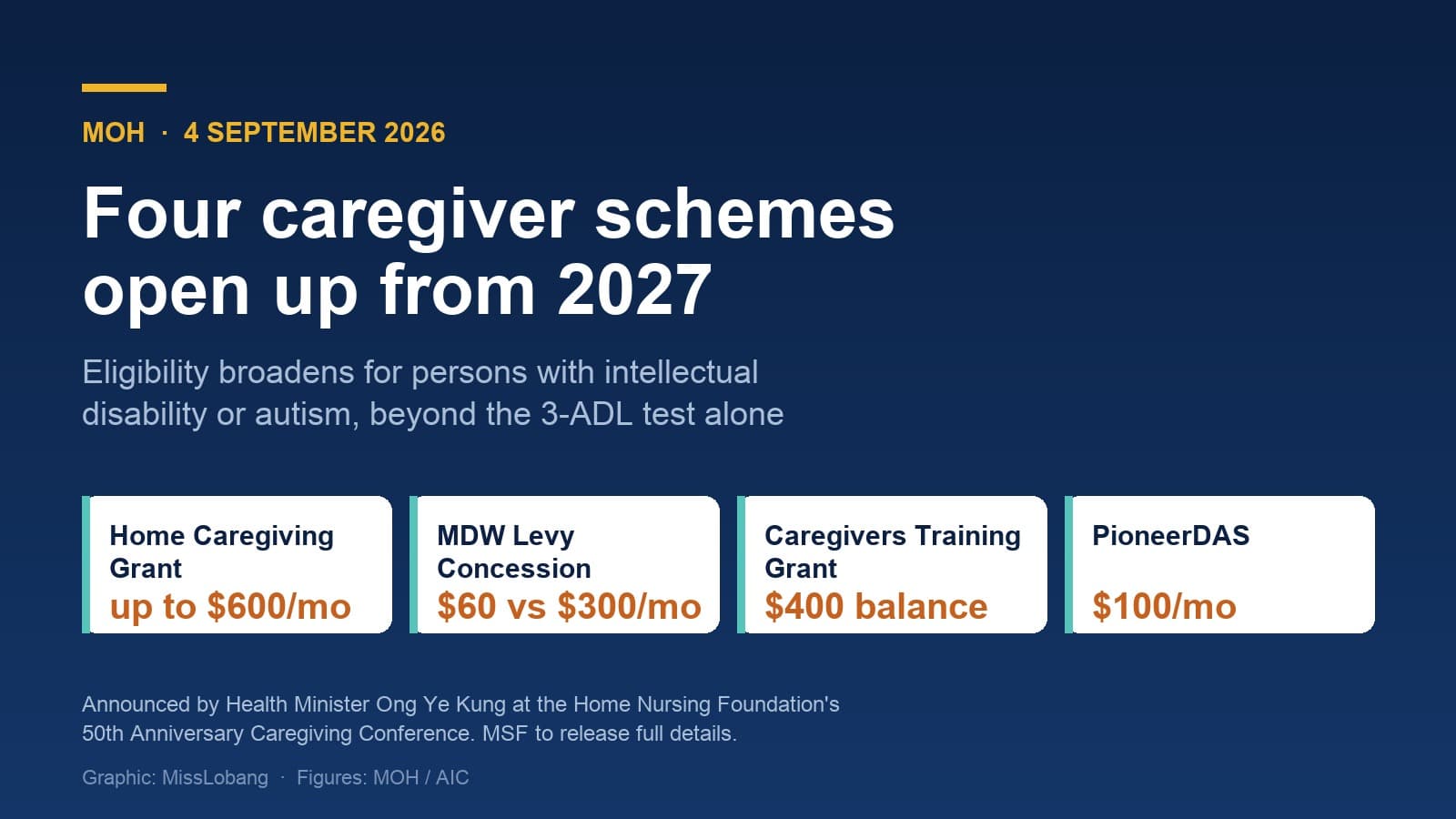
> Quick view: from 2027, eligibility for four government caregiver support schemes will be broadened to cover persons with intellectual disability or autism whose care needs are not captured by the standard activities-of-daily-living test. Health Minister Ong Ye Kung announced it on 4 September 2026. The four schemes are the Home Caregiving Grant (up to $600 a month in cash), the Migrant Domestic Worker Levy Concession for Persons with Disabilities ($60 a month instead of $300), the Caregivers Training Grant and the Pioneer Generation Disability Assistance Scheme ($100 a month). MSF will release the detailed criteria later. There is nothing new to apply for yet.
Speaking at the Home Nursing Foundation's 50th Anniversary Caregiving Conference on Friday 4 September 2026, Health Minister and Coordinating Minister for Social Policies Ong Ye Kung announced a change that a specific group of families has been asking for over several years.
From 2027, the eligibility criteria for four caregiver financial support schemes will be broadened to include the care needs of persons with intellectual disability or autism.
The problem the change is meant to fix
Almost every disability-linked government payout in Singapore is gated on the same test: how many of the six activities of daily living (ADLs) the care recipient permanently needs help with. The six are washing, dressing, feeding, toileting, mobility, and transferring (getting from a bed to a chair, and back). Continence is not one of them.
The Home Caregiving Grant requires help with at least three of the six. That test works reasonably well for frailty and physical disability. It works badly for a person who can physically wash, dress and feed themselves but cannot be left alone safely.
In the Minister's own words, there is "a group of persons with intellectual disabilities or autism with significant care needs that may not qualify for HCG. They may be able to perform the ADLs, but they have significant care needs that are not adequately reflected by ADL assessment."
So the government will adjust the policy to recognise those care needs, and the adjustment will apply across all four schemes from 2027.
The four schemes affected
These are the current published terms, taken from the Agency for Integrated Care's own scheme pages. The eligibility route is what changes in 2027, not necessarily these amounts.
| Scheme | What it pays now | Current ADL bar |
|---|---|---|
| Home Caregiving Grant (HCG) | $600, $400 or $200 a month in cash, by income tier | at least 3 of 6 |
| MDW Levy Concession for Persons with Disabilities | levy of $60 a month instead of the standard $300 | at least 1 of 6 |
| Caregivers Training Grant (CTG) | subsidised caregiver courses, balance capped at $400 | at least 1 of 6, or care recipient aged 65+ |
| Pioneer Generation Disability Assistance Scheme (PioneerDAS) | $100 a month in cash | at least 3 of 6 |
Home Caregiving Grant. The payout is means-tested on monthly household income per person: $600 where that figure is $1,500 or less, $400 from $1,501 to $3,600, and $200 from $3,601 to $4,800. Households with no income are assessed on an annual value of under $21,000 instead. If the household owns more than one property, the payout drops to the lowest tier of $200 regardless of income.
MDW Levy Concession. This is the largest single line for many families: $240 a month saved, or $2,880 a year. A household can hold up to two concessions if it is caring for two eligible persons at the same time, the care recipient must live at the same address as the employer, and this particular concession covers care recipients aged 16 to 66 (other levy concession schemes pick up the age groups outside that).
Caregivers Training Grant. A care recipient starts with a $400 balance the first year it is tapped, then receives a $200 top-up every 1 April, with the balance capped at $400. Course fees are drawn from that balance, there is a co-payment of at least $10 per course, the caregiver must be the main caregiver, and the caregiver has to actually complete the course. Migrant domestic workers count as caregivers for this grant.
PioneerDAS. $100 a month for Pioneer Generation members with disabilities, on top of the rest of the Pioneer Generation Package.
What the Minister did not change
This part matters, because it is the request that comes up most often and it was addressed directly.
There has been long-standing feedback to lower the Home Caregiving Grant's bar from three ADLs to two. That was declined. The stated reason: it "would broaden the scope of the scheme multiple times, and can dilute the objective of HCG which is to focus resources on those with higher levels of functional impairment, and who need the assistance most."
So if your family member has a physical disability and needs help with two of the six ADLs, this announcement does not change anything for you. The change is specific to intellectual disability and autism.
Eight Caregiver Support Touchpoints, also from 2027
The second announcement is a physical front door. From 2027, eight sites will be equipped as Caregiver Support Touchpoints (CSTs), where a caregiver can walk in and ask, in the Minister's framing, "I am a caregiver. What should I do? What help can I get?"
- Five aged care service providers: Tiong Bahru-Redhill, Toa Payoh, Bedok, Bukit Panjang and Yishun
- Three Enabling Services Hubs: Tampines, Punggol and Jurong
Staff there are meant to identify needs, explain what support exists, and connect caregivers to services for the care recipient and for themselves, including help setting up a self-care routine, a contingency plan for when the caregiver cannot provide care, and referrals to respite services or peer support groups. It is open regardless of whether the person being cared for is a senior, someone with a disability, dementia, a mental health condition or a serious illness. The government said it hopes to expand beyond eight.
A common caregiver training framework is also coming in early 2027, organised around what a caregiver needs at each stage rather than scattered across different websites. The new Skills and Workforce Development Agency (SWDA) will work with AIC, SG Enable and training providers to run sessions closer to home, including at the CSTs under the SkillsFuture Care Programme.
What to do now
Nothing on the new criteria yet. MSF has been named as the agency that will publish the details, and the change takes effect in 2027.
What is worth doing in the meantime:
- Check whether you already qualify under the current rules. The AIC pages for each of the four schemes list the criteria in full, and applications go through AIC's eFASS portal with Singpass. Approval takes up to four weeks.
- Do not pay for two assessments. For care recipients with autism spectrum disorder or intellectual disability, needs are already determined by an MSF-approved assessor using a Client Assessment Form rather than the standard Functional Assessment Report. And if you are already applying for IDAPE, ElderFund, ElderShield, CareShield Life or MediSave Care, the severe disability assessment done for those is accepted for HCG and PioneerDAS, so a second assessment fee is not required.
- If you are being asked for money to "secure" a grant, it is a scam. AIC's own site carries the warning: its staff will never ask you to transfer money or share bank log-in details over the phone. The 24/7 ScamShield Helpline is 1799.
Fine print
- Every figure here is from MOH's published speech text of 4 September 2026 and from the Agency for Integrated Care's current scheme pages, read on 4 September 2026.
- The broadened criteria are announced, not published. Amounts, assessment routes and start dates for the new group have not been detailed, and MSF may set conditions not covered here.
- Scheme rules change. Confirm your own eligibility with AIC, MSF or MOH before you commit to anything. This is a summary of a government announcement, not financial or medical advice, and nothing here is personalised advice.
Related
- Best Home Care and Eldercare Services in Singapore 2026
- Pioneer Generation MediSave Top-Up 2026
- Cost-of-Living Special Payment 2026: $400 to $600 From 9 September
- How to Use Your CDC Vouchers for Best Value in 2026
Cover graphic: MissLobang. Figures: MOH and the Agency for Integrated Care.