5 Best Savings Accounts in Singapore (2026) — Highest Interest Rates Ranked
Deals

5 Best Savings Accounts in Singapore (2026) — Highest Interest Rates Ranked

DBS Multiplier vs OCBC 360 vs UOB One vs BOC SmartSaver vs SC Bonus$aver — the best savings account for salary crediting is not the one with the biggest number on the poster. Every headline rate on this list hides an insurance or investment purchase, and on salary plus card spend alone the ranking inverts completely: OCBC 2.20%, UOB 1.90%, Standard Chartered 1.85%, DBS 1.80%, BOC 1.60%. DBS pays that rate on only your first S$50,000 until you hit a second bonus category — a cap most comparisons quote as S$100,000. Rates read off each bank's own rate card on 24 August 2026.

Marcus Wong27 April 20269 min readUpdated 7 Sept 2026

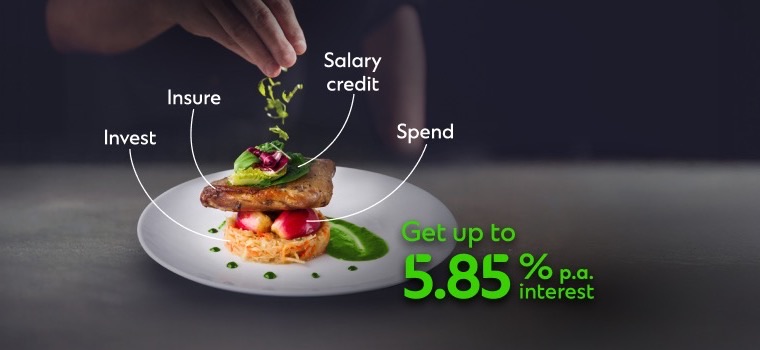
Every rate on the poster is a maximum you probably will not hit — so rank by the salary-plus-card column, not the headline.

> Quick view: SC Bonus$aver 5.85% leads and is the only account here where salary credit is optional · OCBC 360 4.70% until 31 Dec 2026, then 4.45% · BOC 4.60% · DBS 4.10% · UOB One 1.90% · but on salary + card spend alone the order flips to OCBC 2.20%, UOB 1.90%, SC 1.85%, DBS 1.80%, BOC 1.60% — and DBS pays that on your first S$50,000 only until you hit a second bonus category.

1
Standard Chartered Bonus$aver logo

Standard Chartered Bonus$aver

The highest-rate bonus savings account in Singapore. From 1 May 2026 the maximum dropped from 7.05% to up to 5.85% p.a. on the first S$100,000 — still comfortably ahead of OCBC's promotional 4.70% and BOC's 4.60%. Crucially, salary credit is *optional*. There are four bonus categories on top of a 0.05% base rate: Salary (0.90%, min S$3,000/month), Card spend (0.90%, min S$1,000/month), Invest (1.50%, min S$30,000 in eligible unit trusts held for at least six months) and Insure (2.50%, min S$24,000 annual premium — doubled from S$12,000 on 1 January 2026, the same revision that cut the Salary and Card bonuses from 1.50% each) — so self-employed and freelancers get the rare gift of an account that doesn't penalise them. Two catches worth knowing: there is no bill-payment category, and the Invest and Insure bonuses only pay out for six months before you need a fresh purchase to keep them. On salary plus card spend alone you're at roughly 1.85%. Min S$3,000 balance, S$5 fall-below fee. Best yield-per-effort pick if you're already buying insurance or investments.

S$228 sign-up cashback: apply for a Bonus$aver current account as main account holder AND a Bonus$aver World Mastercard as principal cardholder between 1 Jul and 30 Sep 2026 (new-to-Bonus$aver customers only), then deposit S$50,000 of fresh funds and keep the balance until the end of the second calendar month after account opening. Re-verified 7 Sep 2026: Standard Chartered's promotions page now dates the window 1 July to 30 September 2026.

Valid till 30 Sept 2026

Get Deal
2
BOC SmartSaver Account logo

BOC SmartSaver Account

Revised upward in November 2025 while the Big-3 were cutting — BOC SmartSaver offers up to 4.60% p.a. on the first S$100,000, plus up to 0.60% on the next S$900,000. That held the number-two spot outright until OCBC's promotional Save bonus nudged it into third on headline rate until 31 December 2026; BOC returns to second on 1 January 2027 when OCBC reverts to 4.45%. Read the fine print, though: 3.00% of that 4.60% comes from the Wealth bonus, which needs an eligible insurance or wealth purchase — a S$150,000 single premium, S$24,000 a year on a 5-year regular-premium plan, or S$12,000 a year on a 10-year plan. The everyday categories are much smaller — Salary (0.50%, min S$3,000/month), Card spend (0.60% from S$750/month, rising to 0.90% from S$2,500/month) and three bill payments of at least S$30 each (0.10%). The base rate is 0.10% p.a. on the whole balance, and the 'up to 0.60%' above S$100,000 is a 0.50% Extra Savings bonus (unlocked by any one of the card, salary or bill-payment conditions) plus that base. Without the wealth purchase you're realistically nearer 1.60% p.a. Best for people already buying insurance or investments who want to diversify beyond the Big-3.

Visit website
3
OCBC 360 Account — Promotional 4.70% p.a. Until 31 December 2026 logo

OCBC 360 Account — Promotional 4.70% p.a. Until 31 December 2026

Rates were cut from 5.45% to up to 4.45% p.a. on the first S$100,000 effective 1 May 2026, with the realistic Salary+Save+Spend tier dropping from 2.45% to 1.95%. Then OCBC reversed course: **from 1 August to 31 December 2026 the Save bonus is promotionally raised to 0.50% p.a. on the first S$75,000 and 1.10% on the next S$25,000 (from 0.40% and 0.50%) — a blended 0.65% across the cap — taking the maximum to up to 4.70% p.a. and the realistic Salary+Save+Spend tier to 2.20% p.a.** For the rest of 2026 that makes it the second-highest account on this list, ahead of BOC SmartSaver — and the best-paying Big-3 local bank by a wide margin. It reverts to 4.45% on 1 January 2027, so treat the extra 0.25% as a bonus for this year rather than a reason to commit long-term. Credit at least S$1,800 salary (worth 1.00% on the first S$75,000 and 2.00% on the next S$25,000 — the biggest salary bonus on this list), spend at least S$500/month on selected OCBC cards (worth only 0.25%, the smallest card bonus here), grow your average daily balance by at least S$500 month-on-month, then add insure/invest with OCBC (1.00% / 2.00% each) on top of the 0.05% base. The 'Save' bonus for ending the month higher than the last remains unique to OCBC, and rewards the habit rather than the balance — which is precisely the bonus being boosted, so the promo pays off most for people who are actively adding to the account each month. Note the Insure and Invest bonuses run for 12 months only. Best for disciplined savers stacking four or more categories, and the strongest salary-crediting account here on salary bonus alone.

Visit website
4
DBS Multiplier Account logo

DBS Multiplier Account

The only Big-3 local bank account that wasn't cut in the May 2026 round — DBS Multiplier holds at up to 4.10% p.a. on the first S$100,000. The most flexible setup of the lot: no minimum spend per category, and no minimum salary, just transact more with DBS to unlock higher tiers. **The catch every comparison table gets wrong is the cap, not the rate.** Income plus ONE category earns bonus interest on your first S$50,000 only — you need income plus TWO or more categories before the cap becomes S$100,000, the figure everyone quotes. Read off the rate table DBS publishes on its own Multiplier page: income + 1 category pays 1.80% on S$500–S$15,000 of monthly eligible transactions, 1.90% to S$30,000 and 2.20% above it; income + 2 categories pays 2.10% / 2.20% / 3.00%; income + 3 or more pays 2.40% / 2.50% / 4.10%. So the full 4.10% needs three categories AND S$30,000 of eligible transactions a month, and DBS's own promotion page markets the two-step salary-plus-one-category setup as 1.8% p.a. — which is what most salaried readers will actually get, on half the balance they expected. Note that your salary counts towards the transaction total, so a S$3,500 salary plus S$800 of card spend is S$4,300, the bottom band. Categories include card spend, insurance, investments and home loans. Best for existing DBS customers who want a 'set and forget' account and whose banking is already spread across DBS products.

S$250 cash reward — register first, then credit a salary of at least S$1,600/month (or an NS allowance of at least S$500/month) via GIRO SAL/PAY to any DBS/POSB account for 4 consecutive months, with the first credit in by 31 Oct 2026. Open only to customers who did NOT credit a salary with DBS/POSB at any point between 1 Jan and 31 Dec 2025, and capped at the first 12,000 qualifying customers. Stack up to S$50 more within those 4 months: S$40 for setting up an income/property tax GIRO with at least one successful deduction, and S$10 for opening an SRS account and contributing S$10 via digibank — S$300 in total.

Valid till 31 Oct 2026

Get Deal
5
UOB One Account logo

UOB One Account

Once the simplest path to 4% p.a., UOB One has been cut twice — to 2.50% in September 2025, then to up to 1.90% p.a. from December 2025 — making it the lowest of the major local-bank accounts. The qualifying conditions are unchanged: S$500/month UOB card spend, plus either a salary credit of at least S$1,600 or three GIRO/PayNow debit transactions. Only the salary path reaches the full 1.90% on S$150,000; the GIRO route caps at 1.40% on S$125,000, and card spend on its own earns just 0.65% on S$75,000. The salary must carry the SALA reference code to count. That S$150,000 cap is still the largest on this list, but the rate just doesn't compete anymore. Worth keeping only if you bank heavily with UOB or specifically need the higher cap; everyone else should switch.

Visit website

Quick Comparison — Singapore Bonus Savings Accounts (rates read off each bank's own rate card, 24 August 2026)

AccountMax InterestRealistic Rate (No Insure/Invest)Bonus Interest CapSalary RequiredMin Card SpendBonus Categories
SC Bonus$aver5.85% p.a.~1.85% p.a.S$100,000No (optional, ≥ S$3,000)S$1,000/moSalary + Card + Invest + Insure (no bills)
BOC SmartSaver4.60% p.a.~1.60% p.a.S$100,000Yes (≥ S$3,000)S$750/mo (0.90% from S$2,500)Salary + Card + Bills + Wealth/Insure
OCBC 3604.70% p.a. to 31 Dec 2026, then 4.45%~2.20% p.a. to 31 Dec 2026, then ~1.95%S$100,000Yes (≥ S$1,800)S$500/moSalary + Save + Card + Insure + Invest
DBS Multiplier4.10% p.a.1.80% p.a. (2.20% only above S$30,000/mo of transactions)S$50,000 on income + 1 category; S$100,000 from 2 categoriesYes (any amount; total eligible transactions ≥ S$500/mo)Any DBS card spendSalary + Card / Insure / Invest / Loan
UOB One1.90% p.a.1.90% p.a.S$150,000 (S$125,000 on the GIRO route, S$75,000 on card spend alone)Yes (≥ S$1,600) — or 3 GIRO debits for 1.40%S$500/moSalary + Card (only 2 conditions; card alone = 0.65%)

How the rates got here

Singapore's bonus savings landscape has reshuffled significantly in the past year. From 1 May 2026: OCBC 360's max rate dropped from 5.45% to 4.45% p.a., and Standard Chartered Bonus$aver from 7.05% to 5.85% p.a. — itself already down from 8.05% on 1 January 2026, when SC also cut its Salary and Card bonuses from 1.50% to 0.90% each, raised the Invest minimum from S$20,000 to S$30,000 and doubled the Insure minimum premium from S$12,000 to S$24,000. UOB One has cut twice (to 2.50% in Sep 2025, then 1.90% from 1 Dec 2025) and is now the lowest of the major local banks. BOC SmartSaver was revised upward on 1 Nov 2025 to up to 4.60% p.a. DBS Multiplier is the only big-bank account that hasn't moved, holding at 4.10%.

Then it moved again on 1 August 2026 — this time upward. OCBC promotionally raised its Save bonus from 0.40% / 0.50% to 0.50% on the first S$75,000 and 1.10% on the next S$25,000 for anyone who grows their average daily balance by at least S$500 a month — a blended 0.65% across the S$100,000 cap, against roughly 0.43% before. That lifts OCBC 360's maximum from 4.45% to up to 4.70% p.a. until 31 December 2026, and pushes the realistic salary-plus-save-plus-spend tier from 1.95% to 2.20% p.a. It is the first rate rise from a Big-3 bank in over a year — and it puts OCBC temporarily ahead of BOC SmartSaver's 4.60%. From 1 January 2027 the Save bonus reverts and OCBC drops back to 4.45%.

The accounts above are ranked by their standing (post-promotion) maximum rate, so the order still holds after OCBC's promo ends — just note that between now and 31 December 2026, OCBC at 4.70% sits above BOC at 4.60%.

One thing every headline rate hides: the top tier almost always needs an insurance or investment purchase. BOC's 4.60% is 3.00% wealth bonus; SC's 5.85% needs all four categories including a S$24,000 annual premium. Strip those out and the everyday, salary-plus-card rate is closer to 1.6%–2.2% at every bank on this list. Rank by what you'll realistically hit, not the number on the poster. Every rate here was read off each bank's own rate card on 24 August 2026 — the DBS figures come from the bonus interest rate table DBS publishes as an image on its own Multiplier page, which is where the S$50,000 cap is stated and where most roundups stop reading.

Best savings account for salary crediting in Singapore

If the only decision you're making is where to credit your salary, ignore the headline rates — those are inflated by insurance and investment bonuses you may never buy. What matters is the salary bonus itself, and the minimum salary you need to unlock it.

AccountSalary bonusMin. monthly salaryNotes
OCBC 360Up to 1.00% (first S$75k) / 2.00% (next S$25k)S$1,800Largest salary bonus; pairs with the Save bonus, which is promo-boosted to 31 Dec 2026
DBS MultiplierBuilt into the tier (income + 1 category = 1.80%, rising to 2.20% only above S$30,000 of monthly eligible transactions)Any amountNo minimum salary at all — the most forgiving if your income is irregular — but on one category the bonus covers only your first S$50,000
UOB OnePart of the 1.90% two-condition structureS$1,600Lowest salary threshold of the lot, and the only one where salary + card spend alone gets you the full advertised rate
BOC SmartSaver0.50%S$3,000High threshold for a small bonus
SC Bonus$aver0.90%S$3,000Optional — the account still works without it

Three practical rules:

You can only credit your salary to one account. Banks detect salary credit by the GIRO/PayNow/FAST transaction code (SALA), and splitting your pay across two banks usually means neither hits its minimum. Pick one.

Match the threshold to your actual pay, not your target pay. If you earn S$2,500 a month, BOC and Standard Chartered's S$3,000 salary bonuses are simply unreachable — OCBC (S$1,800) and UOB (S$1,600) are the realistic choices, and DBS has no minimum at all.

If you're self-employed, a freelancer or on irregular income, Standard Chartered Bonus$aver is the outlier worth knowing about — it is the only account here where salary credit is optional rather than required, so you are not locked out of the top tier for not having a payslip.

How to maximise bonus interest with card spend and insurance

Every account here stacks bonus categories, so the real question is which ones are worth chasing.

Card spend is the cheapest bonus to unlock, because it is money you were spending anyway. The thresholds are all reachable — S$500 a month at OCBC 360 and UOB One, S$750 at BOC SmartSaver (0.60%, rising to 0.90% only above S$2,500), S$1,000 at Standard Chartered — and DBS Multiplier has no per-category minimum at all, it simply counts the spend towards your monthly transaction total. The trap is opening a card you would not otherwise carry: an annual fee, or worse cashback than the card you already use, quietly eats the extra interest on any balance under about S$40,000.

Insurance and investment bonuses are the opposite trade. They pay the most — 2.50% (Insure) and 1.50% (Invest) at Standard Chartered, 3.00% (Wealth) at BOC SmartSaver, 1.00% / 2.00% each at OCBC 360 — and they cost the most to unlock: a S$24,000 annual premium plus S$30,000 in eligible unit trusts at Standard Chartered, and at BOC either a S$150,000 single premium, S$24,000 a year on a 5-year regular-premium plan, or S$12,000 a year on a 10-year plan. They are also temporary. Standard Chartered's Invest and Insure bonuses run for six months before you need a fresh purchase; OCBC's Insure and Invest bonuses run for 12 months. Run the arithmetic first: BOC's 3.00% Wealth bonus on a full S$100,000 balance is S$3,000 a year, which does not pay for a S$12,000-a-year policy you did not otherwise want. These bonuses are worth taking only if you were already buying the product.

The stack that works for most salaried people needs no new products at all: credit your salary to one bank, route your existing card spend through that same bank, and — at OCBC — keep adding to the balance each month so the Save bonus counts. That is 2.20% at OCBC 360 (salary + save + spend, while the promo runs), 1.90% at UOB One and 1.80% at DBS Multiplier on the first S$50,000.

Is it worth switching banks for a higher rate?

Do the arithmetic before you move. On a S$50,000 balance, a 0.25% difference is S$125 a year — real, but not life-changing. On the same balance, dropping one qualifying condition you can't sustain (a S$1,000 monthly card spend, say) can cost you far more than switching gains you.

Switching is worth it when: the gap is a full percentage point or more, you can meet the new account's conditions every month without changing your spending, and your balance is large enough for the difference to clear a few hundred dollars a year. It is not worth it when you are chasing a promotional rate that expires in a few months, or when the new account's minimum balance would trigger a fall-below fee. There are no account-closure fees at any of the five banks here, but Standard Chartered charges S$5 a month if you fall below S$3,000 — so the downside of a bad switch is a recurring fee, not a one-off cost.

One thing that does tilt the maths: a sign-up cashback is a one-off payment that can be worth more than a year of the rate difference you are chasing. Standard Chartered's S$228 (new Bonus$aver customers, account plus Bonus$aver World Mastercard, S$50,000 in fresh funds, applications in by 31 August 2026) and DBS's S$250 for four consecutive months of salary credit are both larger than the 0.25%-on-S$50,000 gap that tempts most switchers. Just don't let a one-off reward lock you into an account whose monthly conditions you can't meet.

Related reads

Frequently Asked Questions

Which Singapore bank gives the highest interest on a savings account in 2026?

Standard Chartered Bonus$aver has the highest headline rate at up to 5.85% p.a. on the first S$100,000 — and uniquely does not require salary credit (it's optional). Second place currently belongs to OCBC 360: a promotional Save bonus running from 1 August to 31 December 2026 lifts its maximum to up to 4.70% p.a., putting it just ahead of BOC SmartSaver's 4.60% until the promo ends and it reverts to 4.45% on 1 January 2027. DBS Multiplier follows at 4.10%, and UOB One sits at the bottom of the major local banks at 1.90% after consecutive cuts in late 2025. Bear in mind these are maximums that assume you meet every bonus category, including insurance and investment purchases.

Which savings account offers the best interest rates for salary crediting in Singapore?

Judged on the salary bonus alone — rather than the headline rate, which is inflated by insurance and investment bonuses — OCBC 360 pays the most, at up to 1.00% p.a. on your first S$75,000 and 2.00% on the next S$25,000, for a salary of at least S$1,800 a month. DBS Multiplier is the most flexible: it has no minimum salary at all, so income of any size counts — but income plus one other category pays 1.80% (2.20% only if your monthly eligible transactions top S$30,000) and, importantly, on your first S$50,000 rather than S$100,000. UOB One has the lowest qualifying salary at S$1,600, and is the only account here where salary credit plus card spend alone reaches the full advertised 1.90%. BOC SmartSaver (0.50%) and Standard Chartered Bonus$aver (0.90%) both need S$3,000 a month, which puts them out of reach for many. One important limit: you can only credit your salary to one account, because banks identify it by the SALA transaction code — splitting your pay across two banks usually means neither hits its minimum. If you are self-employed or freelance, Standard Chartered Bonus$aver is the account to look at, since salary credit there is optional rather than required.

Is it worth switching banks just for a higher savings interest rate?

Only if the gap is big enough to survive the conditions attached to it. On a S$50,000 balance, a 0.25% difference works out to S$125 a year — real money, but not enough to justify restructuring your finances. A full percentage point on the same balance is S$500 a year, which is worth the paperwork. Before you move, check three things: whether you can meet the new account's qualifying conditions every single month without changing how you spend (a missed condition drops you to a base rate of around 0.05%–0.30%, which wipes out the gain); whether the minimum balance would trigger a fall-below fee, as Standard Chartered charges S$5 a month below S$3,000; and whether the rate you are chasing is promotional, since a boost that expires in a few months is not a reason to switch. None of the five banks here charge an account-closure fee, so the real cost of switching is the admin of moving your salary credit, GIRO arrangements and card spend — which is also why it is worth doing properly once rather than chasing every revision.

Is the high interest rate guaranteed?

No. Bonus savings accounts in Singapore are tiered — you only earn the headline rate when you meet all the qualifying conditions in a given month. If you miss a category (e.g. didn't spend on the credit card that month), you drop to a lower tier or to the base rate of around 0.05%–0.30%. Banks revise tiers periodically, so the published 2026 rate may change in 2027.

Are funds in Singapore savings accounts safe?

Yes. All five accounts in this ranking are with banks insured under the Singapore Deposit Insurance Corporation (SDIC) scheme, which guarantees up to S$100,000 per depositor per scheme member if the bank fails. Spread balances above S$100,000 across multiple banks to keep all funds insured.

Can I have more than one bonus savings account?

Yes — and many Singaporeans do. You can only credit your salary to one account, so the usual approach is to pick the bonus account whose conditions you can actually meet every month, fill it to its cap, then park anything above the cap in a digital bank or money market product like Trust Bank, MariBank, or Chocolate Finance. Since caps here are S$100,000 (S$150,000 for UOB One), anyone with more than that will need a second home for the excess anyway. There is no Singapore law limiting how many bank accounts an individual can hold.

What interest rate will I actually get on a Singapore savings account?

Far less than the headline. Every account on this list puts most of its top rate behind an insurance or investment purchase — 3.00% of BOC SmartSaver's 4.60% is the Wealth bonus, and Standard Chartered's 5.85% needs both a S$30,000 investment and a S$24,000 annual insurance premium. On salary credit plus card spend alone, the realistic rates in August 2026 are roughly 2.20% for OCBC 360 (salary + save + spend, helped by the promotional Save bonus running to 31 December 2026, after which it returns to 1.95%), 1.90% for UOB One, 1.85% for Standard Chartered Bonus$aver, 1.80% for DBS Multiplier and 1.60% for BOC SmartSaver. DBS deserves a second asterisk: at income plus one category its bonus interest covers only the first S$50,000, not S$100,000, so the same 1.80% is earned on half the balance — DBS's own salary promotion page markets that two-step setup as 1.8% p.a. If you aren't going to buy the wealth product, rank by that column instead — the order changes completely, and the account with the highest headline rate drops to third.

DBS Multiplier vs OCBC 360 vs UOB One — which should I pick?

OCBC 360 is the clear pick of the Big-3 right now: the promotional Save bonus running to 31 December 2026 takes it to up to 4.70% p.a., well ahead of DBS Multiplier's 4.10% — even though DBS is the only one of the three that wasn't cut in the May 2026 round. Pick OCBC if you can stack four or five bonus categories and you add to your balance every month, since the boosted bonus specifically rewards a growing balance. Pick DBS if your banking is spread across DBS products, since it has no minimum spend per category, no minimum salary, and rewards total transaction volume instead — it is also the more forgiving account if your income is irregular. But check the cap before you commit: on income plus one category DBS pays bonus interest on your first S$50,000 only, and the rate at that level is 1.80%, not the 2.20% most comparisons print. UOB One has dropped to 1.90% (after cuts in Sep + Dec 2025) — it's no longer competitive on rate, only on the larger S$150k cap and the lowest salary threshold at S$1,600. If you don't need to stick with a Big-3 bank, Standard Chartered Bonus$aver at up to 5.85% beats all three.

How often should I review my savings account choice?

Review at least twice a year — there is no predictable annual cycle. The 2025–26 round of changes landed in September, November and December 2025, again in May 2026, and once more on 1 August 2026 when OCBC raised its Save bonus for a limited period. Banks give roughly a month's notice by letter or in-app message. Note that promotional rates cut both ways: OCBC's boost expires on 31 December 2026, so an account that looks best today may not be on 1 January. Qualifying thresholds also creep up quietly over time. If your account drops a tier you weren't aware of, you could be earning hundreds less per year, so set two calendar reminders and compare against the latest MissLobang ranking.

Which savings account has the highest interest without a salary crediting requirement?

Standard Chartered Bonus$aver — and by a wide margin. Salary credit is one of its four bonus categories, not a gate: skip it and you simply forgo that 0.90%, leaving up to 4.95% p.a. still available from card spend (0.90%, min S$1,000/month), Invest (1.50%, min S$30,000 in eligible unit trusts) and Insure (2.50%, min S$24,000 annual premium) on top of the 0.05% base. Every other account here treats salary credit as the key that unlocks the rest: OCBC 360, DBS Multiplier and BOC SmartSaver all build their top tiers around it, and UOB One's only salary-free route is 3 GIRO debits plus S$500 of card spend, which caps at 1.40% p.a. on S$125,000. If you don't want bonus conditions at all, the alternatives are outside this list: digital banks and cash-management accounts such as Trust, GXS, MariBank and Chocolate Finance pay a flat rate with no salary, spend or insurance requirement, and Singapore Savings Bonds and T-bills pay their rate regardless of how you bank. Those are the accounts to look at if you are self-employed, freelancing, between jobs, or retired.

Are there any savings account sign-up promotions running in Singapore right now?

Two are live as we update this in August 2026, and one closes within days. Standard Chartered is paying S$228 cashback to customers who are new to Bonus$aver and apply for both a Bonus$aver current account (as main account holder) and a Bonus$aver World Mastercard (as principal cardholder) between 1 July and 31 August 2026 — you then need to deposit S$50,000 in fresh funds and keep the balance there until the end of the second calendar month after the account is opened. 'Fresh funds' excludes money already sitting with Standard Chartered, or money withdrawn and re-deposited within 30 days of opening. DBS is paying S$250 to anyone who registers for its salary promotion and credits a salary of at least S$1,600 a month — or an NS allowance of at least S$500 — via GIRO SAL/PAY for four consecutive months, with the first credit landing by 31 October 2026; it is open only to people who did not credit a salary to DBS/POSB at any point during 2025, and it is capped at the first 12,000 qualifying customers, so it can close before the stated date. Within those same four months you can stack S$40 for setting up an income or property tax GIRO with at least one successful deduction, and S$10 for opening an SRS account and contributing S$10, taking the total to S$300. OCBC, UOB and BOC are not running a comparable cash reward on these accounts as at 24 August 2026.

#best savings account singapore 2026#highest interest savings account singapore#best savings account for salary crediting singapore#salary crediting account singapore 2026#top bank accounts highest savings interest singapore#best high yield savings account singapore 2026#dbs multiplier account#ocbc 360 account#uob one account#boc smartsaver#standard chartered bonussaver#savings account comparison singapore#where to save money singapore

You Might Also Like