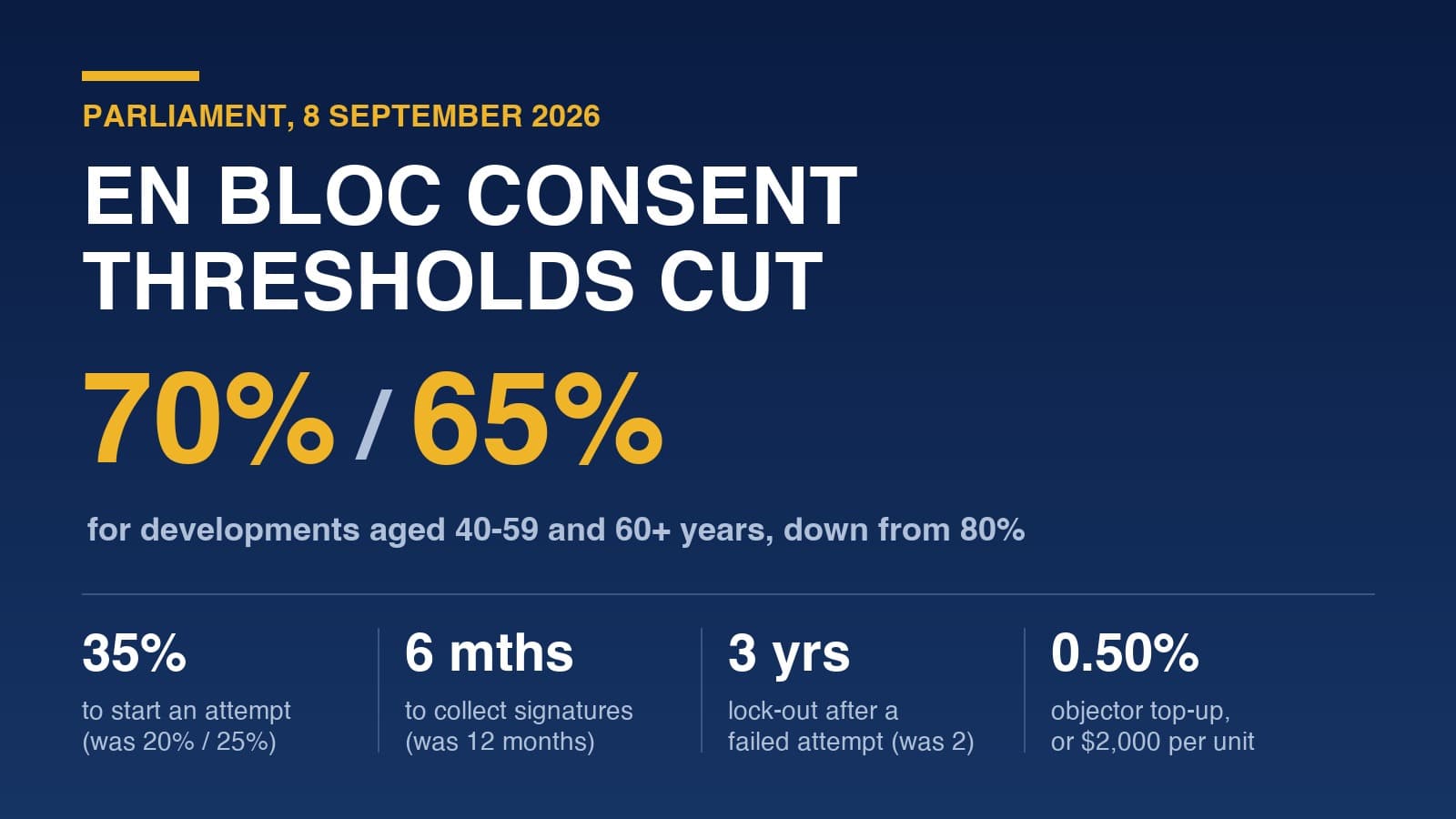
> Quick view: Parliament passed the Land Titles (Strata) (Amendment) Bill on Tuesday 8 September 2026. A private development aged 40 to 59 years will need 70% consent for a collective sale, and one aged 60 years and older will need 65%, both down from 80%. Newer blocks are unchanged at 90% (under 10 years) and 80% (10 to 39 years). Four safeguards for owners who do not want to sell were tightened in the same Bill. The new rules are not in force yet: the commencement date has not been announced.
Singapore's collective sale consent thresholds were set in 1999 and have not been recalibrated since. On 8 September 2026 Parliament changed them, passing the Land Titles (Strata) (Amendment) Bill on the day of its Second Reading. The Bill had its First Reading on 4 August 2026.
If you own a unit in an ageing condominium, this is the most consequential private-property rule change of the year so far. Here is exactly what moved.
The four consent tiers
| Age of development | Consent threshold | Change |
|---|---|---|
| Less than 10 years | 90% | Unchanged |
| 10 to 39 years | 80% | Unchanged |
| 40 to 59 years | 70% | New, down from 80% |
| 60 years and older | 65% | New, down from 80% |
Only the two oldest bands moved. Everything below 40 years is exactly where it was, so an owner in a 2015 condo sees no change at all.
The Ministry of Law's reasoning, set out when the Bill was introduced on 4 August, is that the 1999 thresholds were written for a much younger housing stock. Many developments have since aged into the range where staying put means heavy, repeated capital spending.
How your building's age is counted
The Land Titles (Strata) Act already measures a development's age from the date of its latest Temporary Occupation Permit, or its Certificate of Statutory Completion where no TOP was issued. That is the reference point for the new bands too.
The practical point: do not work from the year people say the estate was built. Ask your MCST or managing agent for the TOP date in writing, because a single year can be the difference between the 80% band and the 70% band.
Four rules that moved the other way
The same Bill tightened four things, all of them in favour of owners who do not want to sell.
1. It is harder to start an attempt. Requisitioning the general meeting that constitutes a collective sale committee now needs at least 35% of owners by share value or by number of units. The old bar was 20% by share value or 25% by number of units. MinLaw's stated aim is to ensure exercises are only launched where there is already meaningful support.
2. The signature window is halved. A collective sale committee has 6 months to obtain signatures to the collective sale agreement, down from 12 months. MinLaw frames this as addressing the prolonged pressure non-consenting owners face while still leaving enough time to collect.
3. The lock-out after a failure is longer. The restriction period after a failed attempt goes from 2 years to 3 years. During those three years, convening a meeting to form a new committee faces heightened requisition thresholds: 50% for a first attempt, then 70% for developments aged 40 to 59 or 65% for those aged 60 and above for any second and subsequent attempt.
4. Objectors get more money. Where the court orders a top-up to an objecting owner's share of the proceeds, the figure doubles from 0.25% to 0.50% of the sale proceeds for that unit, or $2,000 per unit, whichever is higher.
A first for Neptune Court style estates
The Bill also opens the collective sale regime to non-strata-titled private residential developments where flat owners hold long leases on their units but do not own the land underneath.
Until now these estates sat outside the regime. A sale needed unanimous agreement between flat owners and the landowner, unless the flat leases ran to at least 850 years, in which case the landowner's interest was treated as nominal. Under the amendments, such developments can be sold by majority consent, with safeguards written in to protect the landowner's interest. Neptune Court, whose flats sit on land owned by the Ministry of Finance, is the example named in the reporting of the debate.
The date that decides which rules apply to you
The commencement date has not been announced. MinLaw's position is that it will be announced when ready, and until then the existing 80% threshold still governs every development aged 10 years or more.
When it does arrive, one binary fact decides which regime your development is in.
| Your situation at commencement | Which rules apply |
|---|---|
| First signature on the collective sale agreement already obtained | The existing framework continues |
| First signature not yet obtained | Most of the new amendments apply |
| Committee midway through collecting signatures | May convene a general meeting to terminate the existing agreement and approve terms for a new one under the enhanced regime, then has 7 months from commencement to reach the new threshold |
MinLaw's stated reason for preserving the old framework where a signature has already been taken is fairness to owners who signed on the basis of the thresholds in force at the time.
If there is a live exercise in your block, the single most useful thing you can do is get the date of that first signature confirmed in writing.
Why the Government moved
Law Minister Edwin Tong put the scale of the problem to Parliament on 8 September. About one in 20 non-landed private homes in Singapore are now aged 40 years or older, which he put at roughly 20,000 dwelling units in close to 250 developments, a number set to keep growing because of the building boom from the 1970s to the 1990s.
His argument was about the cost curve of keeping an old building safe. Concrete cracking and spalling become more frequent, structural repairs more extensive, and the returns on continued upkeep begin to diminish. The illustration he used was lifts: the Building and Construction Authority's guideline is for owners to set aside $120,000 to modernise each lift, while a full replacement can run $200,000 to $300,000 per lift, and even a modernised lift has a finite service life. Repainting, concrete repair, waterproofing and structural inspections sit on top. In some developments, he said, maintenance fees and sinking fund contributions have been raised by as much as 50%.
On the principle behind the age bands, Tong said the consent threshold should reflect the age and circumstances of the development, which is the same principle Parliament endorsed in 1999. He also told the House that "collective sale remains a majority choice" and that "the framework respects the right of owners who choose not to sell".
MPs during the debate raised concerns about the shorter six-month signature window, particularly for large estates, and about the cost of replacement homes for owners who are bought out.
What this means for you
If you own in a condo aged 40 or more. Renewal has become a realistic option where it previously was not, and the older your block, the bigger the shift. Note the second-order effect though: a lower threshold changes what your unit is worth to a buyer who is pricing in redevelopment potential, and it also changes the calculation on that next big sinking-fund top-up.
If you do not want to sell. The number needed to outvote you has fallen, but the process around it has become slower to start, shorter to run, harder to repeat and more expensive to push through over your objection. Read the four safeguards above as a package rather than reading the headline number alone.
If you are buying. A development's age band is now a material fact, not trivia. Ask for the TOP date, ask whether there has been a failed attempt in the last three years, and ask whether a collective sale agreement already carries a first signature.
If you own in a non-strata long-lease estate. A route that did not exist for you now does. It is also brand new, so expect the practice around it to take time to settle.
Fine print
- This is a summary of an official announcement and of the Bill's Second Reading, not financial, legal or property advice. Confirm your own position with your MCST, your own lawyer and the Ministry of Law before you act on any of it.
- The Bill was passed on 8 September 2026 but the commencement date has not been announced. Nothing in the new thresholds applies until it is.
- Figures here come from the Ministry of Law's 4 August 2026 press release on the proposed amendments and from reporting of the Second Reading in Parliament on 8 September 2026. The passage date is from Parliament's own record of Bill 18/2026.