5 Best Digital Bank Accounts in Singapore (2026): Why Trust's 2.40% Needs a Monthly Referral and MariBank's 3.08% Lasts 30 Days
Deals

5 Best Digital Bank Accounts in Singapore (2026): Why Trust's 2.40% Needs a Monthly Referral and MariBank's 3.08% Lasts 30 Days

MariBank has raised its advertised rate to 3.08% p.a. and Trust still leads on 2.40% p.a., but neither number is a rate you can simply park money at. MariBank's 3.08% is 0.88% base plus a 1.60% bonus that stops after 30 days, plus 0.40% for a paid ShopeeVIP subscription, plus a new 0.20% for crediting your salary. Trust's 2.40% is only reachable if one of your three monthly bonus picks is referring a credit card customer who gets approved that month; without that referral the Flex Plan ceiling is 1.50%. The best rate with genuinely nothing to do stays GXS Saving Pockets at 1.08% p.a. Below: what each account pays once the promotion ends, the balance caps, the two products here that carry no SDIC cover at all, and three sign-up offers closing in September.

Marcus Wong26 April 202610 min readUpdated 31 Aug 2026

Every headline rate on this page is conditional. Here is what each one actually pays.

> Quick view: Best rate with nothing to do: GXS Saving Pockets, 1.08% p.a. Best ongoing rate: MariBank 1.48% p.a., which needs a paid ShopeeVIP subscription plus a salary credit and is dated to 31 Dec 2026. Trust's 2.40% needs a credit card referral approved every month. Two of the five are not banks and have no SDIC cover.

1
Trust Bank logo

Trust Bank

Backed by Standard Chartered and FairPrice Group, Trust is Singapore's largest digital bank by customer count. It crossed 1 million users in February 2025, and in March 2026 became the first of the local digital banks to turn a monthly profit. Savings are split into three plans rather than one rate: the Flex Plan pays up to 2.40% p.a. on balances up to S$1.2 million, the Signature Plan up to 1.00% p.a. on conditions like salary credit and card spend, and the Zen Plan a flat 0.40% p.a. with no conditions at all. The Flex Plan is where the headline lives, and it is harder than it reads. You start at a 0.05% p.a. base and add any three of eight bonus 'scoops' each month: +1.20% for referring a Trust credit card customer who gets approved that month, +0.70% for buying S$20,000 of eligible TrustInvest funds, +0.45% for crediting at least S$1,500 of salary via GIRO with a SALA purpose code, +0.30% for keeping a S$100,000 average daily balance, +0.20% for increasing that balance by S$3,000 on the previous month, +0.20% or +0.10% for five card spends of S$30 or more, +0.15% for receiving S$1,500 of incoming PayNow, and +0.15% for S$500 of foreign currency spend. Only one combination reaches 2.40%, and it is the top three: referral, S$20,000 of funds and salary. Skip the referral and your realistic ceiling is 1.50% p.a. Two other details worth knowing: salary credited by FAST rather than GIRO does not count, and the card-spend scoop pays 0.20% to NTUC union members but only 0.10% to everyone else, so the same plan is worth less to a non-member. Any balance above S$1.2 million earns the 0.05% base. You can switch plans monthly in the Trust app, there is no minimum balance and no monthly fee, and deposits are SDIC-insured up to S$100,000. Where Trust genuinely shines is the FairPrice integration: Linkpoints earn faster and the Trust card gives cashback at FairPrice. If you do your weekly grocery run there, Trust is the easiest account on this list to justify.

Flex Plan up to 2.40% p.a. on balances to S$1.2 million, Signature Plan up to 1.00% p.a., Zen Plan a flat 0.40% p.a. with no conditions; switch plans monthly in the app. No minimum balance, no monthly fee. Trust's standing referral offer gives you a sure-win cashback scratch card for each friend you refer.

Get Deal
2
GXS

GXS Bank

A joint venture between Grab and Singtel, GXS launched in 2022 and is the digital bank of choice for anyone deeply embedded in the Grab ecosystem. The GXS Savings Account splits your money into 'Saving Pockets' (effectively sub-accounts) where each pocket earns its own rate. GXS cut its headline hardest of the three, and that has quietly made it the most honest account on this list: the Main Account pays 0.88% p.a. and Saving Pockets 1.08% p.a. (up to 8 pockets, no lock-in, no penalties), both credited daily. Because MariBank's base rate is also 0.88% and Trust's condition-free Zen Plan is only 0.40%, that 1.08% is still the highest rate on this page you can hold indefinitely without a single monthly condition, a subscription or an expiring promotion. The fixed-term Boost Pocket has gone up rather than down, and now reaches 1.75% p.a.: that is the 0.88% base plus a maturity bonus that runs 0.13% at 1 month, 0.34% at 3 months, 0.52% at a new 4-month tenure, 0.42% at 8 months and 0.87% at 12 months. Read that ladder before you pick, because it is not monotonic. The 4-month tenure pays a bigger bonus than the 8-month one, which makes 8 months the worst-value slot on the board: you lock up your money for twice as long and get 0.10 percentage points less. You can open up to 8 Boost Pockets, and total balance across the account is capped at S$95,000. No minimum balance, no fees. Open GXS for the Grab integration, for funding GrabPay and topping up rides, and, if you cannot be bothered with monthly bonus-category admin, for the Saving Pockets rate too.

Main Account 0.88% p.a. and Saving Pockets 1.08% p.a., both credited daily. Boost Pocket (fixed term) up to 1.75% p.a. on maturity. New users: S$20 cashback on your first S$5,000 into a 3-month Boost Pocket named 'First Boost', which GXS advertises as an effective 2.82% p.a., valid till 30 Sep 2026 and limited to the first 1,500 eligible customers. Refer a friend for S$8 each, till 31 Dec 2026. No minimum balance, no fees; S$95,000 account cap.

Valid till 30 Sept 2026

Get Deal
3
MariBank

MariBank (Sea Group)

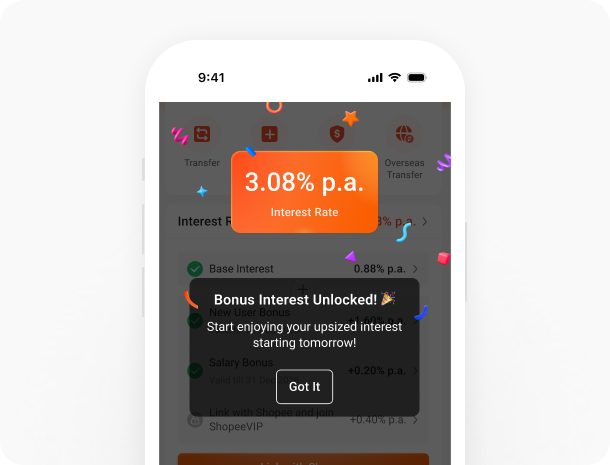
Owned by Sea Group (the parent company of Shopee and Garena), MariBank is the third licensed digital bank, and the one whose advertised rate needs the most unpacking. That rate went up in August 2026, from 2.88% p.a. to 3.08% p.a., because MariBank added a fourth component rather than because the base rate moved. READ THE 3.08% CAREFULLY. The Mari Savings base rate is 0.88% p.a., credited daily, with no minimum deposit, no salary crediting and no minimum spend. On top sits a New User Bonus of 1.60% p.a., which applies for the first 30 days after account opening and only to customers new to MariBank who have not held or closed a Mari Savings Account in the previous 180 days. Next is the ShopeeVIP Program Bonus of 0.40% p.a., which requires you to link your Mari Savings and Shopee accounts, hold an active paid ShopeeVIP subscription and tap 'Claim' in the app. New in this round is a Salary Crediting Bonus of 0.20% p.a., unlocked by a single inward transfer of at least S$500 carrying a SALA or PAYNOW SALA purpose code; a transfer from your own account or any other individual does not count, and each qualifying credit buys you bonus interest to the end of the following calendar month. So 3.08% is a 30-day rate for a brand-new customer who also subscribes to ShopeeVIP and credits a salary. Keep the last two and you are on 1.48% p.a., which is the highest ongoing rate on this page. Credit a salary but skip ShopeeVIP and you are on 1.08%, exactly level with GXS Saving Pockets. Do neither and you earn 0.88%, the same as the GXS Main Account. One thing worth noting for anyone who read an earlier version of this promotion: the S$100,000 balance cap that used to apply to the new-user bonus does not appear in the current terms, which were last updated on 25 August 2026 and now run 17 August to 31 December 2026, replacing the July version of the promotion. The app also carries Mari Invest SavePlus, which feeds the Lion-MariBank SavePlus Fund, a money-market-oriented fund rather than a deposit, which returned 1.80% p.a. over the year to 30 April 2026, and a separate Mari Invest Income option that wraps a bond fund and carries real capital risk. The Mari Credit Card gives 1.5% unlimited cashback with no minimum spend and no FX fees overseas. Best for ShopeeVIP subscribers and salary-crediters, for whom 1.48% is the best ongoing number here, and for Shopee shoppers who want banking and investing in one app. Not for anyone opening it purely for the 3.08%.

Mari Savings Account Bonus Interest Promotion (17 Aug – 31 Dec 2026): 0.88% p.a. base + 1.60% p.a. New User Bonus (first 30 days, customers new to MariBank) + 0.40% p.a. ShopeeVIP Bonus (active paid subscription, must tap Claim in-app) + 0.20% p.a. Salary Crediting Bonus (one inward transfer of min. S$500 with a SALA purpose code) = up to 3.08% p.a. Ongoing rate is 1.48% p.a. with ShopeeVIP and a salary credit, 1.08% with salary only, 0.88% with neither. Separate S$50 Salary Switch promotion runs 17 Aug – 30 Sep 2026. Mari Credit Card: 1.5% unlimited cashback with no minimum spend and no FX fees overseas.

Valid till 31 Dec 2026

Get Deal
4
Chocolate Finance logo

Chocolate Finance

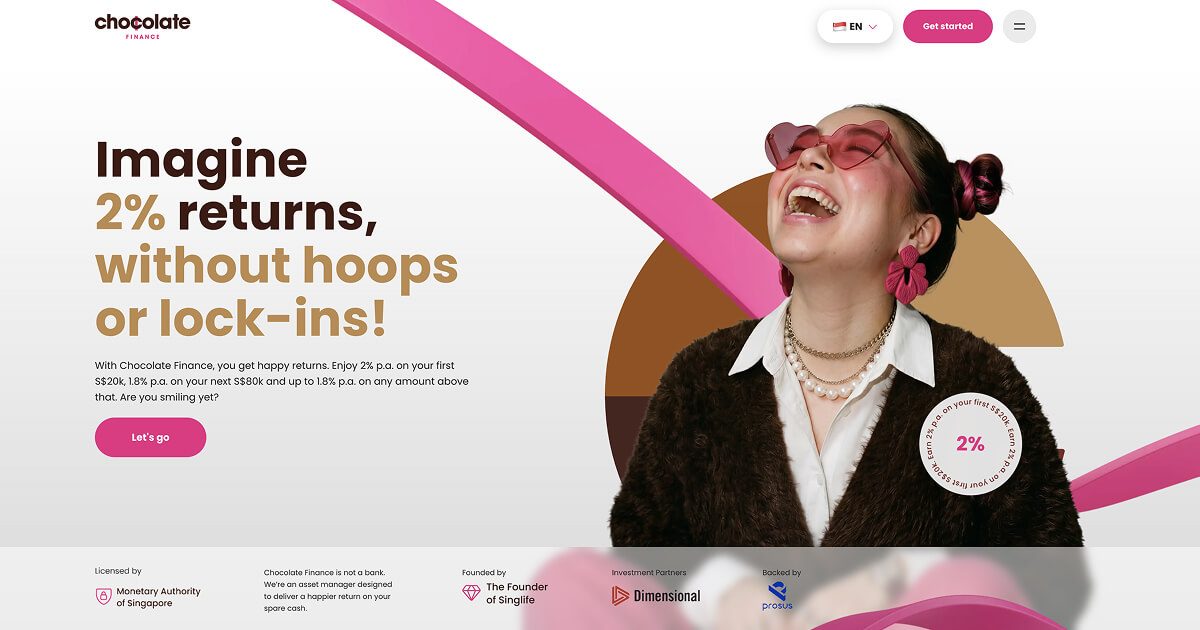
Not technically a bank, it is a regulated investment platform, but Chocolate Finance functions like a high-yield digital savings account for everyday users. It aggregates short-duration money market funds and currently targets 2% p.a. on your first S$20,000, 1.8% p.a. on the next S$80,000 and up to 1.8% p.a. on any amount above that, with daily liquidity (withdrawals back to your bank within 1 business day). No lock-up, no minimum, fully regulated by MAS. The detail most write-ups miss is the Top-Up Programme: if the underlying portfolio fails to deliver the stated return on your first S$100,000, Chocolate tops up the difference for the duration of a qualifying period. That is a promotional support mechanism rather than a guarantee, and it is the reason the target rate has behaved more like a fixed rate than a projection, but it can be changed or withdrawn. There is also a Singapore birthday booster running now, an extra 1% p.a. on up to S$20,000 of newly added SGD for up to 61 days, which you have to opt into. Two live caveats. Returns are targets, not guarantees, and your money is invested rather than deposited, so there is no SDIC cover. And Chocolate's own homepage currently carries three different rate blocks (2%/1.8%, 2.5%/2.2% and 3%/2.7%) in different sections, so check the figure in the app before you commit rather than trusting a page you landed on.

2% p.a. target on your first S$20,000, 1.8% p.a. on the next S$80,000, with the Top-Up Programme covering any shortfall on the first S$100,000 during the qualifying period. Singapore birthday booster: an extra 1% p.a. on up to S$20,000 of newly added SGD for up to 61 days, opt-in required. Not a bank, no SDIC cover.

Get Deal
5
StashAway Simple logo

StashAway Simple

StashAway's cash management product is the more conservative cousin to Chocolate Finance, also based on money market funds, also fully MAS-regulated, and with a longer track record. Simple's projected rate is 1.5% p.a. net of fees, and StashAway publishes the arithmetic behind it: 1.8% p.a. gross, less 0.14% p.a. of underlying fund fees and 0.15% p.a. of StashAway's own management fee. The portfolio is 30% LionGlobal SGD Money Market Fund and 70% LionGlobal SGD Enhanced Liquidity Fund. That 1.5% is the lowest plain-cash number on this list, so it is not the one to pick if you are optimising purely for yield, though its actual annualised returns have run above the projection: 2.68% in Q2 2025, 2.12% in Q3, 1.71% in Q4 and 1.60% in Q1 2026, averaging 2.03% over those twelve months. Its sibling Simple Plus carries a higher yield to maturity, 2.7% p.a. as of 17 July 2026, but holds longer-duration bonds and can genuinely move: the same four quarters ran 5.11%, 6.10%, 1.18% and 0.29%, which is why StashAway suggests a 12-month horizon. A third option, Simple Fixed, locks a rate upfront for a 1-month tenor, quoted at 1.05% p.a. on 28 August 2026, net of all fees and topped up if the underlying fund returns less. Simple has been around since 2020 and has never had a withdrawal hiccup, which is its real selling point, and it sits inside the StashAway investment app, so if you already invest there, Simple is the natural cash holding ground. No minimum, no lock-up, no restrictions on withdrawals or transfers, and no SDIC cover on any of the three.

National Day welcome bonus, 5 Aug – 11 Sep 2026: new investors get a 3.5% p.a. return booster on their first S$10,000 in Simple Plus for 3 months, which StashAway advertises as 6.2% p.a. yield to maturity, plus a S$61 SGD rebate when you invest S$3,000 in SGX-listed ETFs through ETF Explorer. Sign up by 11 Sep 2026. Simple itself stays at a projected 1.5% p.a. with no minimum and no lock-up.

Valid till 11 Sept 2026

Get Deal

Singapore digital bank rates at a glance, verified against each provider's own site on 31 August 2026 with the promotions stripped out

AccountAdvertised rateRate with no conditionsBest ongoing rate you can holdBalance capSDIC-insured?
Trust Bank (Flex Plan)Up to 2.40% p.a.0.40% p.a. (Zen Plan)1.50% p.a. without a monthly card referralUp to S$1.2 millionYes, up to S$100,000
GXS BankUp to 1.75% p.a. (Boost)1.08% p.a. (Saving Pockets)1.08% p.a., nothing to maintainS$95,000Yes, up to S$100,000
MariBankUp to 3.08% p.a.0.88% p.a. (base)1.48% p.a. with ShopeeVIP and salary, to 31 Dec 2026None publishedYes, up to S$100,000
Chocolate Finance2% p.a. target on first S$20k1.8% p.a. above S$20k (target)2% p.a. target, backed by the Top-Up ProgrammeTiered above S$20kNo, not a bank
StashAway Simple1.5% p.a. projected1.5% p.a. projected1.5% p.a. projected (2.03% actual, 12 months to Mar 2026)No minimum or capNo, not a bank

Singapore's banking landscape has changed faster in the last 3 years than in the previous 30. The Monetary Authority of Singapore (MAS) granted digital bank licences in 2020, and by 2026 we have three retail digital banks fully operational (Trust Bank, GXS and MariBank) plus a wave of fintech savings products that operate like digital banks for most practical purposes.

The thing that has changed most since these accounts launched is the rate. The 3% to 4% headline numbers that made digital banks famous in 2023 and 2024 are gone, and what replaced them is a layer of promotional pricing that is easy to misread. As of August 2026 the base rate on a licensed digital bank account here ranges from 0.88% p.a. down to 0.05% p.a. Every number above that is conditional on something, and the conditions are where the money actually is.

How to read a digital bank advert

Ask two questions of any headline rate: how long does it last, and what do you have to keep doing to hold it? On this page, MariBank's 3.08% lasts 30 days, Trust's 2.40% lasts as long as you refer an approved credit card customer every single month, MariBank's 1.48% lasts until 31 December 2026 and needs a paid subscription plus a salary credit, and GXS's 1.08% lasts indefinitely and needs nothing. Those are four very different products wearing similar-looking numbers.

The second habit worth building is checking the base rate before the bonus. Trust's Flex Plan starts at 0.05% p.a., which means 97% of the advertised 2.40% is bonus you have to earn. GXS starts at 0.88% and MariBank at 0.88%, so a missed month costs you far less at either.

Are digital banks in Singapore safe?

The three licensed digital banks, Trust, GXS and MariBank, are full MAS-licensed banks, and your deposits with them are protected by the Singapore Deposit Insurance Corporation (SDIC) up to S$100,000 per depositor per bank, exactly the same cover you get at DBS, OCBC or UOB. On that measure there is no meaningful safety gap.

Chocolate Finance and StashAway Simple are a different animal, and this is the single most misunderstood point about them. They are MAS-regulated, but they are not banks. They are asset managers, your money is invested in underlying funds rather than deposited, and there is no SDIC cover. Their rates are targets or projections, not promises, and they can and do move. That does not make them bad products; it makes them cash-management products rather than savings accounts, and they belong in a different mental bucket.

Why have digital bank rates fallen so far?

The 3% to 4% headline rates of 2023 and 2024 were a product of high global interest rates plus land-grab pricing while the digital banks were buying customers. Both have unwound. Rates across the board have come down, and the banks now have enough scale to stop paying up for deposits. Trust reached its first profitable month in March 2026, which tells you the strategy has shifted from growth to margin. Expect promotional rates rather than permanently high ones from here, and expect them to be reviewed often.

One counter-example is worth noting: GXS raised its Boost Pocket ceiling from 1.6% to 1.75% p.a. this year, and MariBank added a salary-crediting bonus rather than cutting. The direction of travel is still down, but the fixed-term and behaviour-linked products are where any remaining competition is happening.

Which one should you actually open?

If you want the highest rate with no monthly homework, open GXS and use Saving Pockets at 1.08% p.a. It is the only rate on this page that is neither conditional, subscription-gated nor time-limited, and the Grab integration is a genuine bonus.

If you already pay for ShopeeVIP and have a salary you can route, MariBank now pays the best ongoing rate here at 1.48% p.a. Note the two conditions carefully: the salary credit must be at least S$500 and carry a SALA purpose code from a non-individual payer, and the promotion is dated to 31 December 2026. Do not open MariBank for the 3.08%, which is a 30-day new-user rate.

Trust's Flex Plan is the highest number available and has by far the biggest ceiling at S$1.2 million, but be honest about the referral. If you are not going to refer an approved credit card customer every month, price the plan at 1.50% p.a., not 2.40%, and if you are not an NTUC union member, knock another 0.10 points off the card-spend scoop. If you know you will not keep any of it up, Trust's Zen Plan drops you to 0.40% p.a. and GXS is the better home.

Treat Chocolate Finance or StashAway Simple as a place to park spare cash you understand is invested, not as a replacement for your emergency fund.

One practical note: none of these accounts charge a fall-below fee or require a minimum balance, so opening two and splitting your cash costs you nothing. Most people are better off keeping their salary account where it is and using a digital bank purely as the savings pot. The exception is MariBank, where routing the salary is now worth 0.20 percentage points on the whole balance.

Related reads

Frequently Asked Questions

Which digital bank has the highest interest rate in Singapore right now?

It depends on whether you mean the highest advertised rate or the highest rate you can actually keep. MariBank advertises the biggest number at up to 3.08% p.a., but that is 0.88% base plus a 1.60% new-user bonus lasting only 30 days, plus 0.40% for a paid ShopeeVIP subscription, plus 0.20% for crediting a salary. Trust Bank's Flex Plan advertises up to 2.40% p.a. on balances to S$1.2 million, but reaching it requires the +1.20% referral bonus, which means referring a Trust credit card customer who gets approved that month. The highest rate you can hold on an ongoing basis is MariBank's 1.48% p.a., if you keep ShopeeVIP and credit a salary, and that promotion is dated to 31 December 2026. The highest rate with no conditions at all is GXS Saving Pockets at 1.08% p.a. All rates verified against each provider's own site on 31 August 2026.

Is MariBank's 3.08% interest rate real?

The rate is real, but almost nobody earns it for long. MariBank builds 3.08% p.a. from four parts: a 0.88% p.a. base rate that everyone gets, a New User Bonus of 1.60% p.a. that applies only for the first 30 days after you open the account and only to customers new to MariBank who have not held or closed a Mari Savings Account in the previous 180 days, a ShopeeVIP Program Bonus of 0.40% p.a. that requires an active paid ShopeeVIP subscription and a tap of 'Claim' in the app, and a Salary Crediting Bonus of 0.20% p.a. unlocked by one inward transfer of at least S$500 carrying a SALA purpose code. A transfer from your own account or from any other individual does not qualify. So 3.08% is a first-month rate for a brand-new customer who also subscribes to ShopeeVIP and credits a salary. From day 31 you are on 1.48% p.a. if you keep both, 1.08% with the salary credit alone, or 0.88% with neither. The promotion period runs 17 August to 31 December 2026, and the current terms, last updated 25 August 2026, no longer publish the S$100,000 balance cap that applied to the earlier version of this bonus.

Can I actually get Trust Bank's 2.40% on the Flex Plan?

Only if you refer a credit card customer every month. The Flex Plan starts at a 0.05% p.a. base and lets you pick any three of eight bonus rates each month. The three largest are +1.20% for referring a Trust credit card customer who gets approved that month, +0.70% for buying S$20,000 of eligible TrustInvest funds, and +0.45% for crediting at least S$1,500 of salary via GIRO with a SALA purpose code. Those three plus the base come to exactly 2.40%, and no other combination gets there. Drop the referral and your best three are the S$20,000 investment, the salary credit and the +0.30% for a S$100,000 average daily balance, which gives 1.50% p.a. Two smaller traps: salary credited via FAST rather than GIRO does not count, and the five-card-spend bonus pays 0.20% to NTUC union members but only 0.10% to everyone else. Balances above S$1.2 million earn the 0.05% base, and you can switch between the Flex, Signature and Zen plans monthly in the app.

Which digital bank account pays the most with no conditions to meet?

GXS Saving Pockets, at 1.08% p.a. credited daily. There is no salary crediting requirement, no minimum balance, no card spend target, no subscription and no expiry date. You open up to 8 pockets, move money in, and that is the rate. For comparison, the other condition-free options are meaningfully lower: MariBank's base rate is 0.88% p.a. once the 30-day new-user bonus lapses, the GXS Main Account is also 0.88% p.a., and Trust's Zen Plan pays a flat 0.40% p.a. Higher numbers exist on this page, but every one of them is attached to something you must keep doing, keep paying for, or that expires. GXS's total balance cap across the account is S$95,000.

Which GXS Boost Pocket tenure is worth taking?

The 12-month one if you can lock the money up, and never the 8-month one. Boost Pocket pays the 0.88% p.a. base rate daily plus a bonus credited at maturity, and the bonus ladder is not monotonic: 0.13% at 1 month, 0.34% at 3 months, 0.52% at the new 4-month tenure, 0.42% at 8 months and 0.87% at 12 months, for a maximum of 1.75% p.a. The 4-month tenure pays a larger bonus than the 8-month one, so choosing 8 months locks your money away for twice as long in exchange for 0.10 percentage points less. If you want to keep the money reachable, skip Boost entirely and use a Saving Pocket at 1.08% p.a. with no lock-in. You can open up to 8 Boost Pockets, and the S$95,000 cap applies across your whole GXS account.

Are digital bank deposits covered by SDIC in Singapore?

Yes, for the licensed banks. Trust, GXS and MariBank are full MAS-licensed banks, so deposits are insured by the Singapore Deposit Insurance Corporation up to S$100,000 per depositor per bank, identical to the cover at DBS, OCBC or UOB. Chocolate Finance and StashAway Simple are not banks. They are MAS-regulated asset managers, your money is invested in underlying funds rather than deposited, and there is no SDIC protection. That applies to all three StashAway cash products, including Simple Fixed, despite the fixed rate. Their advertised rates are targets or projections rather than guarantees, though both operate a top-up mechanism that covers a shortfall against the stated rate during a qualifying period.

Can I use a digital bank as my main salary account in Singapore?

You can. All three licensed digital banks accept GIRO salary credit, issue a debit card, support PayNow and FAST, and have no minimum balance or fall-below fee. There is now a reason to do it beyond convenience: MariBank pays 0.20% p.a. extra on your whole balance for a salary credit, and Trust's Signature and Flex plans both build bonus interest around it. Watch the mechanics, though. Both banks want the transfer to carry a SALA purpose code, MariBank requires at least S$500 from a non-individual payer, and Trust requires at least S$1,500 via GIRO specifically, so a FAST transfer will not unlock it. The practical gaps are at the edges: no physical branches, limited cheque and cashier's order handling, thinner support for some overseas remittance corridors, and the occasional landlord, agent or institution that still expects a traditional bank. Most people land on a split, with salary at the incumbent bank and the digital bank holding the savings.

Why have Singapore digital bank interest rates dropped in 2026?

Two reasons at once. Global interest rates have come down from their peak, which lowers what every bank can afford to pay on deposits. And the digital banks have stopped subsidising: the 3% to 4% headline rates of 2023 and 2024 were customer-acquisition pricing during a land grab, and that phase is over. Trust posted its first profitable month in March 2026, a sign the sector has shifted from chasing growth to protecting margin. GXS cut the hardest, from a headline above 3% to 0.88% on its Main Account. The trend is not uniform, though. GXS raised its Boost Pocket ceiling to 1.75% p.a. this year and MariBank added a salary-crediting bonus rather than trimming, so the competition that remains is in fixed-term and behaviour-linked products rather than in the headline savings rate.

#best digital banks singapore#trust bank singapore#gxs bank singapore#maribank singapore#high yield savings singapore 2026#digital savings account singapore#chocolate finance singapore#stashaway simple#maribank 3.08 interest rate#trust bank flex plan 2.40#which digital bank to open singapore#are digital banks safe singapore#digital bank no conditions singapore

You Might Also Like