5 Best Neobank Savers in Singapore (2026): Trust vs GXS vs MariBank vs Chocolate vs StashAway Simple
Deals

5 Best Neobank Savers in Singapore (2026): Trust vs GXS vs MariBank vs Chocolate vs StashAway Simple

Singapore savings rates fell hard through 2026, with UOB One down to a maximum 1.90%, and the neobanks cut just as deeply. Three of the five moved again in the past month. GXS raised its Boost Pocket ceiling to 1.75% p.a. and is running a 3% p.a. guaranteed save-and-invest campaign to 30 September. MariBank now advertises up to 3.08% p.a. after adding a salary-crediting bonus. StashAway is offering new clients 6.2% p.a. yield to maturity on Simple Plus if they sign up and invest by 11 September. We compare Trust, GXS, MariBank, Chocolate Finance and StashAway Simple on what they actually pay in September 2026: real rates, caps, conditions and fine print, including Chocolate's SG61 booster running to 30 September. Every figure below was read off each provider's own site on 3 September 2026.

Marcus Wong2 May 202610 min readUpdated 3 Sept 2026

If you last looked at Singapore's neobanks in 2024, throw out the numbers in your head: every provider here cut rates during 2026.

> Quick view: the best no-hoops SGD rate is Chocolate Finance at 2.0% p.a., though it is not a bank. Trust Flex pays up to 2.40% p.a. if you clear 3 of 8 monthly scoops. GXS Boost Pockets now reach 1.75% p.a. Read the conditions, not the headline.

1
Trust Bank: Flex, Signature & Zen plans logo

Trust Bank: Flex, Signature & Zen plans

Trust replaced its old single-rate savings account with three plans you can switch between monthly in the app. Flex is the one worth having: up to 2.40% p.a. by completing any three of eight bonus 'scoops' each month, on deposits up to S$1.2M. The largest on paper is +1.20% for referring a new credit card customer, but that is not repeatable for most people, so the realistic combination is +0.70% for holding S$20,000 in eligible TrustInvest funds, +0.45% for crediting a S$1,500 salary via GIRO, +0.30% for a S$100,000 average daily balance, +0.20% for growing your average daily balance by S$3,000 month-on-month, +0.15% for receiving S$1,500 in PayNow transfers and +0.15% for S$500 of foreign currency spend. The card-spend scoop, five transactions of S$30 or more, is worth +0.20% to NTUC union members but only +0.10% to everyone else. Signature (the default if you pick nothing) caps at 1.00% on four of those scoops, and Zen pays a flat 0.40% with no conditions. Base rate on all three is 0.05%, so Flex punishes an off month. SDIC-insured, Standard Chartered-backed. Best for: people whose salary, card and investing activity already sit in one place, and who will actually check the scoops each month.

Visit website
2
Chocolate Finance logo

Chocolate Finance

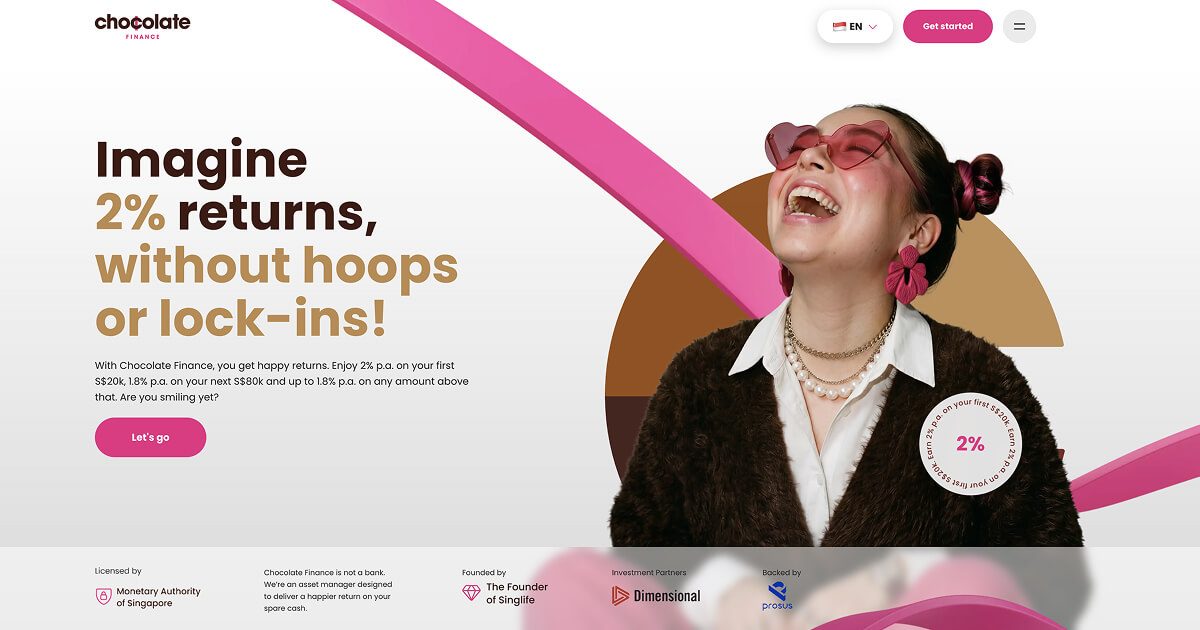
Targets 2.0% p.a. on the first S$20,000 SGD and 1.8% p.a. on the next S$80,000, covering your whole first S$100,000, and up to 1.8% on anything above that, with no monthly conditions at all: no salary credit, no card spend, no subscription. That makes it the highest no-hoops SGD yield on this list, roughly double what GXS or MariBank pay on an ongoing basis. Until 30 September 2026 the SG61 birthday booster adds 1% p.a. on up to S$20,000 of newly added money if you opt in and top up at least S$5,000, taking the top tier to 3.0% p.a. USD is 4.1% p.a. on the first US$20,000 and 3.8% on the next US$80,000. Important caveats: Chocolate is NOT a bank. It is a Capital Markets Services licensee investing in fixed-income funds, so deposits are not SDIC-insured, capital is not guaranteed, and the rates are targets rather than promised interest. Funds are held with regulated custodians (HSBC, State Street). Its returns top-up programme, which makes up any shortfall against the 2% and 1.8% targets, now runs to a qualifying period ending 31 December 2026 on the company's own published rate data, extended from the 30 June 2026 date its FAQ carried earlier this year. Best for: savers who want a genuinely condition-free 2% and accept fund risk in exchange.

Visit website
3
GXS Bank: Savings Account, Saving Pockets & Boost Pockets logo

GXS Bank: Savings Account, Saving Pockets & Boost Pockets

GXS has cut hard on its main account, which now pays 0.88% p.a. with interest credited daily, but it has been moving its pocket rates the other way. Move money into a Saving Pocket, a separate sub-account for goals like a holiday or emergency fund, and it earns 1.08% p.a., currently flagged as a limited-time promotional rate. A Boost Pocket goes higher, up to 1.75% p.a. as of September 2026 (raised from 1.6%), made up of the 0.88% base plus a maturity bonus running from +0.13% on a 1-month term to +0.87% on a 12-month term, paid when the pocket matures; a 4-month term at +0.52% is newly added. You can now hold up to 8 Boost Pockets and 8 Saving Pockets, with total deposits capped at S$95,000 across all of them. Running 1 to 30 September 2026 only, GXS will pay a guaranteed 3% p.a. on a 4-month Boost Pocket if you also invest at least S$5,000 in a GXS Invest fund (excluding Cash Plus) by 30 September and hold that investment to 31 January 2027; both sides must be fresh funds, measured against your 31 August 2026 balance, and 1.6% of that 3% arrives as cashback by 28 February 2027 rather than as interest. Note that the 3.48% figure still circulating online was a limited launch tranche of Boost Pockets and is no longer available. SDIC-insured (Singtel/Grab consortium). Best for: goal-based savers happy to commit part of their balance to a fixed term, since the pocket structure also makes it harder to raid the emergency fund on impulse.

Visit website
4
MariBank: Mari Savings Account logo

MariBank: Mari Savings Account

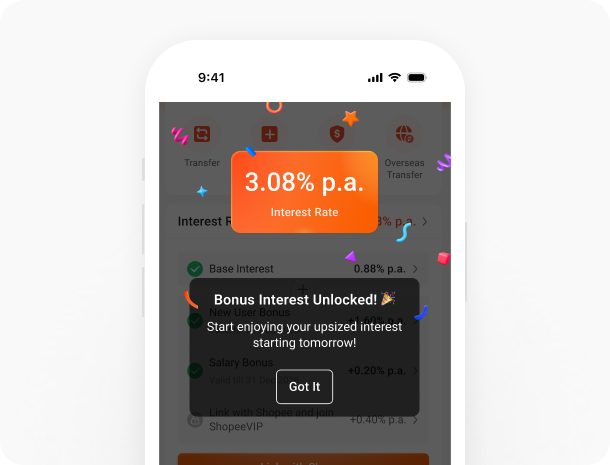
The ongoing rate is 0.88% p.a., with genuinely no conditions: no salary credit, no card spend, no minimum deposit, no fall-below fees, and interest credited daily. The 3.08% p.a. MariBank now advertises (up from 2.88%) is that 0.88% base plus three add-ons: a +1.60% new-user bonus that applies only for your first 30 days after opening (on balances up to S$100,000), +0.40% that requires you to link your Shopee account and hold an active paid ShopeeVIP subscription, and a newly added +0.20% for crediting your salary. So treat 3.08% as a first-month welcome rate, not a rate you can hold; the most a long-term customer can realistically stack is 0.88% plus the ShopeeVIP and salary bonuses. Balances above S$100,000 earn the 0.88% base. SDIC-insured (backed by Sea Group, Shopee's parent). Best for: parking cash you want completely liquid and hassle-free, or Shopee regulars who already pay for ShopeeVIP.

Visit website
5
StashAway Simple / Simple Plus logo

StashAway Simple / Simple Plus

StashAway's cash management products, both with no lock-in, no minimum, and withdrawals in about one working day. Simple has a projected rate of 1.5% p.a. net of fees, invested in low-risk T-bills and bank deposits. Simple Plus carries a 2.7% yield to maturity (last updated 17 July 2026) and holds slightly higher-risk corporate debt with a recommended holding period of at least 12 months, so its value can move against you. Running 5 August to 11 September 2026, StashAway's National Day sign-up offer quotes a boosted 6.2% p.a. yield to maturity on Simple Plus plus S$61 of SGX-listed ETF rebates for new clients who complete sign-up and invest by 11 September; T&Cs apply and it is a welcome offer rather than an ongoing rate. A Simple Fixed option is also available, where the rate is shown upfront at the point you invest, and a separate Simple Guaranteed product was quoting a projected 1.05% p.a. at the time of writing. Neither Simple nor Simple Plus is SDIC-insured, as StashAway is a CMS licensee rather than a bank, though funds sit with regulated custodians. Best for: investors comfortable with money-market and short-duration credit risk who want yield without locking cash up.

Visit website

Rates verified against each provider's own site, 3 September 2026. "Ongoing rate" excludes new-user teasers and one-off bonuses. Chocolate Finance and StashAway are not banks, so their figures are targets rather than guaranteed interest, and are not SDIC-insured.

ProviderOngoing rate (no conditions)Max rateWhat the max requiresBalance capSDIC-insured
Trust Bank (Flex plan)0.05% base2.40% p.a.3 of 8 monthly 'scoops', e.g. S$20k invested (+0.70%), S$1,500 salary (+0.45%)S$1.2MYes
Trust Bank (Zen plan)0.40% p.a.0.40% p.a.Nothing, flat rateS$1.2MYes
Chocolate Finance (SGD)2.0% p.a. target3.0% p.a. targetSG61 booster to 30 Sep 2026: opt in, add S$5k+; 1.8% on next S$80kFirst S$20k at top tierNo, not a bank
GXS Bank0.88% p.a.up to 1.75% p.a.Lock funds in a Boost Pocket for a fixed 1, 3, 4, 8 or 12-month termS$95,000 totalYes
GXS save-and-invest promon/a3.0% p.a. guaranteed4-month Boost Pocket + S$5k in a GXS Invest fund by 30 Sep 2026, held to 31 Jan 2027Fresh funds onlyYes on the pocket
MariBank0.88% p.a.3.08% p.a.+1.60% for first 30 days only, +0.40% needs paid ShopeeVIP, +0.20% salary creditFirst S$100k for bonusYes
StashAway Simple1.5% p.a. projected1.5% p.a.Nothing, projected rate net of feesNo capNo, not a bank
StashAway Simple Plus2.7% yield to maturity6.2% YTMNew clients only: sign up and invest by 11 Sep 2026No capNo, not a bank
For reference: UOB One0.05%1.90% p.a.S$1,600 salary credit + S$500 card spendS$150,000Yes
For reference: OCBC 3600.05%2.20% p.a.Salary + save + spend; promo rate 1 Aug to 31 Dec 2026 (4.70% with insure/invest)S$100,000Yes

What changed since our last check

Three of the five providers moved in the past month, and one of the moves reverses a number this guide carried all summer.

GXS raised its Boost Pocket ceiling from 1.6% to 1.75% p.a. The maturity bonus ladder was rebuilt: +0.13% on a 1-month term, +0.34% on 3 months, +0.52% on a newly added 4-month term, +0.42% on 8 months and +0.87% on 12 months, all on top of the 0.88% base. You can also now hold up to 8 Boost Pockets rather than 5, with the same S$95,000 combined deposit cap.

MariBank's advertised maximum rose from 2.88% to 3.08% p.a., because it added a +0.20% salary-crediting bonus to the existing stack. The ongoing base rate did not move: it is still 0.88% p.a.

StashAway is running a National Day sign-up offer, 5 August to 11 September 2026, quoting 6.2% p.a. yield to maturity on Simple Plus plus S$61 of SGX-listed ETF rebates for new clients who complete sign-up and invest by 11 September. That supersedes the older new-user booster this guide previously described.

Several figures still circulating online, including Trust at 4%, MariBank at 3.21% and GXS at 3.48%, no longer exist. Trust retired its old flat-rate structure for three named plans, GXS's main account now pays 0.88% p.a., and MariBank's base rate is also 0.88%.

How the incumbents compare

The Big-3 fell too, but one of them has since bounced. UOB One now pays a maximum effective 1.90% p.a., while OCBC 360 is running a promotion to 2.20% p.a. on the first S$100,000 from 1 August to 31 December 2026 for salary, save and spend, a temporary lift to the Save bonus and higher than any ongoing rate a neobank on this list will give you. The honest 2026 summary is that neobanks no longer beat a Big-3 account you already qualify for. They win on the money that doesn't fit those conditions, and on not making you jump through hoops every month.

Three of the five options below are licensed digital banks under MAS (Trust, GXS, MariBank) with SDIC protection up to S$100k per bank. Two are non-bank cash management products (Chocolate Finance, StashAway Simple) that are not SDIC-insured and carry investment risk. All rates were verified against each provider's own site on 3 September 2026.

Chocolate Finance vs MariBank

The most common head-to-head, and the answer is clearer than it used to be. Chocolate Finance targets 2.0% p.a. on your first S$20,000 and 1.8% p.a. on the next S$80,000, so the whole of your first S$100,000 is covered, with no monthly conditions at all: no salary credit, no card spend, no subscription. MariBank pays 0.88% p.a. as its ongoing base rate. Its advertised 3.08% is that 0.88% base plus a 1.60% new-user bonus that runs only for your first 30 days, plus 0.40% that requires an active paid ShopeeVIP subscription, plus a 0.20% salary-crediting bonus.

So for the first month, MariBank pays more. From month two onward, Chocolate roughly doubles it, and through the SG61 booster window below, closer to triples it on new money. The catch is protection: MariBank is a licensed bank with SDIC coverage to S$100,000, while Chocolate Finance is a Capital Markets Services licensee investing in fixed-income funds, so your capital is not guaranteed and returns are a target rather than a promise. Pick MariBank if SDIC coverage is non-negotiable; pick Chocolate if you accept fund risk for roughly double the yield.

Chocolate Finance's SG61 birthday booster (1 Aug to 30 Sep 2026)

Running for 61 days to mark Singapore's 61st birthday and Chocolate's second, this is one of three live promotions among the five providers right now, and unlike MariBank's 30-day teaser, you do not need to be a new customer to take it.

Opt in through the Chocolate app, then add and maintain at least S$5,000 above your starting balance (your highest SGD balance during the promotion period before you opted in) until 30 September. Qualifying new money then earns an extra 1% p.a. on up to S$20,000, which works out as:

  • 3.0% p.a. on qualifying new money sitting in the 2% tier (the first S$20,000)
  • 2.8% p.a. on qualifying new money in the 1.8% tier (S$20,001 to S$100,000)
  • an extra 1% p.a. on the actual returns earned on qualifying new money above S$100,000

The boosted portion is not paid daily like the rest. It lands in your Chocolate SGD account about 10 business days after the booster ends on 30 September. The same caveat as always applies: Chocolate is not a bank, so 3.0% is a target return on an invested balance, not guaranteed interest.

GXS's save-and-invest campaign (1 to 30 Sep 2026)

New this month, and the highest guaranteed number on this page. Create a 4-month Boost Pocket with at least S$5,000 of fresh funds, invest at least S$5,000 in any GXS Invest fund other than Cash Plus by 30 September 2026, then hold the pocket to maturity and the investment through to 31 January 2027. GXS then pays a guaranteed 3% p.a. on the Boost Pocket funds, in place of the standard 1.4% p.a. 4-month rate.

Read the construction before you commit, because only part of it is interest: 0.88% p.a. daily base interest, plus 0.52% p.a. bonus interest credited when the 4-month pocket matures, plus 1.6% p.a. paid as cashback into your Main Account by 28 February 2027. Both the pocket and the investment must be fresh funds not previously held with GXS, assessed against your account balance as at 31 August 2026, and the investment carries market risk that the Boost Pocket does not.

GXS vs MariBank

Effectively a tie on the base rate. Both sit at 0.88% p.a., both credit interest daily, and neither requires a salary credit or card spend to earn it, so this comes down largely to structure.

GXS lets you push higher in two steps. Money moved into a Saving Pocket earns 1.08% p.a. with no lock-in (up to 8 pockets), which GXS currently flags as a limited-time promotional rate, and a Boost Pocket pays up to 1.75% p.a., the 0.88% base plus a maturity bonus of +0.13% to +0.87% depending on term. Boost Pocket terms are fixed at 1, 3, 4, 8 or 12 months, you can hold up to 8 of them, and the bonus is only paid if you leave the money in until maturity. Total GXS deposits are capped at S$95,000 across all pockets.

MariBank has no equivalent tiering, so you either hold the base rate or you are inside the 30-day new-user window, but it also has no cap on liquidity, no fall-below fee and no minimum deposit, and it pays 0.88% on balances well past S$95,000 (the base rate continues above S$100,000, only the bonus stops). It is also the one of the two that now rewards a salary credit, at +0.20% p.a.

The practical split: choose GXS if you have a defined savings goal and can leave part of the balance untouched for a fixed term, since 1.75% is roughly double MariBank's rate, but only on locked money. Choose MariBank if you want everything instantly liquid, if you are saving more than S$95,000, or if you already pay for ShopeeVIP and can claim its 0.40% bonus. If neither appeals, note that Chocolate Finance's condition-free 2.0% beats both, at the cost of SDIC protection.

GXS vs Trust

Trust wins on headline rate, GXS on simplicity. Trust's Flex plan reaches up to 2.40% p.a., but only by completing three of eight monthly "scoops". The largest is +1.20% for referring a new credit card customer, which is not something most people can repeat every month, followed by +0.70% for holding S$20,000 in eligible TrustInvest funds and +0.45% for crediting a S$1,500 salary. Miss them and you fall toward the 0.05% base. GXS pays 0.88% p.a. with nothing required at all, rising to 1.75% only if you lock funds in a Boost Pocket. Worth saying plainly, because the search traffic suggests people mix them up: the Boost Pocket ceiling is a GXS rate, not a Trust rate, and no Trust plan pays it.

Trust also offers a no-conditions option, the Zen plan at a flat 0.40% p.a., which is actually worse than simply leaving cash in GXS. So the rule of thumb: if you will genuinely clear three Flex scoops every month, Trust pays roughly triple GXS. If you won't, GXS pays more than Trust's unconditional plan.

Trust vs MariBank

Trust's Flex plan at up to 2.40% p.a. beats MariBank's 0.88% base by a wide margin, but only for people whose monthly banking already looks like Trust's scoop list (salary credit, card spend, invested balances). MariBank asks nothing for its 0.88%, and now adds +0.20% if you credit your salary. Trust's unconditional Zen plan pays 0.40%, which MariBank beats. One detail worth checking before you count on it: the card-spend scoop, five transactions of S$30 or more on your Trust card, is worth +0.20% p.a. to NTUC union members but only +0.10% p.a. to everyone else, and neither is the headline 4% rate widely quoted from Trust's earlier product.

Related reads

Frequently Asked Questions

Are neobanks safe in Singapore?

Trust, GXS, and MariBank are licensed digital banks under MAS, and deposits are SDIC-insured up to S$100,000 per depositor, the same protection as DBS, OCBC and UOB. Chocolate Finance is a Capital Markets Services licensee rather than a bank, so deposits are NOT SDIC-insured, though funds are held with regulated custodians. StashAway Simple invests in money market funds (T-bills, fixed deposits), also not SDIC-insured but very low risk. For peace of mind, prefer Trust, GXS or MariBank for primary savings.

What's the highest neobank interest rate in Singapore right now?

For a rate you can hold long-term, Trust Bank's Flex plan tops the list at up to 2.40% p.a., but you have to complete three of eight bonus 'scoops' every month, such as salary credit, investing and card spend. Chocolate Finance targets 2.0% p.a. on the first S$20,000 with no monthly hoops, though it is not a bank, and until 30 September 2026 its SG61 birthday booster lifts newly added money in that tier to 3.0% p.a. Two limited campaigns currently pay more: GXS is offering a guaranteed 3% p.a. on a 4-month Boost Pocket held alongside a GXS Invest holding until 30 September 2026, and StashAway is quoting 6.2% p.a. yield to maturity on Simple Plus for new clients who sign up and invest by 11 September 2026. Other headline figures are usually temporary. MariBank advertises up to 3.08% p.a., but that stacks bonuses including one that only holds for 30 days after opening and another that requires a paid ShopeeVIP subscription. Its ongoing base rate is 0.88% p.a.

Does Trust Bank pay 1.6% interest?

No, 1.6% is not a Trust Bank rate, and the confusion is common enough that it is worth stating plainly. Trust's three plans pay a flat 0.40% p.a. (Zen), up to 1.00% p.a. (Signature) or up to 2.40% p.a. (Flex, if you clear three of eight monthly scoops), all on a 0.05% base. The figure people are usually thinking of belongs to GXS Bank, and it has since moved: a GXS Boost Pocket now pays up to 1.75% p.a., made up of the 0.88% base plus a maturity bonus of +0.13% to +0.87% depending on whether you pick a 1, 3, 4, 8 or 12-month term, paid when the pocket matures. Separately, 1.6% is the cashback component of the GXS save-and-invest campaign running to 30 September 2026, not an interest rate on its own.

Are neobanks still worth it after the 2026 rate cuts?

Less than they were, and you should do the maths rather than assume. Through 2026 the digital banks cut rates at least as aggressively as the incumbents: GXS's main account is now 0.88% p.a. and MariBank's base is 0.88%, while UOB One pays a maximum 1.90% and OCBC 360 is running a promotion to 2.20% p.a. on salary, save and spend until 31 December 2026. If you already meet a Big-3 account's salary-and-spend conditions, that is likely still your best home for the first S$100k. Neobanks remain genuinely useful for money that does not fit those conditions, such as freelance income, a second pot beyond the bonus cap, or savings you want free of monthly hoops. For the no-conditions comparison, Trust's Zen plan at a flat 0.40% and GXS at 0.88% are the honest benchmarks.

Do I need to credit my salary to a neobank to get the best rate?

It depends on the provider, and in 2026 the trade-off has shifted. Chocolate Finance and StashAway Simple ask for no salary credit and no monthly activity at all, so you simply deposit. GXS imposes no salary condition either, but its unconditional rate is now only 0.88% p.a. MariBank's 0.88% base needs nothing, though it has now added a +0.20% p.a. salary-crediting bonus on top for those who do route their pay through it. Trust Bank is where conditions buy you the most: its Flex plan reaches 2.40% p.a. only if you complete three of eight monthly actions, one of which is a S$1,500 salary credit worth +0.45%. If your salary is locked to an employer-nominated bank, Trust's Zen plan (flat 0.40%, no conditions) or Chocolate Finance are the realistic picks.

Can I have multiple neobank accounts in Singapore?

Yes, there is no rule against holding accounts at Trust, GXS, MariBank and traditional banks simultaneously. A common 2026 structure: salary credited to a Big-3 account to clear its bonus conditions on the first S$100k, a Trust Flex plan for money you can route enough monthly activity through, and Chocolate Finance or StashAway Simple for overflow cash you want liquid. Spreading also keeps you under the SDIC S$100k-per-bank cap if you have substantial savings. Note that cap is per bank, so Trust, GXS and MariBank each carry their own S$100k of coverage.

Is MariBank halal or syariah-compliant?

No. MariBank is a conventional digital bank licensed by MAS, and the Mari Savings Account pays conventional interest. There is no syariah-compliant deposit product and no Islamic banking certification. The same is true of GXS and Trust. If you need a syariah-compliant savings account in Singapore, the established options are Maybank's Savings Account-i and CIMB's FastSaver-i, both structured to avoid interest. Note that those accounts pay materially less than the neobank rates in this guide, which is the trade-off.

#best neobank singapore 2026#trust bank savings#gxs bank singapore#maribank singapore#chocolate finance#stashaway simple#digital bank savings singapore#high yield savings singapore#neobank vs bank singapore#gxs vs maribank#maribank vs chocolate finance#chocolate finance sg61 booster#trust bank interest rate 2026#is maribank halal#gxs boost pocket rate#gxs vs trust

You Might Also Like