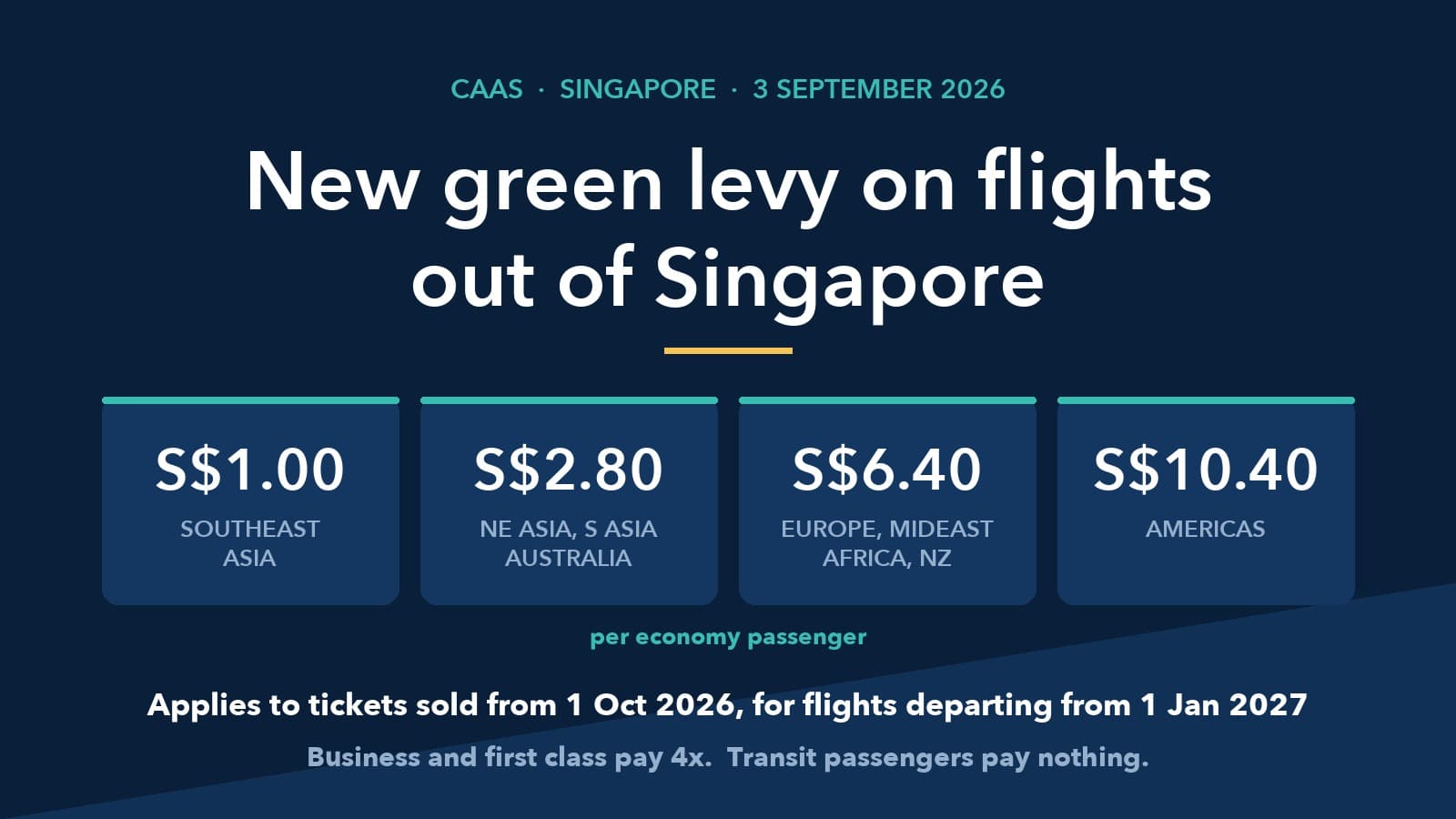
*Published 3 September 2026. All figures below are from the Civil Aviation Authority of Singapore's own media releases of 3 September 2026 and 10 November 2025. Cover: original graphic by Miss Lobang using CAAS's published levy table.*
Singapore's Sustainable Aviation Fuel levy has been announced, deferred once, and argued about for the better part of a year. On 3 September 2026 the Civil Aviation Authority of Singapore (CAAS) confirmed it is going ahead for passengers, and at the same time pushed the air cargo half of it back by a full year.
> Quick view: from 1 October 2026, tickets sold for flights departing Singapore on or after 1 January 2027 carry a SAF Levy. Economy and premium economy pay S$1.00 to S$10.40 depending on region. Business and first pay four times that, S$4.00 to S$41.60. Transit passengers pay nothing, and a ticket sold before 1 October escapes it no matter when you fly.
What you will actually pay
The levy is per passenger, and it varies on two things only: how far you are going, and whether you are sitting in an economy or a premium cabin. CAAS groups every destination from Singapore into four geographical bands.
| Band | Where | Economy cabin | Premium cabin |
|---|---|---|---|
| I | Southeast Asia | S$1.00 | S$4.00 |
| II | Northeast Asia, South Asia, Australia, Papua New Guinea | S$2.80 | S$11.20 |
| III | Africa, Central and West Asia, Europe, Middle East, Pacific Islands, New Zealand | S$6.40 | S$25.60 |
| IV | Americas | S$10.40 | S$41.60 |
In CAAS's own examples, that is S$1.00 to Bangkok, S$2.80 to Tokyo, S$6.40 to London and S$10.40 to New York in economy.
Worth noting how modest that turned out to be. CAAS had earlier estimated the levy at around S$3.00, S$6.00 and S$16.00 for economy to Bangkok, Tokyo and London. The actual figures came in at S$1.00, S$2.80 and S$6.40, roughly 60% below the estimate, which CAAS attributes to the lower prevailing cost of sustainable aviation fuel since those numbers were first drawn up.
Two dates, and both have to be true
This is the part worth reading twice, because most summaries mention only one date.
You pay the levy only if both of these hold:
- Your ticket was sold from 1 October 2026, and
- Your flight departs Singapore from 1 January 2027
Fail either test and there is no levy. A ticket issued on 30 September 2026 for a flight in March 2027 is not charged. A ticket bought in November 2026 for a flight departing on 20 December 2026 is not charged either, because the flight is before the start date.
So yes, booking before 1 October genuinely avoids it. Whether that matters is covered further down.
The band follows your first stop, not your destination
Buried in paragraph three of the November release is a rule with real consequences: *for flights with multiple stops, the levy is based on the immediate next destination after departing Singapore.*
Read that against the band table and a small oddity appears. A direct Singapore to New York flight is Band IV, so S$10.40 in economy. Route yourself Singapore to Tokyo and onward to New York, and the levy is assessed on the Tokyo leg, which is Band II, so S$2.80. Same final destination, different levy.
Before anyone reorganises an itinerary around this: the gap is S$7.60. A connecting routing almost always costs more in fare, time and risk than that, so this is a footnote for people who were already connecting, not a strategy. It does explain why two travellers heading to the same city can see different amounts on their fare breakdown.
Premium economy is not a premium cabin
CAAS defines the Economy Cabin as economy class *and* premium economy class. The Premium Cabin is business class and first class only.
That matters because the multiplier is not gentle. Premium cabin pays exactly four times the economy figure for the same band, based on industry norms for calculating per-passenger emissions in different cabins. A premium economy seat to the Americas is therefore charged S$10.40, not S$41.60. If you fly premium economy long-haul, you are on the cheap side of a 4x cliff.
Who pays nothing
- Transit passengers. The levy applies only to Origin-Destination passengers, meaning journeys that begin in Singapore. If you are connecting through Changi from somewhere else to somewhere else, you are not charged.
- Anyone holding a ticket sold before 1 October 2026, whenever they fly.
- Anyone departing before 1 January 2027.
- Certain training flights and flights for charitable or humanitarian purposes, which CAAS exempts outright.
Today's actual news: cargo gets another year
The passenger levy was already scheduled. What changed on 3 September is the cargo side. CAAS is deferring the SAF Levy for air cargo shipments by one year, so it now applies to services sold from 1 October 2027 for flights departing Singapore from 1 January 2028.
The reason given is practical rather than political. Cargo involves a much wider cast than passenger ticketing, airlines, air express companies, freight forwarders and shippers, with varying commercial arrangements, so CAAS wants more time to build a collection mechanism that works. The published cargo rates, when they arrive, are S$0.01 to S$0.15 per kilogramme by band.
CAAS also confirmed that SAFCo, the non-profit company it wholly owns, completed its first voluntary SAF procurement trial in August 2026 with nine participants including Singapore Airlines, Scoot, Changi Airport Group, DBS, OCBC and Temasek. A request for proposal for the levy-funded procurement is planned by end 2026, with the first batch of fuel expected to be uplifted in mid-2027.
So should you book early to dodge it?
Honestly, for most people, no.
Run the numbers. A couple flying economy to Bangkok avoids S$2.00. A family of four flying economy to the United States avoids S$41.60 in total. You have to be booking four business class seats to the Americas before the saving reaches S$166.40, and at that fare level the levy is a rounding error.
Set against that, airfares for the same route routinely swing by tens or hundreds of dollars between September and departure. Booking a 2027 trip in the next four weeks purely to avoid a levy of at most S$10.40 a head means locking in today's fare, which may or may not be the better one. If you were going to book anyway and the fare is good, the timing is a small bonus. It is not a reason to rush.
One genuine gap: CAAS's releases do not address what happens if a ticket sold before 1 October is later changed or reissued. If you book early and expect to amend your dates, ask the airline how it treats a reissue before you rely on the exemption.
The fine print
- The levy must be shown as a distinct line item in the fare breakdown, like other taxes and charges, so you can verify what you were charged.
- It is collected by the airline, then channelled to a statutory SAF Fund used to buy sustainable aviation fuel and its associated environmental attributes, plus administration costs.
- The quantum was set against Singapore's 1% SAF uplift target for 2026, with an ambition to raise that to 3% to 5% by 2030. That means the amounts above are not fixed forever.
- General and business aviation flights pay per aircraft, by wingspan band, from S$40 up to S$6,500.
This is a summary of published government policy, not travel or financial advice. Confirm the details with your airline or with CAAS before making decisions that depend on them.
Related
- Singapore Airlines Great Fares From S$198
- KLM Real Deal Days
- Anak Krakatau Eruption
- Japan's New Travel Rules: Departure Tax, JR Pass and Tax Refund Changes
- Singapore Airlines Fare Sale
- Best Travel Booking Sites in Singapore
- Best Travel and Miles Credit Cards in Singapore
- NATAS Travel Fair 2026: Deals and Promo Codes
*Sources: CAAS media release "CAAS to Start Sustainable Aviation Fuel Levy for Origin-Destination Passengers, General and Business Aviation Flights from 1 October 2026 for Flights Departing from 1 January 2027" (3 September 2026), and CAAS media release "New Sustainable Aviation Fuel Levy to Apply From 1 April 2026 for Flights Departing From 1 October 2026" (10 November 2025), which carries the full band and rate tables. Dates and amounts checked against caas.gov.sg on 3 September 2026.*