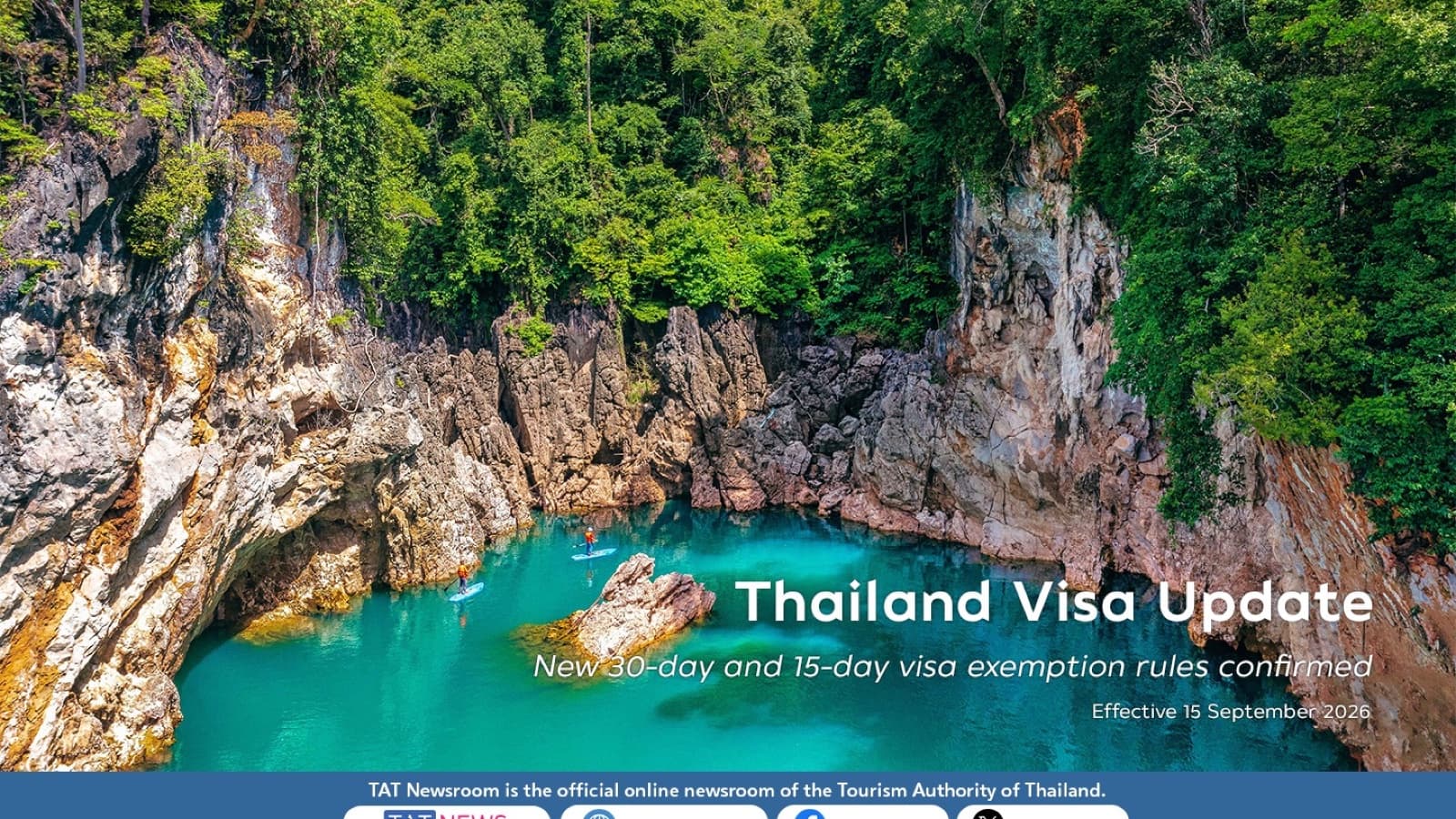
> Quick view: from Monday 15 September 2026, a Singapore passport gets you 30 days visa-free in Thailand instead of 60. The test is your arrival date, not your booking date. Land in Thailand at any point up to 23:59 on Sunday 14 September and you still receive the 60-day stamp for that whole trip.
Thailand's Ministry of Interior published four new regulations in the Royal Gazette on 31 August 2026 (Volume 143, Special Issue 207 Ngor). They repeal the 60-day visa exemption that has been running since 15 July 2024 and replace it with a shorter one. Each regulation takes effect 15 days after publication, which puts the changeover at 15 September 2026.
The Tourism Authority of Thailand confirmed the details in its own press release on 1 September. Singapore appears at position 48 on the new 30-day list, which runs to 60 countries and territories in total. Two countries (Seychelles and Mauritius) drop to a 15-day exemption, and Visa on Arrival shrinks to just three nationalities: Azerbaijan, Belarus and Serbia.
Thai officials have framed the change as part of an effort to curb crime involving foreign nationals.
What actually changes for a Singapore passport
| Until 14 Sep 2026 | From 15 Sep 2026 | |
|---|---|---|
| Visa-free stay | 60 days | 30 days |
| Countries on the list | 93 | 60 |
| Stated purpose | Tourism, plus certain short-term work and business | Tourism |
| Land-border entries per year | Not capped | Capped at 2 for most nationalities, but Singapore is exempt |
| Cost | Free | Free |
The date that matters is the day you land
This trips people up, so it is worth being blunt about it. The cutoff is not when you booked, not when you paid, and not when you fly out of Changi if you are on a red-eye. It is the moment you are stamped in at Thai immigration.
Clear the booth before midnight on Sunday 14 September and you get 60 days for that trip, and that stay is not retroactively cut short on the 15th. Anyone already in Thailand on a 60-day stamp keeps the period they were granted on arrival. Clear it after midnight and you get 30.
If you have a long Thailand trip already booked that straddles the date, this is the one thing to check. Pulling an arrival forward by a single day can be the difference between 30 and 60 days.
The bit nobody is telling Singaporeans
Almost every write-up of this change leads with "60 days down to 30". For a Singapore passport there is a second clause in the same regulation that matters more, and it is good news.
The new rules reintroduce a cap on land border crossings: travellers entering visa-free through a land checkpoint may do so no more than twice per calendar year. That is a hard limit for most nationalities on the list.
Singapore is expressly carved out. The regulation states the restriction does not apply to nationals of Malaysia, Brunei Darussalam, Indonesia and Singapore, or to other nationalities the Minister may later designate. So if you are one of the people who buses or drives up to Hat Yai several times a year, that pattern is untouched. You are simply doing it on a 30-day stamp instead of a 60-day one.
"Tourism" is now the stated purpose
The 60-day scheme that is being repealed covered tourism plus certain short-term work and business engagements. The replacement 30-day category is written for holders seeking entry for tourism, and the short-term work and business references are gone from that wording.
For a holiday this changes nothing. If you have been using the visa exemption to slip in for a two-day client meeting or a conference, check your position with the Royal Thai Embassy before you travel rather than assuming the old wording still covers you. The e-Visa site lists a separate tourist visa route for MICE participants supported by the Thailand Convention and Exhibition Bureau.
If you need longer than 30 days
Two routes, and they are very different amounts of effort.
Extend once, in Thailand. The standing practice at Thai immigration offices is a single 30-day extension of a visa-exempt stay for 1,900 baht, paid in cash at the counter. It has to be done in person, it is not available through the online e-extension system, and it is granted at the officer's discretion rather than automatically. The new regulations do not address extensions, so treat this as the existing rule and confirm it with the immigration office nearest your accommodation.
Apply for a tourist visa before you go. Thailand's official e-Visa portal is thaievisa.go.th, run by the Ministry of Foreign Affairs. For tourism and leisure it offers single and multiple entry, with 3-month or 6-month visa validity. The portal lists six required documents: your passport biodata page, a photograph taken within the last six months, proof of your current location, a travel booking confirmation, proof of accommodation in Thailand, and financial evidence of no less than 20,000 baht (three months of bank statements, or a sponsorship letter). Fees are set by the Royal Thai Embassy or Consulate-General handling your application, and submitting one does not guarantee it is granted.
The arrival card is still separate, and still free
None of this replaces the Thailand Digital Arrival Card (TDAC). Thai Immigration's official portal at tdac.immigration.go.th states plainly that all passengers must complete it, and that foreigners are required to submit their arrival card information 3 days in advance of their arrival date. The official site charges nothing for it. Ignore any site that wants a fee to file it for you.
There is a separate rule on the same notice worth knowing if you are a long-stayer: anyone remaining in Thailand more than 90 days must notify the nearest immigration officer in writing of their place of stay, and repeat that every 90 days.
One thing to watch when you go looking for the embassy
The domain thaiembassy.sg is not the Royal Thai Embassy. Visiting it today returns a parked domain-owner page with no consular content on it at all. If you are searching for embassy guidance, go through the Ministry of Foreign Affairs at mfa.go.th or the official e-Visa portal rather than trusting a plausible-looking address.
What this means for you
For the overwhelming majority of Singaporeans this is a non-event. A long weekend in Bangkok, a week in Phuket, ten days island-hopping: all of it fits inside 30 days with room to spare, and none of it costs anything extra.
It bites in three specific cases. Snowbirds and remote workers who have been stringing together long low-season stays lose half their runway. Anyone with a trip already booked that lands close to 15 September should look hard at their arrival date. And anyone travelling for business rather than leisure should read the new wording before they rely on it.
The land-border carve-out is the quiet win. Of the 60 nationalities on the new list, Singapore is one of only four named as exempt from the two-crossings-a-year cap.
*Photo: Tourism Authority of Thailand official campaign artwork (TAT Newsroom). Facts verified against the TAT Newsroom press release of 1 September 2026, Thailand's official e-Visa portal at thaievisa.go.th, and the Thai Immigration Bureau's TDAC portal. Immigration rules can change at short notice and are applied at the discretion of the officer at the booth. Confirm your own position with the Royal Thai Embassy or Thai Immigration before you travel.*