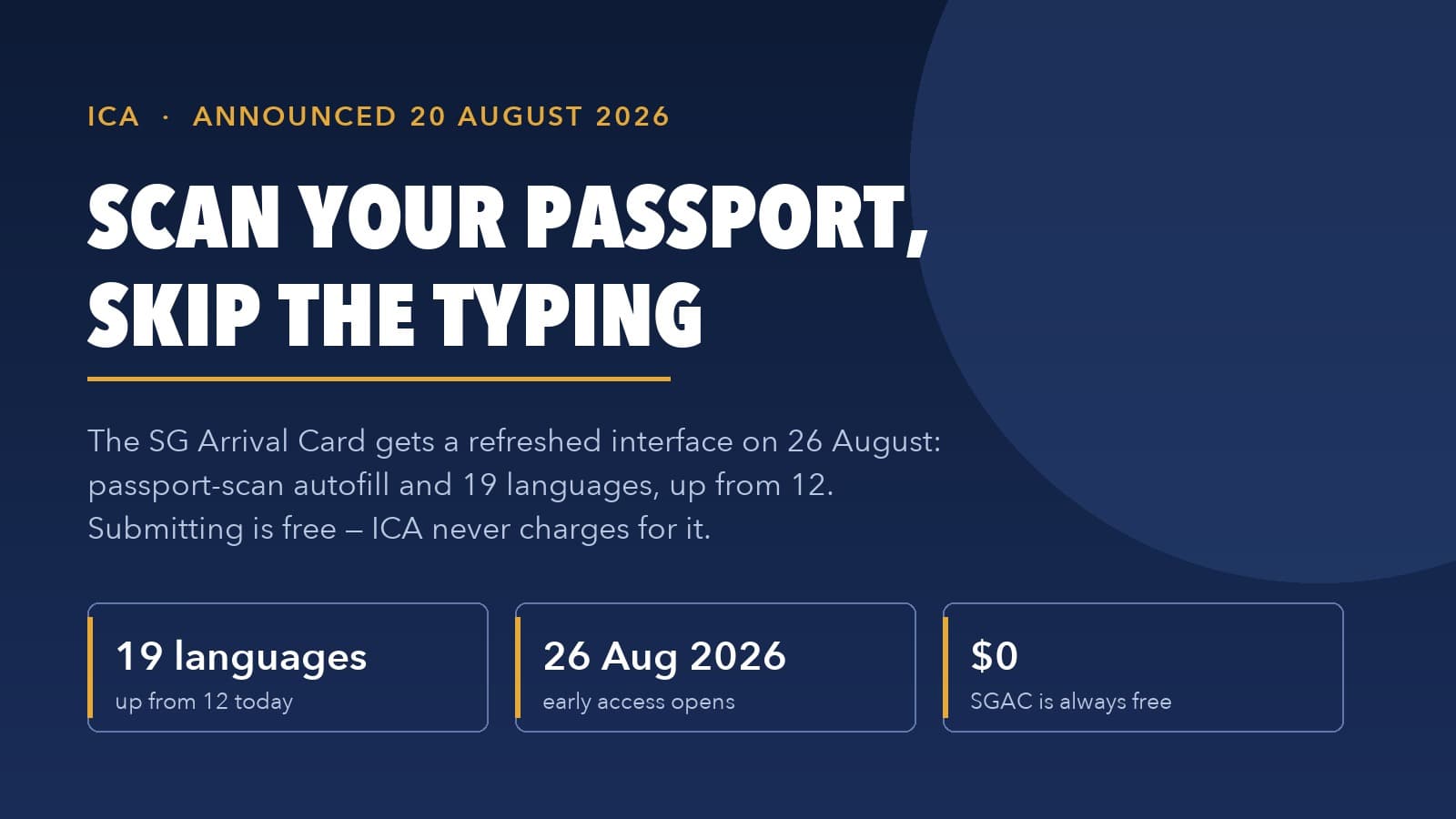
> Quick view: ICA announced on 20 August 2026 that the SG Arrival Card is getting a refreshed interface, in early access on the ICA website from 26 August. It gains passport-scan autofill and goes from 12 languages to 19. What has not changed, and what a lot of people still get wrong: if you fly or sail into Singapore you must submit one — Singapore citizens and PRs included. The land-checkpoint exemption covers Woodlands and Tuas only. It is free, and ICA names 61 websites that charge for it.
Anyone who has filled in the SG Arrival Card at 1am on the night before a flight, squinting at a passport and typing the number twice to be sure, is about to get some of that time back.
On 20 August 2026, the Immigration & Checkpoints Authority (ICA) announced on its official channels that the SG Arrival Card (SGAC) e-Service is being refreshed. The new version goes into early access on the ICA website from 26 August 2026, before a wider rollout across ICA's channels.
What actually changes
1. Passport-scan autofill. The refreshed form builds a passport scan directly into the personal-information field: point your camera at the passport and the details fill themselves in, instead of being typed. This sits alongside the two retrieval options the e-Service already has — retrieve with passport and retrieve with visa reference number — but is meant to be easier to find and use.
2. Nineteen languages, up from twelve. The live e-Service today offers exactly twelve — English, Bahasa Melayu, Bengali, German, French, Vietnamese, Hindi, Tamil, Thai, Japanese, Simplified Chinese and Korean (checked on eservices.ica.gov.sg on 20 August 2026). Seven are added: Arabic, Bahasa Indonesia, Dutch, Tagalog, Italian, Spanish and Russian. For a household hosting relatives who do not read English comfortably — or a helper's family visiting — that is the practical part of this announcement.
3. A cleaner interface. ICA describes the redesign as a more user-friendly design with smoother, easier navigation.
The part people get wrong: flying home does not exempt you
This is where the reader value sits, because the exemption is narrower than most Singaporeans think.
ICA's own SGAC page states that all travellers must submit the SG Arrival Card with the electronic health declaration before arriving in Singapore, except:
- those transiting or transferring through Singapore without seeking immigration clearance; and
- residents — Singapore citizens, Permanent Residents and Long-Term Pass holders (Student's Pass, Dependant's Pass, Long-Term Visit Pass and Work Pass) — travelling through Woodlands and Tuas Checkpoints.
Read the second one carefully. The exemption is tied to the land checkpoints, not to your pink IC. Drive or bus back from Johor Bahru and you submit nothing. Fly home from Bangkok, Tokyo, KL or Bali — or arrive by sea — and you submit an SGAC like everyone else on board. Citizens, PRs and Long-Term Pass holders start from the e-Service's own "Singapore citizens, Permanent Residents & Long-Term Pass Holders" path, which collects the health declaration rather than full arrival details.
That health declaration is not a formality: ICA says it exists for disease control, and those who make false declarations may be prosecuted under the Infectious Diseases Act.
The three-day rule
You must submit the SGAC within three days before arrival, including the day of arrival. ICA's own worked example: arriving on 30 June means you can submit from 28 June onwards.
Submit too early and the form will not take it. This is the single most common reason a traveller finds themselves doing it in a taxi to the airport — so put it on the calendar for three days out, not two weeks out.
It is free — and ICA has published a list of 61 sites that charge you
ICA states it plainly: SGAC submission is free of charge, and ICA does not support or endorse commercial entities that charge a fee to submit it. They are not affiliated with ICA.
The scale of the problem is in ICA's own public advisory, which carries an annex of 61 websites offering paid SGAC submission (list last updated 17 March 2026). The names are built to be mistaken for the real thing — sgarrivalcard.sg, singapore-arrival-card.com, sg-arrivalcard.com, sg-travelpass.com, sgentrycard.com, visitpass-sg.com. ICA says it has received reports from people who transacted with such sites believing they were on the official e-Service, and were charged a processing fee for something that costs nothing.
The one rule that protects you: official ICA websites and e-Services always contain ".ica.gov.sg". The real thing is eservices.ica.gov.sg/sgarrivalcard, or the MyICA Mobile app from the App Store or Google Play. Anything else is a third party, however official the name looks.
Spot a site impersonating ICA? ICA asks that you report it to the police anti-scam helpline on 1800 722 6688, or via police.gov.sg/i-witness.
What it means for you
- Booking a trip at NATAS this weekend? This is the form you will be filling in on the way home. Nothing to do now — just do not pay anyone for it later.
- Wait for the 26th if you like, but you do not have to. The current e-Service and MyICA app still work, and MyICA's profile-saving function already carries your details across trips.
- The SGAC is not a visa. Submitting one says nothing about whether your visitor needs a visa — that is a separate requirement on ICA's entry-requirements page.
- Hosting family from overseas? Send them the official link yourself. The seven new languages help, but a relative who Googles "Singapore arrival card" is exactly who those 61 sites are built for.
Source: ICA announcement on its official channels, 20 August 2026 (reported by CNA and AsiaOne the same day). Submission rules, exemptions, the three-day window, the free-of-charge statement and the 61-site annex were verified on ica.gov.sg on 20 August 2026. Cover: MissLobang designed graphic (no agency campaign artwork was issued for this announcement).