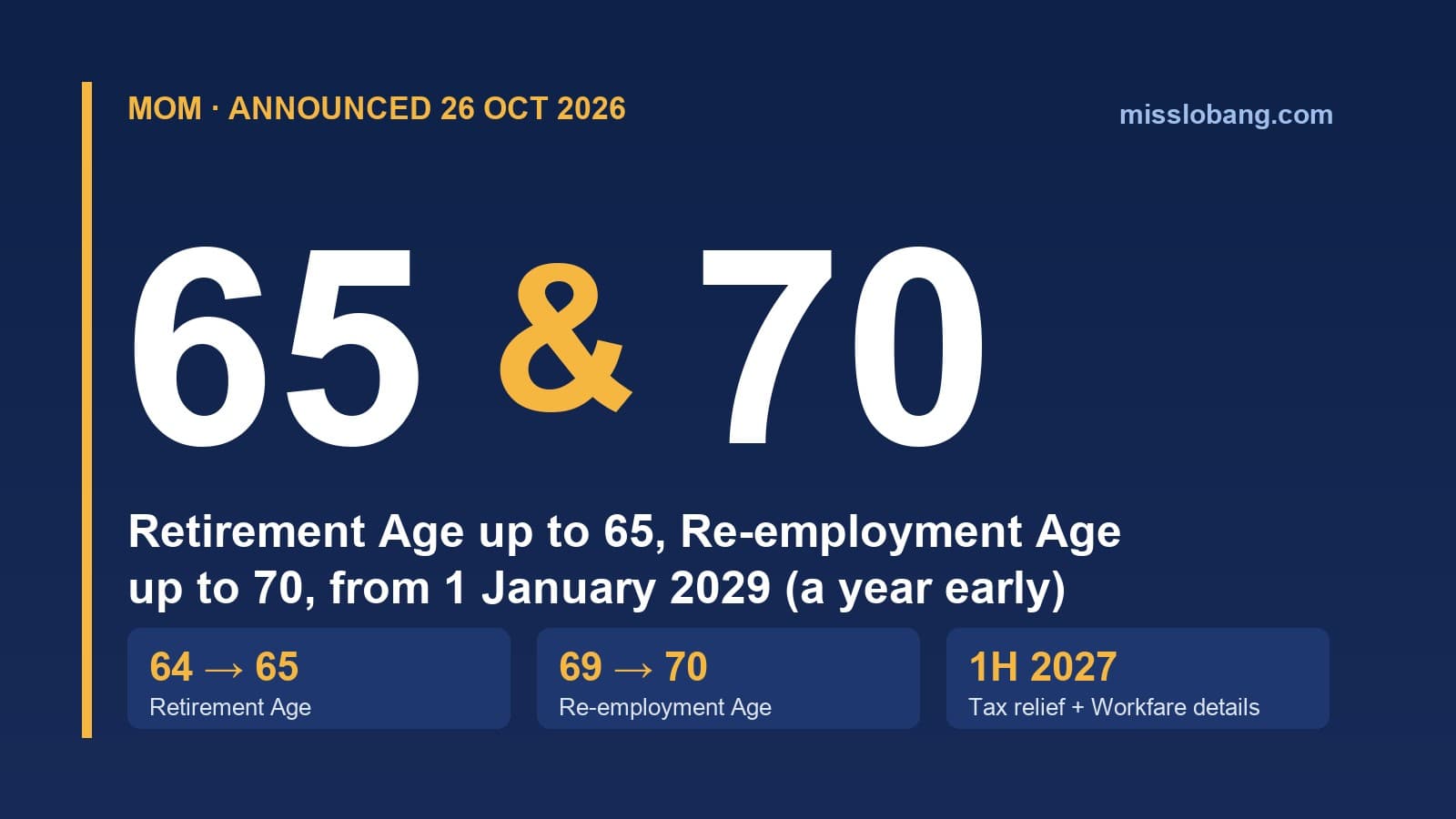
Singapore's Retirement Age will rise to 65 and the Re-employment Age to 70 on 1 January 2029, a year earlier than planned. The Ministry of Manpower announced on 26 October 2026 that the Government has fully accepted the six recommendations of the Tripartite Workgroup on Senior Employment (TWG-SE). Bringing the age increase forward is the headline, but the package also promises more take-home pay for seniors who keep working, through higher tax relief and an enhanced Workfare Income Supplement.
> Quick view: What: Retirement Age 64 → 65, Re-employment Age 69 → 70 · When: 1 January 2029 (was due by 2030) · Also coming: higher Earned Income Relief for seniors working past these ages, enhanced Workfare, higher Employment Assistance Payments, new Flexi-Load Programme · Who: Singapore Citizen and PR employees · Dollar details: first half of 2027 · Action needed: none yet
What changes, and when
| Today (since 1 July 2026) | From 1 January 2029 | |
|---|---|---|
| Retirement Age | 64 | 65 |
| Re-employment Age | 69 | 70 |
The current ages took effect on 1 July 2026 under the 2019 plan, which had set 65 and 70 for 2030. MOM says bringing the next step forward gives senior workers greater assurance that they can continue working if they wish to.
What the two ages mean in practice. Before the Retirement Age, an employer cannot retire you because of your age. After it, and up to the Re-employment Age, an employer must offer eligible employees re-employment. An employer that cannot do so must pay a one-off Employment Assistance Payment (EAP) to tide you over while you look for another job. Neither age forces anyone to keep working, and neither changes your CPF payout age.
The six recommendations, in plain terms
- More flexible jobs. A new Flexi-Load Programme will fund employers to create part-time and fractional roles. It replaces the Part-Time Re-employment Grant when that expires at the end of 2027. A new career-longevity office led by the Skills and Workforce Development Agency, with NTUC and SNEF, will help workers plan mid- and late-career switches.
- Retirement and Re-employment Ages up on 1 January 2029, as above.
- Higher Employment Assistance Payments. The recommended minimum and maximum EAP amounts, last updated in 2022, will be raised for wage growth.
- Lower tax for seniors who work past these ages. The Earned Income Relief will be enhanced for senior workers beyond the Retirement and Re-employment Ages, so they keep more of their pay.
- A new Re-Employment Credit for employers from 2028, replacing the Senior Employment Credit that expires in 2027.
- Support for lower-wage seniors. The Workfare Income Supplement will be enhanced and the Progressive Wage Credit Scheme updated.
Today's numbers, for reference
These are the current figures the workgroup's report lists. The new amounts have not been announced.
| Scheme | Current amount |
|---|---|
| Earned Income Relief (max claimable) | $1,000 below 55 · $6,000 at 55-59 · $8,000 at 60+ |
| EAP, re-employment ends at age 64 to below 66.5 | 3.5 months' salary, min $6,250, max $14,750 |
| EAP, re-employment ends at age 66.5 to 69 | 2 months' salary, min $4,000, max $8,500 |
| Senior Employment Credit (employers) | Up to 7% wage offset for Singaporeans 60+ earning under $4,000 a month, until end-2027 |
The fine print
- Details come later. MOM says further details of all six measures will be released in the first half of 2027. Until then, there are no new dollar figures, and anyone quoting them is guessing.
- Re-employment is for eligible employees. Under today's rules that generally means Singapore Citizens and PRs who have worked for the employer for at least three years, with satisfactory work performance and medical fitness. Check MOM's re-employment pages for the exact conditions.
- Self-employed people and freelancers are not covered by the retirement and re-employment law, which applies to employees.
- The tax relief enhancement targets workers beyond the statutory ages, not every senior. It is not a general income tax cut.
What it means for you
- If you are in your late 50s or early 60s and want to keep working, 1 January 2029 is the date your job protection extends by a year. Nothing needs to be done now.
- If you are an employer, plan for the 2028 switch from the Senior Employment Credit to the new Re-Employment Credit, and watch for the Flexi-Load Programme as the Part-Time Re-employment Grant winds down in end-2027.
- For retirement planning, working longer also means more years of CPF contributions. That is one more reason to check your CPF balances and top-up options now.
This is a summary of MOM's announcement, not financial or legal advice. Confirm your own situation with MOM, CPF Board or IRAS.
Related
- CPF 4% Floor Rate Extended to 31 December 2027
- Best CPF Top-Up Hacks in Singapore
- CPF Special Account Explained
- Best SkillsFuture Courses in Singapore
*Source: Ministry of Manpower press release "Tripartite Workgroup Recommends Six Measures to Build Age-Friendly Jobs and Multi-Generational Workplaces", 26 October 2026, and the TWG-SE report annex. Current scheme figures are as listed in that report. Cover image: MissLobang designed graphic based on MOM's announcement.*