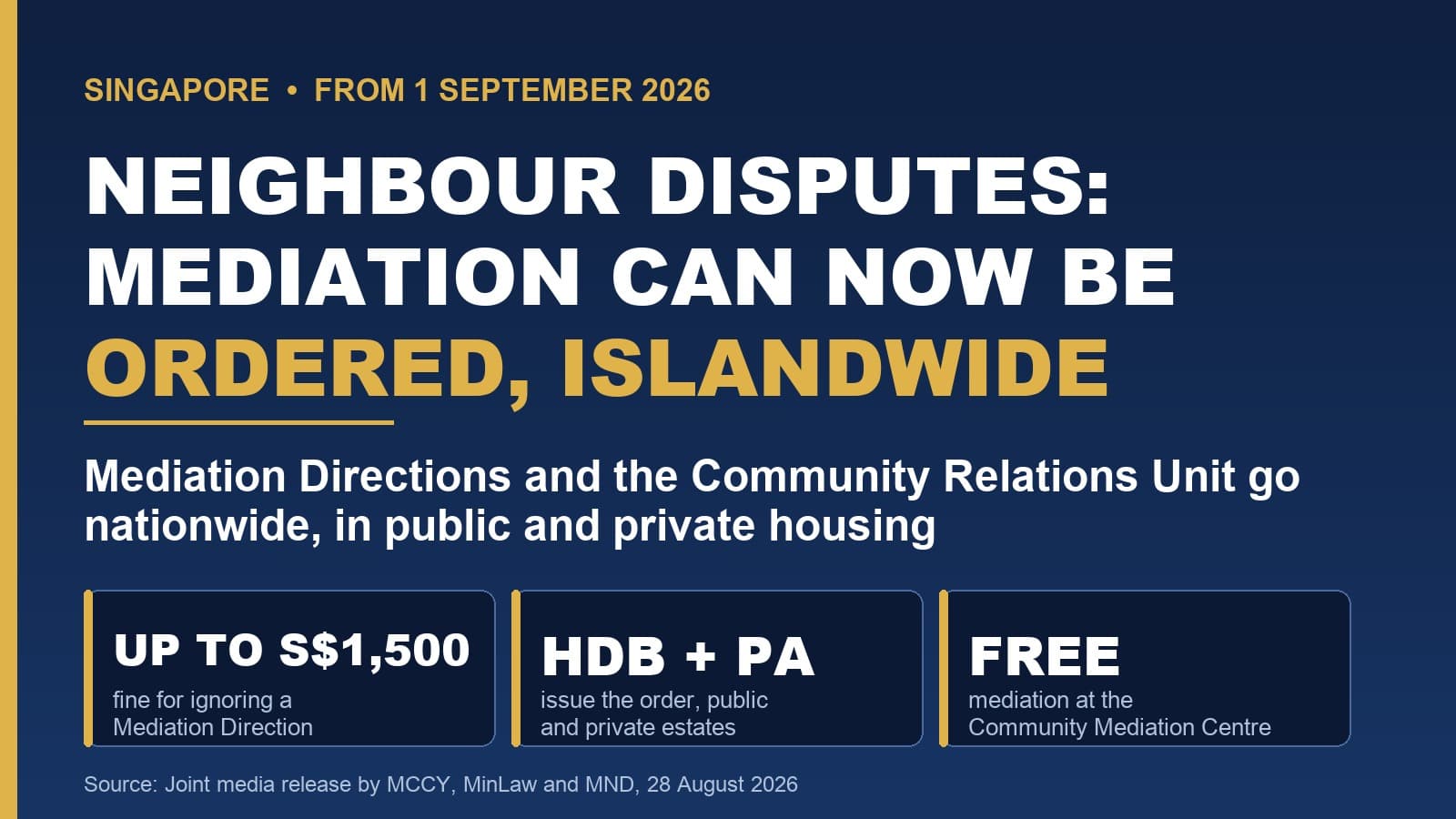
> Quick view: From 1 September 2026, HDB and the People's Association can issue a Mediation Direction that legally requires you and your neighbour to attend mediation at the Community Mediation Centre. Ignoring one without reasonable excuse is an offence with a fine of up to $1,500, and a complainant who ignores one cannot then file a claim at the Community Disputes Resolution Tribunals. The Community Relations Unit also goes islandwide for severe noise, covering both HDB and private housing.
Singapore's neighbour dispute rules change on 1 September 2026. In a joint media release on 28 August 2026, the Ministry of Culture, Community and Youth (MCCY), the Ministry of Law (MinLaw) and the Ministry of National Development (MND) said two measures piloted in Tampines HDB estates since April 2025 will be extended across the whole island: the Mediation Direction framework and the Community Relations Unit (CRU).
The short version for residents: mediation stops being something your neighbour can quietly ignore.
1. Mediation can be ordered, not just offered
A Mediation Direction is an order requiring disputing neighbours to attend mediation at the Community Mediation Centre (CMC). In the ministries' words, these orders are "backed by law and must be complied with".
From 1 September:
- HDB and the People's Association (PA) can issue Mediation Directions in public housing estates.
- PA can also issue them in private housing estates.
That second line is the one most coverage skips. Condo and landed residents sit inside this framework too, not only HDB households.
If both sides reach a settlement at the CMC, they can, with mutual consent, register the settlement agreement as a Community Disputes Resolution Tribunals (CDRT) order. That matters later: a registered settlement is far simpler and faster to enforce than a private promise.
2. What happens if you ignore one
Non-compliance without reasonable excuse is an offence carrying a fine of up to $1,500.
There is a second consequence that usually costs more than the fine. MinLaw has stated that a complainant who fails to comply with a Mediation Direction will not be allowed to file a CDRT claim against their neighbour. If you are the one complaining and you skip the session, you lose your route to the tribunal. Where a respondent fails to comply and a claim is filed anyway, the CDRT may make an adverse costs order against them, because they failed to make reasonable efforts at amicable resolution.
So the pressure now runs both ways. Attend, or lose either your case or your costs.
3. The Community Relations Unit goes islandwide
The CRU handles the small number of cases involving excessive and prolonged noise that causes significant distress to multiple residents. From 1 September it covers both public and private housing estates, nationwide.
CRU officers can:
- take statements from disputing neighbours and other people who can assist investigations
- issue warnings and abatement orders requiring a person to stop the noise nuisance
- deploy noise sensors, used to collect objective evidence on the direction, timing and intensity of noise
Failing to comply with an abatement order is a criminal offence.
Answering media queries on 28 August, MinLaw and MND said the CRU team will grow to about 18 public officers, up from the 15 it had when first announced.
One more change lands on the same date, and it matters for families dealing with a neighbour who is unwell. From 1 September 2026 the CDRT can order a person to undergo mandatory assessment and/or treatment where there is reason to believe a mental health condition is contributing to the unreasonable interference caused to neighbours, and that person has refused voluntary assessment or treatment.
What the CRU is not
The ministries were blunt about the limits. Good neighbourly relations "cannot be legislated or enforced into existence", the release said, adding that the first and best response remains direct communication, mutual understanding and mediation.
CRU intervention is reserved for the most severe noise cases, after neighbours and agencies have exhausted other avenues, or where the circumstances warrant it. The ministries said this also ensures CRU resources go where they are most needed. A one-off party or an occasional dragged chair is not a CRU matter.
The Tampines pilot, in numbers
Both measures ran in Tampines HDB estates from April 2025.
Mediation Directions issued: 4
| Outcome | Cases |
|---|---|
| Both parties attended, settlement reached | 2 |
| Both attended, no agreement (referred to the CRU, situation has since improved) | 1 |
| Feedback provider did not attend, was issued a warning, later withdrew the case | 1 |
CRU noise cases managed: 9
- 5 were assessed to involve severe neighbour noise. After intervention by the CRU and partner agencies, the nuisance in most has reduced or ceased. One case remains ongoing.
- 4 were found, after further investigation, not to involve severe noise. In one of those, the CRU issued Mediation Directions and the parties reached a settlement agreement.
- 4 cases involved people with mental health conditions, suspected conditions or special needs. The CRU worked with the Agency for Integrated Care, the Institute of Mental Health and Family Service Centres to engage those individuals and their families.
- 1 case involved noise used deliberately to disturb neighbours. It stopped after joint intervention by the CRU and partner agencies.
The number that explains the change
Figures the ministries provided to media on 28 August show why voluntary mediation needed teeth.
In 2025, 1,676 voluntary neighbour mediation cases were registered nationwide. Only 317 proceeded to mediation, and 250 of those ended in a settlement. 1,198 never got that far because one or both parties declined or did not respond.
Noise disputes alone: 994 registered, 205 proceeded, 167 settled, and 688 did not proceed for the same reason.
Read it as a settlement rate. When neighbours actually sat down over a noise dispute, roughly four in five sessions ended in a settlement. The problem was never that mediation fails. It is that most people never showed up.
What to do about a noisy neighbour, in order
The framework assumes you have tried the earlier steps, so work down the list.
- Talk to them first. Every agency response starts by asking whether you have.
- Report it through the OneService app or the OneService Kaki chatbot, available on WhatsApp, Telegram or Instagram.
- Apply for community mediation at the CMC. Mediation there is free. Apply through the CMC online portal, or call the MinLaw Enquiry Line at 1800 2255 529. Sessions are held in person at the MinLaw Services Centre, 45 Maxwell Road, or virtually.
- If your neighbour ignores the invitation, this is where the new rule bites: HDB or the PA can now direct them to attend.
- CDRT stays the last resort, and a mediated settlement can be registered as a tribunal order with both parties' consent.
- CRU handles only severe, prolonged noise where the steps above have not worked.
Fine print
- The date is 1 September 2026 for both the nationwide Mediation Direction framework and the nationwide CRU.
- Both were introduced under the enhanced Community Disputes Management Framework in November 2024, and piloted in Tampines HDB estates from April 2025.
- $1,500 is the maximum fine for non-compliance without reasonable excuse, not an automatic charge.
- Mediation at the CMC is free. A CDRT claim is a separate process with its own requirements.
- This is a summary of an official announcement, not legal advice. Confirm your own situation with HDB, MinLaw or the CMC before you act on it.
*Source: joint media release by MCCY, MinLaw and MND, 28 August 2026, and its annex on the Tampines pilot. Cover graphic designed by MissLobang from the announcement.*